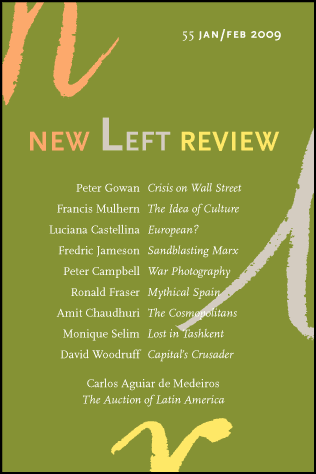
Against mainstream accounts, Peter Gowan argues that the origins of the global financial crisis lie in the dynamics of the New Wall Street System that has emerged since the 1980s. Contours of the Atlantic model, and implications—geopolitical, ideological, economic—of its blow-out.
document
article
The idea of culture in Raymond Williams’s classic work, and discrepant readings of it, fifty years on. Gestation amid CP debates on the English tradition, hidden affinities with the Frankfurt School, and counterposition to the verities of today’s liberal multiculturalism.
interview
A former MEP discusses the actual workings of the Europarliament, and the realities of ‘European construction’ in the realm of culture. What have been the outcomes of efforts to build a continental political identity?
articles
Reviewing the Brighton Photo Biennial, Peter Campbell writes on the aesthetics, ethics and technology of war photography: images as evidence, cameras as combatants, from the Crimean War to Abu Ghraib.
The life-world of social scientists in Uzbekistan, seen through an ethnographic prism. Monique Selim traces the material and intellectual struggles of post-Soviet scholars, and the instrumentalization of ethnicized knowledge by the Karimov regime.
The interweaving of literary affinities and cross-cultural influences, occluded by postcolonialist discourse, that characterized a vanished cosmopolitan modernism. Amit Chaudhuri explores paradoxes of belonging and defamiliarization in Bloomsbury and Bombay.
Within the global wave of privatizations, those enacted in Latin America stand out for their breathtaking speed and scale. Medeiros contends that the principal motivation was not economic but political, driven by new capitalist coalitions emerging from the 1980s debt crisis.
reviews
Fredric Jameson on Christoph Henning, Philosophie nach Marx. Austerities of a German rejection of social philosophy, in the name of the Moor.
David Woodruff on Anders Åslund, How Capitalism Was Built. A vocal advocate of shock therapy casts a blinkered eye over its results in the former Eastern Bloc.
Ronald Fraser on Henry Kamen, Imagining Spain. Excavation of the historical myths that have shaped peninsular self-perceptions.