Can you tell us something about your family background?
My parents come from Hong Kong’s lower class, who mostly live in public-housing estates or villages. But they studied hard, did well in their exams, and got into Hong Kong University. With their degrees they were able to find jobs in middle-class occupations—my father with an it company, my mother in family counselling. So I was brought up in a typical Hong Kong middle-class family, on a private housing estate. I was born in 1996, the year before Hong Kong’s handover. My family is Christian, and I went to a Christian school. The culture of the city was very conservative, built around the idea of individual success. Once when I asked a teacher how we could contribute to society, she told the class: ‘You can join a multi-national corporation and when you are wealthy you can give donations to the poor.’ That was a typical outlook.
How important has the Christian background of your family been for your outlook? What church does the family belong to?
My family belongs to the Christian Tsung Tsin Mission of Hong Kong. The denomination of the church is not important, because Hong Kong people do not choose church membership for theological reasons. My parents went to this church because it was close to home, and because I went to the kindergarten affiliated to it. I started going to church when I was three years old. Christianity teaches me that the most powerful being is God. No human being can have supreme power over other human beings, and no one is perfect because all of us have original sin. There are many high officials and legislators who are also Christians, so religion does not have the same effect on everyone. For me, the teaching of Christianity has laid a good foundation to be concerned about elderly people who live alone, and many other social justice issues. In addition, I saw the film Jesus Christ in China. From the time I was in primary school, I realized that it was very difficult to have religious freedom under a Communist regime, and that quantifiable material things should not be the goal of our lives. Rather, we should be prepared to make sacrifices for values and beliefs. The church has also had a big impact on my organizational capacity. Every Christmas and Easter there are large-scale activities, parties, shows and cell groups. When I was a senior high student, I had to lead junior high students in Bible classes. I learned how to lead small group meetings and games, as well as public speaking. I got these skills by being involved in the church. It so happens that there are about two or three hundred high-school and college students at my church, out of about a thousand members in all, because it’s located in the Central and Western District, with a high density of the so-called ‘famous schools’.
When and how did you become politicized?
When I was fourteen, there was a campaign in Hong Kong against building a high-speed rail link to China. That was in 2009–10, and caught my attention. I read the news about it, and followed the arguments on the internet but as an observer, not a participant. The turning point for me was the announcement in the spring of 2011 that a compulsory course in ‘Moral and National Education’ would be introduced into the school curriculum over the next two years. In May, I founded an organization with a few friends that we were soon calling Scholarism, to fight against this. We began in a very amateur way, handing out leaflets against it at train stations. But quite soon there was a response, and opposition built up. This was the first time in Hong Kong’s history that secondary-school pupils had become actively involved in politics. We opposed the new curriculum because it was a blatant attempt at indoctrination: the draft course hailed the Communist Party of China as a ‘progressive, selfless and united organization’. Secondary-school students didn’t want this kind of brainwashing. But they also didn’t want an additional subject of any kind, on top of their already heavy course loads, so even those who didn’t care much about the content of Moral and National Education were against it, and came out in large numbers on the demonstrations we organized.
Were you surprised by the speed and scale of the response?
Yes. Three months after Scholarism started, we organized a petition to the government demanding the withdrawal of the programme. A team of 200 volunteers stood outside train stations in ten districts, six to eight hours a day in 30-degree heat, collecting signatures. In ten days, 100,000 people signed the petition. Initially, there had been no media interest in Scholarism, and even the teachers’ union paid little attention to us. But this soon changed, especially after I was interviewed on television with lots of microphones in front of me, and showed I could handle that. All this attracted some of the political parties to our cause, and drew growing support among Hong Kong people generally.
Scholarism was born in May 2011, between the outbreak of the Arab Spring in Tunisia and Egypt at the beginning of the year and the occupation of Wall Street that autumn. Did either of those movements have any significance for you?
No, these events had no impact on us. I was aware of them, but their demands and methods were so different from the anti-National Education movement that they were not part of our political imagination. In 2011, the general public in Hong Kong did not understand the meaning of ‘civil disobedience’, and we had no interest in the Arab Spring or Occupy Wall Street. When Scholarism was first established, we were just thinking of distributing flyers on the street.
In March 2012 came the election of C. Y. Leung as the new Chief Executive of the territory. Did it have any impact on the movement?
Yes, it dramatized the undemocratic system of rule in Hong Kong. The two leading candidates for the post were both multi-millionaires, and the choice between them was made by just 1,200 people. Leung had been picked at the last minute by Beijing, and was widely regarded as the worse of the two—more cunning and ruthless, and a secret member of the ccp itself. His election undoubtedly aroused a lot of anxiety and anger, which his performance in office has only confirmed. It helped radicalize the popular mood. In July 2012, a big march uniting a wide range of political and civic organizations drove home our demand for the withdrawal of National Education. The government turned a deaf ear. So in September, with all other avenues of protest exhausted, we turned to direct action, mobilizing 120,000 people for a demonstration at the Hong Kong Government Offices, with three of our members starting a hunger strike in the park opposite. Elections to the Legislative Assembly were due in mid-September: twenty-four hours before they were held, the government capitulated, putting the programme on hold.
You were still just fifteen at the time, leading this huge mass movement. Was that experience your only political education, or did some of it come from reading books or pamphlets?
Four years ago, I read no books at all. Like any other Hong Kong teenager, I just played computer games. I learnt about politics online, following arguments among social activists on the internet and looking at how the different parties among the Pan-Democrats were failing to organize any effective opposition in the city. You could say Facebook was my library. I like reading Wang Dan’s work; I met him when I visited Taiwan.
To what extent is the Chinese student uprising of 1989 a background influence for popular consciousness in Hong Kong—a quarter of a century later, there are still mass commemorations of June Fourth every year?
That’s true. The memory of June Fourth is very much alive. But you shouldn’t overestimate its political meaning. The candle-lit vigils have become a kind of ritual. They are moved more by emotional pity for the victims of 1989 than by solidarity with their actions. You could see the same kind of reaction for our three-person hunger strike in the park by the Government Offices. The same cry went up: ‘Protect the students!’ The belief is that adults should protect young people. Actually, it was we who were protecting them, not the other way around.
What was the next step for Scholarism, after your victory in forcing the government to abandon Moral and National Education?
The curriculum was withdrawn, but it was clear that the project behind it—spreading the influence of the ccp in Hong Kong through business, media, education—hadn’t been. If we didn’t take action, it would come back. To stop that, we needed direct elections to the Legislative Council and the right of all citizens to nominate candidates for the post of Chief Executive. So we organized around these two demands.
How did you view your chances of success in launching this campaign—crossing traditional red lines for Beijing?
Well, of course we couldn’t calculate the odds in advance, and we knew that the Pan-Democrats set the bar very low. Basically, their demand was just the minimum requirement for a democratic election, that everyone should have an equal vote in choosing the Chief Executive. They had lost every time they tried to put up a struggle, and were quite pessimistic. They had very limited hopes. Based on my experience, I was optimistic. We felt we had just won a big victory, and should be aiming for another: not merely the right to vote directly for the Chief Executive, but also to choose who would be the candidates. The Pan-Democrats regarded that as impossible. In early 2013, Benny Tai, a professor of law at Hong Kong University, initiated a movement to Occupy Central with Love and Peace. He invited me to a restaurant for a meal, and told me over lunch that I was too idealistic—there was no sense in demanding civic nomination of the Chief Executive, the people of Hong Kong wouldn’t accept it.
How did this difference play out in what became the Umbrella Movement?
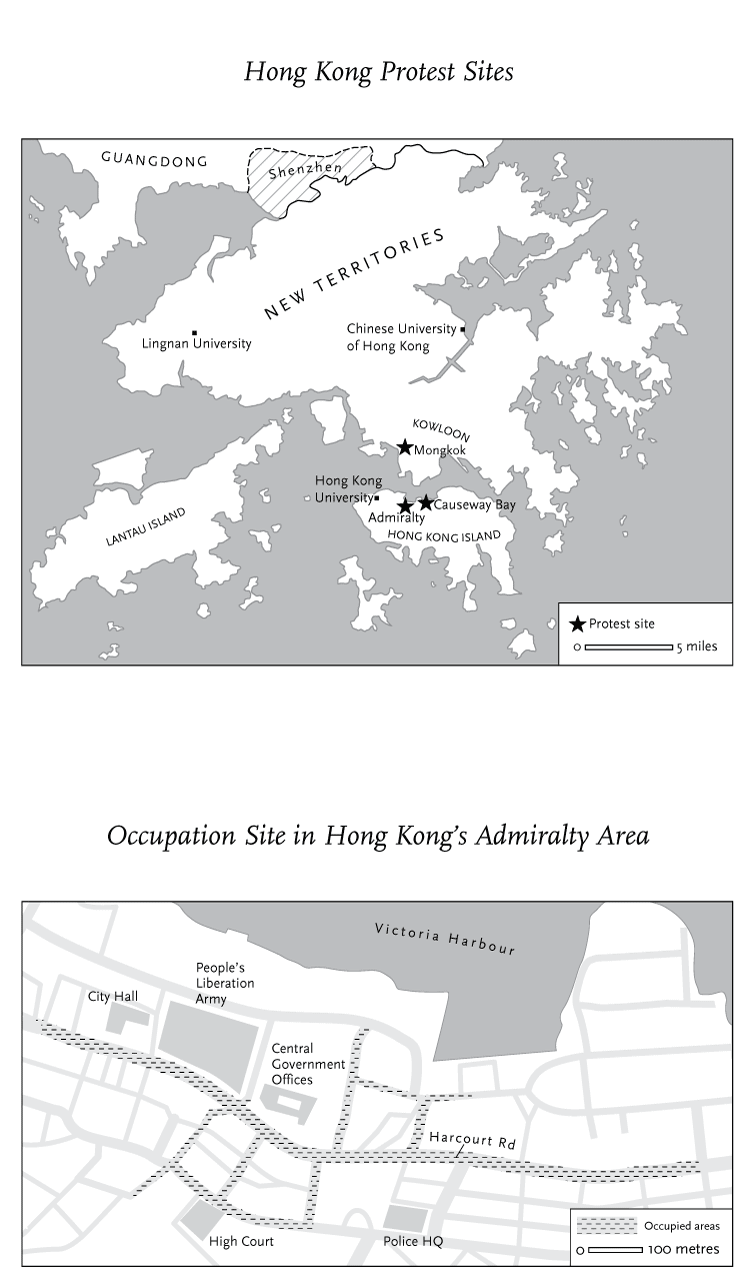
Tai and his two colleagues called for a peaceful demonstration in the Central Business District on October 1 to ‘send a message’ to the government. We didn’t think that was either meaningful or adequate. The cbd is very unfavourable terrain for a mass occupation, difficult to access from overhead walkways and deserted at weekends. So four days earlier, on September 26, Scholarism led a breakthrough past the security barriers surrounding Civic Square in the middle of the Government Offices complex, occupying the space, which was quickly cordoned off by police with the students inside. It was this action of ours that triggered the whole subsequent movement. I was arrested for the breakthrough on September 27, along with others. Most of us were released soon afterwards, but I was held for 46 hours, longer than the rest, and while I was locked up, police attacked the students in Admiralty with tear gas. This was unprecedented in Hong Kong, and transformed popular attitudes to the protesters. There was a huge outpouring of solidarity, and soon students were even outnumbered by young professionals and office workers taking part in the movement, which covered areas in three separate parts of Hong Kong and lasted eighty days in all.
University students took a more prominent part in these events, in which the Hong Kong Student Federation was a leading actor. How would you describe this organization?
The Federation supported the Pan-Democratic parties for many years, going back to the eighties, and showed solidarity with the student uprising in China in 1989, when its then Secretary-General Andrew To went to Beijing, and was one of the last students to leave Tiananmen Square on the night of the crackdown. But there has never been much continuity in its actions, as the Chairman and Secretary change every year. Today only three out of the city’s eight universities, which number no more than 80,000 students out of a population of seven million, can really be regarded as politicized: the old colonial Hong Kong University on the island, the Chinese University of Hong Kong in Shatin, founded in 1963, and Lingnan University, a liberal arts college created in 1999. They have different profiles; the hku student newspaper has called for the independence of Hong Kong, a right-wing idea. The cuhk is on the left, with a campus culture like Berkeley’s. Lingnan is a fortress of Cultural Studies, where nearly every professor is progressive—it’s the most radical of the three. The others are apolitical. During the Umbrella Movement, some five or six hundred professors signed a statement in support of student struggles. But in general, it’s only teachers of politics and social science who take an interest in public affairs. The majority of professors are in no way progressive: they just want to write research papers and pursue their academic careers. This is a big contrast with Taiwan, where they are more socially conscious.
Would it be correct to see the different forces taking part in the Umbrella Movement as composing a spectrum from moderate to radical positions, with the main Pan-Democratic parties at the most moderate pole, Occupy Central a bit less so, the Federation of Hong Kong Students more radical, and Scholarism as the most militant and uncompromising? Where would Civic Passion, on one side, and the League of Social Democrats, on the other, fit into such a classification?
I think the Pan-Democrats and the Occupy Central leadership are equally moderate in terms of ideas and action. Similarly, Scholarism and the Federation of Students are quite similar in terms of radical action and ideas. The difference I would say is in their respective analyses of the situation. Scholarism proposed and successfully convinced the Federation of Students to take control of Civic Square; otherwise there would have been no subsequent movement. Going to Beijing was their idea and only half the members of Scholarism agreed to pursue this line of action. Also, the core leaders of Scholarism tend to be more willing to be in the front line, facing the police, and more receptive and prepared for radical action than our counterparts in the Federation of Students. The League of Social Democrats has always stood with these two student organizations in ideas and actions. Civic Passion talks about radical action, such as rewriting the Basic Law, but it is not practical; they clamour for Hong Kong independence without saying how. They are not always consistent in their slogans: they promoted the idea of fighting back against police violence yet they set the action goal of no injuries and no arrests. So I don’t really know how to place Civic Passion in the political spectrum.
How strong is sentiment in favour of independence for Hong Kong now?
It’s increasing. But it’s not a serious prospect. There is no international support for it. The demand poses as being very radical, but it’s superficial and will fade.
What kind of support did the movement get from the trade unions in Hong Kong?
Very little. De-industrialization has weakened them a lot. Leung Kwok-hung—‘Long Hair’—called on them to come out in solidarity with the movement, but only the Free Union responded positively.footnote1
What kind of balance-sheet would you make of the Umbrella Movement?
It greatly increased political awareness in Hong Kong society, as more and more people joined the movement. The city had no prior experience of large-scale civil disobedience. In 2012, the campaign against National Education involved no civil disobedience—at that time I myself was against it. The Umbrella Movement made it much more widely accepted as an instrument of change—in my view, as the only route to change in the political system, after twenty years of futile agitation of a conventional sort. Of course, this time we gained nothing by way of political reform. The government refused to give way, and the movement eventually came to an end without achieving any of its aims. But we didn’t lose the war, because we’ll start the next round stronger than we did this one.
But will you just be reiterating the same demands as last year? They ran into a blank wall then. Won’t people say, what’s the point of repeating demands that have already been flatly refused? Don’t you risk disillusioning them?
The last time we got 10,000 students on strike. If we keep pressing for political reform, the next time we can get 50,000. The fight for direct elections has been going on for ten years in Hong Kong, and there’s no sign of support for it declining. It’s a popular demand, and Hong Kong people are persistent. In June or July, we’ll be calling for an unofficial referendum, larger and more militant than the one Occupy Central set up in 2014 calling for universal suffrage, in which 800,000 citizens participated.
What’s the strength of Scholarism today?
We have three hundred members, 30 per cent at university and 70 per cent in high schools. The gender balance is 60 per cent men and 40 per cent women. The numbers sound very small. But you have to remember that all the Pan-Democratic parties put together have only 700 members, and proportionately fewer of these are active. Our job is to increase our organizational strength—to extend the structure of resistance and the networks around it, just as the ccp tries to do. For us the priority target remains the city’s high schools. That’s where we should concentrate our efforts, because if you can win over youth, you’ll be winning the future. The task isn’t at all easy, because there are intense pressures on students in Hong Kong, which is a very exam-oriented society, with narrow access to higher education. Less than 20 per cent of high-school students get entrance into universities. To succeed requires very long hours of study, leaving little time or energy for other activities. Then there is political repression. When we started, there was no personal price to pay for civic activism, apart from deduction from study. But since the Umbrella Movement, activists know they are likely to be arrested, and obviously parents put pressure on them not to risk that. It’s crucial we find a successor for my role in the high schools, but it hasn’t been easy to find one. Still, time is on our side.
How about your own studies, then?
Obviously, they’ve suffered. I hated maths anyway, but during the two big mobilizations, I was working in the movement round the clock, with very little sleep. There was no way I could lock myself up in a study from nine in the morning till midnight. When the Sunflower student movement broke out in Taiwan, occupying the parliament and forcing a review of the trade deal with China, I was trapped in exams—very frustrating. So my results were poor, I didn’t get into either hku or cuhk, but only into the Open University, the worst of the eight, where a lot of the teaching is just skimpy PowerPoints online.
Since you’ve been blocked on the political front, wouldn’t it make sense to increase demands on the social front, given the enormous inequalities in Hong Kong society, and the wretched conditions in which the poor and the weak live in the city, while billionaires flaunt their wealth at the top? Could the government afford to be equally unyielding in the face of mobilization around issues like working hours, housing, pensions?
Hong Kong society is deeply conservative—even lower-class attitudes are right-wing. There’s no support among the poor for pensions. Anything ‘left’ is associated with the ccp: even such an elementary demand as a normal eight-hour working day, which is not particularly left-wing at all. The popular conviction is that if you just work hard, you will be a success and can become rich too. If you’re not rich, that’s because you didn’t get better results in school or in your job. Poverty is treated as an individual failure, not as a structural problem. High-school students, especially, take no interest in social issues. They just want more democracy. Their mindset is that society should become more liberal, not more equal. In general, the most popular subject for study is economics, where courses drill in the mantra that the free market is always best, and social change amounts to no more than a shift in a demand curve. It’s another kind of brainwashing, if a less drastic one than the ccp’s, but it’s not perceived as such. The only way to build Scholarism is to concentrate on political demands.
If Hong Kong society is so conservative that it’s very difficult to get popular support for even modest social demands, doesn’t this create a paradox for the dynamic of Scholarism itself? For the question then would be: what actual difference would democratic election of the Legislative Council and the Chief Executive make, if you achieved it? After all, Hong Kong already enjoys freedom of expression and association, habeas corpus, an independent judiciary, and what is generally meant by the rule of law. Political democracy would no doubt prevent these being eroded, but apart from this negative gain, what positive benefits could it deliver, if the population is perfectly satisfied with the social and economic status quo?
The social mood in Hong Kong is conservative—on socio-economic issues, parents’ attitudes towards their children’s education and private property ownership—but Hong Kong changes quickly and people also adapt quickly to new momentum. This conservative social mood can be changed if we influence our student base and help progressive politicians to win seats in the legislature. If the progressives can win more seats, have access to more resources (hk$100,000 a month for every seat won) then they can at least invigorate policy advocacy discourses for things such as standard working hours, universal retirement schemes or annual review of the minimum wage level. Under the current system, they are a permanent minority and people give up debating policies because they think these debates are futile, given the structural composition of the Legislature. If the Pan-Democrats can advocate policy change, then at least gradually the social mood may change. Our aim is to make society more equal, after we have made it more liberal.
Previous texts in this series have been Göran Therborn, ‘New Masses?’ (nlr 85), André Singer, ‘Rebellion in Brazil’ (nlr 85), Erdem Yörük and Murat Yüksel, ‘Class and Politics in Turkey’s Gezi Protests’ (nlr 89) Bhaskar Sunkara, ‘Project Jacobin’ (nlr 90) and Evgeny Morozov, ‘Socialize the Data Centres!’ (nlr 91). See also Sebastian Veg, ‘Legalistic and Utopian: Hong Kong’s Umbrella Movement’ in this number.