Across most of the globe there has been a decline of left forces of all kinds over the past two decades. But there have been three or four countries in which political parties that trace their roots to the traditions of the Third International or to Maoism have remained stable or even grown: South Africa, Nepal, India and, arguably, the Philippines. South Africa has the sacp, while a Maoist party is the single largest political force in Nepal, and Maoism retains a national presence in the Philippines. The case of India is very interesting in that here there are representatives of both formations, which have—to an uneven extent—maintained or actually strengthened their reach over the past twenty years. Both the Stalinized Communist Party of India–Marxist (cpm) and the once larger, but now smaller and shrinking, Communist Party of India (cpi) have remained forces of some political significance. The cpm, unseated in West Bengal after a record 34 continuous years in office, even in defeat obtained around 30 per cent of the vote, at the head of the Left Front which won 41 per cent.footnote1 Formations owing allegiance to the Maoist tradition, meanwhile, have actually increased their membership and extended their influence in recent years. Why has this been the case?
If only three or four countries have been bucking what is otherwise a global trend, the reasons must lie in the specificities of their respective socio-political formations. In India, the explanation for the persistence of Maoist and Communist forces is best sought in the country’s peculiar dualism, in which stable macro-structures of bourgeois liberal democracy co-exist with extremely undemocratic, violent socio-political realities at the meso- and micro-levels, especially, but not only, in the countryside. Secondly, steady capitalist development has brought dramatic polarizations between prosperity and extreme deprivation, overlaid onto the enduring pre-capitalist structure of the caste system, with great social deference at one end of the hierarchy and contemptuous exclusion at the other. In this context, traditional Stalinized and Maoist notions of developmentalism in the name of socialism continue to exert a powerful appeal for large masses of people.
The combination of sustained macro-level democracy and capitalist advance with persistent underdevelopment and socio-economic exploitation has pushed the Indian left in two different directions. The legatees of the Communist tradition have essentially been co-opted into the liberal-democratic system of electoral and parliamentary politics. Even their stalwart defenders recognize that their many years in power in West Bengal as part of the Left Front—dominated by the cpm and its junior partner, the cpi—and their alternating terms of office in Kerala have corrupted them programmatically, bureaucratically, socially and morally. The effects of their long involvement in ‘managing capitalist development’, even as this process has taken an increasingly neoliberal turn, were evident in the West Bengal Left Front’s behaviour over land acquisition in Singur and Nandigram, though this did at least cause rumblings internally. However, political differences between the cpm and the cpi are not of serious consequence. In the wake of the recent state-assembly reverses in West Bengal and Kerala, talk of a possible near-term merger of the two parties has resurfaced. Were it to go ahead, which is by no means certain, it would be of much less moment than if it had taken place 15 to 20 years ago.
Even if the cpm and cpi were willing—which they are not—they are increasingly incapable of carrying out mass mobilizations among the poorest and most deprived, either to defend them or to help fulfil their basic needs and aspirations. Perhaps the most dramatic indication of this came in 1992, when the Hindu right organized the destruction of the Babri Masjid at Ayodhya—the greatest mass mobilization in India since independence. But at this decisive moment in modern Indian history, the parliamentary left could not even carry out a counter-mobilization against the onslaught of communalism. Bringing out their captive trade-union wings in the standard form of one-day bandhs (strikes) and mass processions with economic demands is no substitute for a sustained practice of extra-parliamentary mass mobilizations that address a whole range of issues. The only relatively bright spot is the growth of the cpm’s and cpi’s women’s wings; but this too is taking place within a broader women’s movement in India that, compared to its past, is more sectoral in character, more fragmented, in which socialist- or Marxist-feminists exercise less influence than before.
Red corridor
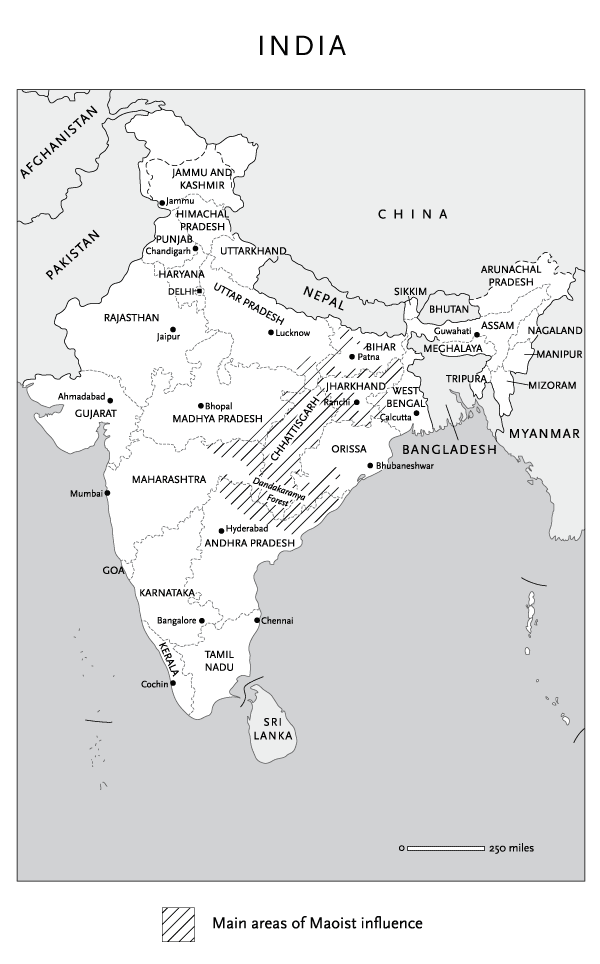
Indian Maoism, by contrast, has moved in the opposite direction. With the exception of one strand—the cpi-ml (Liberation) group, which is itself stagnating—it has remained essentially immune to the lures of parliamentary and electoral politics, at least concerning its own direct involvement. It has rooted itself among the poorest and most deprived sections of the population: Dalits and especially tribals in Central India. Its base area of Dandakaranya is a hilly, thickly forested region covering an area of 92,000 square kilometres, over twice the size of Kerala, cutting across the states of Andhra Pradesh, Orissa, Maharashtra and most of Chhattisgarh.footnote2 Naxalites also have a presence in the states of Madhya Pradesh, Uttar Pradesh, Bihar, Jharkhand, West Bengal, Tamil Nadu, Kerala, Gujarat and Uttarakhand. In July 2011, the government declared that 103 out of the country’s 602 administrative districts were affected by ‘left-wing extremism’.footnote3
Maoism has survived and grown in India for one obvious reason which neither the state nor the mainstream parliamentary left are prepared fully to acknowledge: it has been the principal defender of the poorest and most deprived against their class oppressors and the politicians, bureaucrats, police and paramilitaries backing them at various levels. Like Marxist revolutionaries everywhere, India’s Maoists face the persistent riddle of how to bring about enduring radical transformation in a capitalist society with stable and entrenched structures of bourgeois democracy; as well as strong military and police apparatuses as a back-up for sustaining class rule. Yet Indian Maoists have simply failed to register the existence of this strategic dilemma, since their theoretical understanding of the Indian social formation as semi-feudal and semi-colonial effectively denies the existence of the country’s complex reality. Their strategy has essentially been one of armed overthrow of the state through a struggle in which the ‘countryside will surround the city’. They now give greater emphasis to lower- and working-class urban mobilization, and also speak of building ‘mobile liberated zones’—from which revolutionaries move out when under pressure, to return later. But in the longer term, their strategy is simply a recipe for comprehensive failure, and in the short and medium term paves the way for many damaging and unacceptable practices.
This is so for a number of reasons. Firstly, a military strategy cannot in the long run succeed against the Indian state. Provincial governments and some opposition parties have sometimes found it useful to harp on the ‘Maoist threat’ and exaggerate its impact, as a way of obtaining more Central funds, which are then used for various other purposes; at other times, it has suited them to make a rapprochement with the Maoists. But much weaker national governments than that of India have been able to defeat very significant insurgencies which had mass support. The principal lesson the authorities have learned is that the more prolonged the stand-off between themselves and even popularly rooted armed insurgencies, the more wearied becomes the latter’s mass base, the more likely internal divisions are to emerge, and therefore the weaker the insurgency will become. The lessons of the Liberation Tigers of Tamil Eelam (ltte) defeat in Sri Lanka are clear. Here was a non-state insurgency with unusually strong military capacities—it had its own air force and navy—confronting a state far weaker than India’s, with a mass base that was not just looking for life improvement but was even committed to the strategic goal of Tamil independence. Yet it still lost militarily to its opponent, which was of course helped out by the Indian state. It is not a coincidence that India, precisely after the Rajapaksa government’s victory over the ltte, escalated its coercive actions against ‘Naxalites’.
Second, a militarized strategy demands a top-down command structure, which necessarily shapes the organization in an authoritarian manner, minimizing the scope for internal democracy and putting a premium on secrecy and strict obedience. When things go wrong, as they inevitably will in one way or another, suspicions abound, and peremptory, ad hoc punishments tend to be imposed both on activist members and on sections of the wider social base. Fear becomes a means of cementing loyalty inside the organization and among its supporters. Alongside this, a militarized strategy creates a culture of hostility to those who do not share the same perspective; other progressive forces are seen as possible or actual competitors for support from the same social layers that armed Maoism is determined to monopolize. Such sectarianism tends to take extreme militarist forms.footnote4
Thirdly, even though Maoist cadres are drawn from among tribals and Dalits, there remains a crucial disjuncture between the concerns of the leadership and those of the mass base. The former is ideologically committed to the long-term project of overthrowing the state; the villagers are looking for more concrete, near-term improvements in living conditions. To some degree, these immediate needs are held hostage to the more distant strategic aim. For example, the building of roads can lead to some life improvements in rural areas, but it can also facilitate government actions against the ‘liberated zones’; Maoist groups thus have an interest in preventing those forms of development they cannot control. Finally, the need for finances, in order to secure weaponry and to carry out positive developmental activities among Dalits and tribals, means that armed Maoists cannot be consistent or wholehearted in their opposition to class enemies, but seek compromises with them that are financially favourable in the areas they control. These ‘liberated zones’ are therefore not liberated in the classical sense of, for example, China’s Yan’an in the late 1930s. There are thus serious limits to the Maoists’ ability to carry out socially transformative measures within these zones which could then create deeper and wider loyalties to their more abstract, longer-term goals.
Questions of force
Making these criticisms, of course, in no way implies endorsement of the Indian state’s repression and demonization of the ‘Naxalites’. One can condemn unwarranted acts of violence by Maoists, but these cannot be equated with the brutalities committed by the Indian state. The government’s bid to crush Maoism has involved a frontal assault on sections of the latter’s social base, which remains the most oppressed in Indian society; the continuation of this policy will mean further violence of this kind, with profound implications for Indian democracy. The government’s stance is all the more dangerous because it receives legitimation from a whole array of intellectuals, academics and media figures, endorsing the idea that armed Maoism is ‘enemy number one’. This is plainly ludicrous. The principal danger to Indian democracy comes not from Naxalism but from the forces of Hindutva, which have carried out violence and brutality on a scale that dwarfs anything armed Maoism has done.footnote5 The forces of the Hindu right have succeeded in institutionalizing themselves within Indian civil society in a way unmatched by the whole of the left, mainstream or Maoist; its political and cultural vehicles have been legitimized as an acceptable part of the mainstream. For example, the instigators and apologists for the 2002 anti-Muslim pogrom in Gujarat—figures such as Chief Minister Narendra Modi—are not only unpunished, but lauded as statesmen.
The state’s efforts to ‘eliminate Naxalism’ are also a cover for de-legitimizing all forms of radical left politics. Thus when the mainstream parliamentary left effectively endorses the Indian state’s policies towards the Maoists—or worse still, as in West Bengal, even orders armed actions against them—it is doing serious damage to its own cause. The state’s bid to shrink the public space for radical activity of even a non-violent kind is evident in the treatment of Maoist ‘sympathizers’: for example, the civil rights activists Arundhati Roy and Binayak Sen (also a dedicated medic for the poor) have been accused of sedition. No doubt the very high public, indeed international, profile of the two—Sen’s trial aroused protests from a host of Nobel Laureates—has stalled further action.footnote6 But the point has been made, and warning served to other civil-rights activists to think twice before attacking government policies vis-à-vis ‘Naxals’.
It is important to stress that in India, even struggles for elementary demands are met with violence at a very early stage. Time and again, repression has succeeded in preventing such movements from reaching a critical mass or in finishing them off altogether. Neither the mainstream left nor many progressive social movements have wanted to come to grips with this question of force, but it cannot be dodged. A posture of Gandhian non-violence at all costs and in all circumstances often fatally disarms such struggles. Indian Maoists have at least addressed this reality, even if inadequately, and their very success in sustaining themselves among the poorest is testimony to the partial efficacy of taking up arms. However, what should be at best a defensive posture, politically subordinated to a more sophisticated strategy for long-term transformation, has unfortunately become the main strategy itself. Ironically, it is the Indian far right—most notably the Sangh Parivar—that has been most able to control its use of force within an overarching strategic and political framework, to which its violent actions are firmly subordinated.
Parliamentary Stalinism
If Maoism is in a long strategic cul-de-sac, what of the Stalinized mainstream left parties? Over the last three decades, as in many other countries, the centre of gravity of Indian politics has shifted significantly to the right. The mainstream left has not been left untouched by this drift. Its trajectory could be seen as broadly parallel to that of Europe’s former mass Communist parties, which went from Stalinism to Euro-communism to ultimate subordination to their Euro-socialist competitors; except that it is the cpm and cpi which have themselves become the main social-democratic force in Indian politics. Indeed, with the rightward drift of Congress, it is ironically the cpm and cpi that are today the principal legatees of the old Nehruvian consensus—the social-democratic vision of a strongly secular, welfarist and non-aligned, yet capitalist India. Formal commitment to a communist future leaves no imprint on these parties’ programmes or behaviour.
Yet for all the manifest deficiencies of the cpm’s and cpi’s brand of democratic centralism—far removed from best Bolshevik practice—there is still more internal discussion within them, and greater accountability of leaderships to members, than in any other party in India. Unlike most social-democratic parties of the later 20th century, they remain strongly opposed to Western imperialism. However, they have been consistently unprepared to offer a public repudiation of Stalinism, whatever some intellectuals and sympathizers inside or outside the two parties might say privately. There is likewise no public acknowledgement of China’s capitalist transformation. The consequence of such silence is that they are incapable of learning the lessons of the past or of strategically orienting their own cadres and activists. Ideological and programmatic mistakes are not directly confronted; errors are sidestepped, not overcome. The parties cannot be genuinely self-critical of their past or present, and honest intellectual, political and moral rectification cannot take place. Most importantly, without an explicit, public and wholesale repudiation of Stalinism and its legacy, there is no way that a new, principled programmatic perspective—a ‘socialism for the 21st century’—can be built.
What, then, are the prospects for the parliamentary left? Since the cpm is the hub of these forces, some reflections on its possible future trajectory may not be amiss. The party’s stunning defeat in the West Bengal state elections of 2011 is widely seen as a historic turning point. Given the scale of the rebuff from voters, this is understandable; but it is also revealing that the cpm’s electoral fortunes, its eligibility to govern at provincial level, are considered the prime indicator of its political strength. This in itself illustrates the cpm’s degeneration since it first became a serious contender for government office in the late sixties. It has been a degeneration in two intimately related senses—political-organizational and structural. On the first count, the cpm was once a movement-based party, whose cadres were motivated by an ideological programme which, though Stalinized, nonetheless inspired involvement in mass struggles on behalf of various oppressed sectors—protecting Muslims from communal violence in the mid-sixties, or struggling for justice in rural areas. Four decades on, the transmogrification of the party is complete—though not without lingering tensions between its theoretical commitment to anti-capitalist and anti-imperialist perspectives and its focus in practice on the electoral route to power, above all in West Bengal and Kerala.
Despite the shared ‘social democratization’ of the cpm’s wings in these two states, the deformities of the regional party in the richer and more powerful West Bengal have been much greater. Three important differences between the two states have affected the evolution of their respective cpm units. First, land reform in Kerala gave the great majority of the rural population ownership rights, to at least small household plots, thereby ensuring that basic food needs could be met, either directly through crops grown or through sale of agricultural produce. In West Bengal, Operation Barga, which ended by 1981, gave sharecroppers security of tenure and rights to usufruct, but stopped there, never initiating the kind of redistribution of land ownership that would have greatly weakened the rich and middle peasantry, which continues to enjoy significant influence in the panchayat structure that was also set up and regularized by the Left Front in West Bengal.
Here lies the second difference. In Kerala, the panchayat structure saw a genuine devolution of funds and decision-making powers that has enabled a range of local grievances to be addressed and needs fulfilled. Moreover, control of the state government has alternated between the cpm-led Left Democratic Front coalition (ldf) and the Congress-led United Democratic Front (udf); the Muslim and Christian communities, 23 and 19 per cent of Kerala’s population respectively, have broadly remained loyal to their respective parties, the Indian Union Muslim League and the Kerala Congress. This has meant that neither the cpm nor Congress could ever hope to establish the kind of top-down, centralized control over the Panchayati Raj that the cpm has in West Bengal. There the party succeeded in making it a mechanism for electoral-political dominance through the systematization of a structure of patronage and coercion, with its associated forms of blandishments and threats, rewards and punishments. In both West Bengal and Kerala it is proximity to power and its benefits that mainly motivates the cpm’s cadres, rather than commitment to a Third International ideological legacy. But in West Bengal the organizational degeneration and lumpenization of its cadre base is much greater, because the continuity of its hold on power helped to create a much stronger meshing of party and administrative (civilian and police) bureaucracy—a ‘partocracy’ that lends itself to all kinds of abuses. This has resulted in a very effective form of patronage for those willing to pledge loyalty to the cpm; the party becomes a crucial avenue for resolving many everyday problems—access to health care, distress finances, employment for a family member, help with the bureaucracy, vengeance against an enemy, and so on.
The third key difference lies in the far superior levels of health and education in Kerala, which have enabled the state to compensate for the lack of industrialization, and therefore of adequate labour absorption, through the export of personnel of varying skill levels to other parts of India and abroad, thus creating a remittance economy; to this can be added a growing tourism sector. In West Bengal the Green Revolution, and agricultural growth rates more generally, ran out of steam by the end of the 1980s and early 1990s. Looking to the Chinese policy of inviting fdi to promote industrialization, the cpm’s state leadership took advantage of the 1991 reforms giving India’s states greater economic autonomy from the centre and pushed the party towards an increasingly neoliberal line. By 2006, confident of its control over the rural hinterland—perhaps thinking to follow Beijing’s example in this regard too—the cpm pursued land acquisitions to fuel sez-led industrialization, to be realized by outside investors, Indian and foreign. This was the strategy that led to the Singur and Nandigram episodes of state-sponsored violence, which backfired dramatically in political-moral as well as electoral terms. Alongside this, the 2006 report by the Delhi-appointed Sachar Committee showed how miserable the socio-economic situation was for Muslims in West Bengal—they make up nearly a quarter of the population—compared with most other Indian states with large Muslim communities. This created great disillusionment amongst an otherwise loyal voter base. Protection of their lives from communal assault was no longer enough; they demanded improvement. Both of these conjunctural developments contributed to the shift in public perceptions against the cpm and Left Front in West Bengal.
Where does the cpm go from here? In Kerala, the 2011 state assembly elections actually brought a reversal of the shift against the Left Democratic Front expressed in voting for the national Lok Sabha elections of 2009, and in the 2010 panchayat elections in the state. In the latest elections, the incumbent ldf coalition almost defied the longstanding trend of alternating stints in power, obtaining 68 seats out of the total 140 to the victorious udf’s 72. There is no reason to think the Kerala party unit will alter its programme or strategy: it will continue along the established lines, expecting to return to power the next time around.
What about the West Bengal unit and the central party leadership in Delhi? Until the end of the 1980s, national-level policy in the cpm was little more than the upshot of inner-party efforts at balancing the interests and concerns of the two main state-level units, with West Bengal dominant. The emergence of coalition politics at the Centre from 1989 onwards gave smaller parties such as the cpm unexpected leverage—even parties with 20–30 Lok Sabha seats could be considered useful partners—and opportunities to play a much bigger role at the national and international levels. It was here that a tension then emerged between, on the one hand, sections of the Delhi-based leadership, and on the other, the West Bengal leadership and its supporters in Delhi. At one level this tension is rooted in a disjuncture between a theory and formal programme that is anti-neoliberal and anti-imperialist, and a practice in West Bengal that became increasingly neoliberal in orientation, implemented by a state-level leadership seeking more stable relations with a Congress-led centre. At another level, the issue of whether the parliamentary left should join a Congress-led central government has frequently divided the party, as more generally it has the non-Maoist left outside the cpm and cpi. The seduction of gaining central power, to strengthen the cpm’s hold of its regional bastions as well as perhaps extending its influence elsewhere, has been pitted against the very real fear, if not strong likelihood, that the left would end up sharing responsibility for a neoliberal drift internally and pro-American consolidation externally, without real power to change either course.
For too many on the left, as well as some liberals, the issue of whether the cpm should have joined the 1996 United Front government, when its leader Jyoti Basu was offered the Prime Ministership, or the 2004 Congress-led United Progressive Alliance administration, has been seen as the crucial strategic question—the decisive test that would have determined its future fate—when it has not been anything of the kind. The real tragedy of the cpm is that either way—whether it had joined a Congress-led government at the centre or not, and whether or not it joins one in future—its further de-radicalization is assured. Of course, there is no question of the cpm somehow rejuvenating itself to become a much more radical anti-Stalinist force. The point is that it cannot even hope to again become the kind of movement-based party, with ideologically motivated and dedicated cadres, that it once was. The party’s major internal stocktaking will take place at its next congress, to be held in Kerala and scheduled for April 2012. The cpm will not disappear in the coming period. It will continue on well-worn paths, hoping—indeed expecting—that the mistakes of the new Trinamool Congress dispensation in Calcutta will once again hand it electoral victory. It has no other vision. If the chance to join a central coalition government again arises, the cpm will this time most likely take it. But for the longer term project of building a more radical and principled Indian left, this will mean little or nothing.
Radical perspectives
One of the key arguments used to justify unwavering loyalty to India’s mainstream left parties is that this is a period in which progressive forces are on the defensive. The mainstream parties are held to be the principal mechanisms for preserving the remaining historic gains made by the socialist movement, and for preventing a further rightward drift towards communalist, anti-democratic forces. This reasoning has been deployed to legitimize unprincipled alliances with non-bjp parties and the pursuit of a ‘Third Front’ politics. The very nomenclature—an unspecified entity that is neither bjp nor Congress—is an indication of how far the cpm and cpi have moved from earlier demands for a ‘left and democratic front’. But such compromises are based on a deeply flawed perspective: the idea that the transition to socialism will involve some kind of interregnum of social democracy or its equivalent in developing countries. This notion should be laid to rest. On this count, the right is correct: the present variety of neoliberalism, with a more or less human face, is the only kind of capitalism on offer.
What is required, then, is a much more radical and offensive perspective, guided by an explicitly anti-capitalist politics. While it can share much ground with existing social-democratic demands—for re-establishing the principles of universal and free healthcare, quality public education, guaranteed pensions, affordable public housing and transport—which have become all but impossible to fulfil in contemporary capitalism, this politics must also put forward what used to be called ‘anti-capitalist structural reforms’. Also required is the reassertion, in more creative contemporary forms, of classical transitional demands: transparency, opening management’s books, workers’ control, direct democracy and so on. There is much that can be learnt from the rich international history of such efforts—Yugoslavia’s self-management workers’ councils; Cuba’s urban farming experiments; participatory budgeting in Brazil; communities of peace in Colombia; panchayat-based resource planning in Kerala; the tradition of democratic unionism forged in South Africa’s struggle against apartheid.
In more abstract terms, what is required is a politics that unites the particular with the universal. Historically, the two have most often been conjoined through the broader political projects of nationalism, socialism and democracy, whether separately or in combination. For the most part, where socialist revolutions have successfully transformed the state they have been connected to progressive nationalist struggles. But that era is over, and it is now the project of a socialism connected to the struggle for deepening existing democracy that must inspire hopes for radical transformation. In the past, the principal organizational embodiment of such a combined politics has invariably been the political party, or the united front of such parties. We can be more flexible—perhaps we can create a new party, a new front, or some combination of radical parties and socialist-oriented movements.
What does this imply for the pursuit of radical politics in India? No existing political force can be the nucleus around which a left alternative will be built. This can only come about through a recomposition and realignment of existing forces, which will inevitably involve splits and fusions as well as accretions from unexpected sources. What this implies is that it is not loyalty to an organization but to a programme embodying principled radical positions that is important: the programme makes the organization, rather than the other way around. Second, there must be a combination of electoral and parliamentary activity with extra-parliamentary mobilization. Indeed, for an effective left, it is success at the extra-parliamentary level which essentially determines success in electoral terms. Thus the left must have and constantly seek to expand an ideologically trained and committed cadre base; for this, it must practise a politics of passion, far removed from the mundane compromises of bourgeois forces. The organization that will embody the programme of this new kind of left must itself practise the strongest forms of internal democracy: complete freedom of discussion and debate among members, the right to form tendencies and factions, and proportional representation of these groupings at all levels of leadership. Within the leadership there should also be representation, proportional to the membership, of women, tribals, Dalits and Most Backward Classes (the lowest non-Dalit castes). This would be a means of attracting such social groups, especially their most active and committed elements, away from existing, sectorally oriented organizations whose politics lack a clear anti-capitalist thrust.
Finally, the left cannot fall into the trap of a narrow bourgeois nationalism. In South Asia, the ‘socialism in one country’ perspective of both Stalinism and Maoism was and is a disaster. The Indian left that still speaks of semi-feudalism and semi-colonialism or believes in a stage-ist approach—and hence rationalizes electoral–political alliances with non-Congress and non-bjp parties—is unprepared to recognize that India is a sub-imperialist, regional power. This is a crucial problem. It is not enough to attack American imperialism and oppose India’s strategic alliance with the us and Israel, important though these stances are. It is vital to acknowledge India’s own imperial role in South Asia: its oppressions in Kashmir and the Northeast; its overt and covert interventions in support of reaction in Bangladesh, the Maldives, Bhutan, Sikkim, Nepal and Sri Lanka; as well as the mutual hypocrisies of relations between the Pakistani and Indian ruling classes. Opposition to all this must begin here. Indian Stalinism often tails the Indian state in its nationalist posturing, while the Maoists will only recognize other Maoists as politically serious partners. Indian socialists seeking a wider and deeper radical internationalism must not only solidarize with anti-imperialists elsewhere; they must also prioritize the building of a more unified South Asian struggle. Edward Thompson once said very beautifully that throughout history, there have been struggles for decency, humanity and justice, and struggles for power. These are not parallel tracks; they meander, and sometimes merge. When they do, power is being harnessed towards the important goals. When the tracks separate, some choose to go towards power while others continue on the path of principled politics. Our best hope is to continue on this latter path and seek to merge it with the path of power, so that we can then move forward on both fronts.