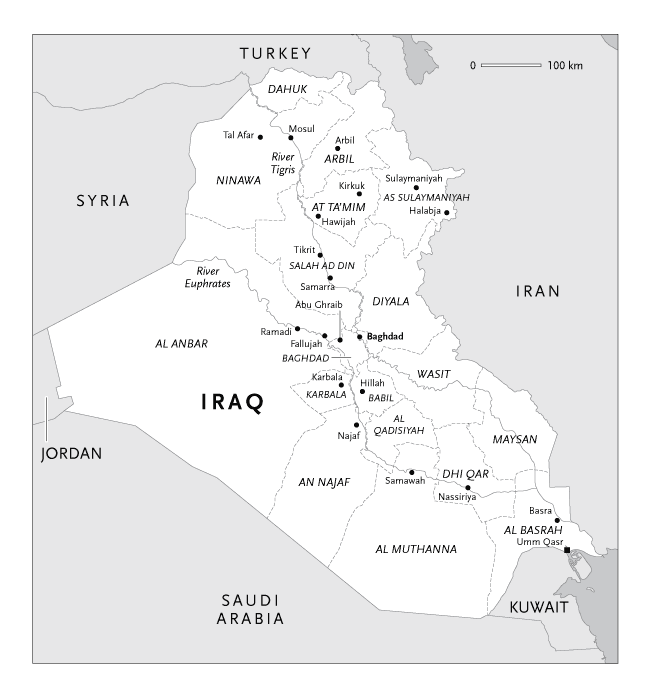
Ifirst went to Iraq in 1978, and I’ve been there I suppose fifty or sixty times. Sometimes for as long as three months, at other times for a fortnight or so. In all I have spent a bit more than half my time in Iraq since the Occupation. I was there before, during and after the invasion, initially based in Kurdistan since I couldn’t get a visa to Baghdad, because I and my brother had written a book on Iraq in the nineties. So when the us-led attack began, I was in the North. I was in Kirkuk and Mosul when they fell, and as soon as the road south was open, I drove down the main highway from Arbil to Baghdad. By the time I left the city, looting was still proceeding apace. The Information Ministry was being set on fire as I set off to Jordan, thick clouds of smoke rising over Baghdad and driving west you could already see all these battered little white pickups, which are very typical in Iraq, loaded with loot, going along the main highway and then turning off the road to Ramadi and Fallujah.
Yes, one of the surprises of the resistance is just how swiftly it developed. I think this has never quite been explained. The speed with which it took off was very striking. The Americans were starting to suffer casualties as early as June, within a couple of months of the invasion. Occupations often do lead to resistance against them, but it’s difficult to think of another example of it happening so quickly. After the British captured Baghdad in 1917, it took three years before the rebellion against them started. During the Second World War, the resistances in Europe or Southeast Asia all took much longer to get going than the present insurgency in Iraq.
One of the main reasons most Iraqis wanted to be rid of Saddam was the degradation of life because of the un sanctions against Iraq, which destroyed most of the economy, coming on top of the effects of the Gulf War in 1991 and the eight-year war with Iran. There was a widespread sense among Iraqis that they couldn’t take it any more—they wanted some form of normal life to return. I think it took about two months for them to realize that the American Occupation wasn’t going to deliver this. The electricity supply was poor from the start, and it stayed poor. Looting didn’t stop. At first, most Iraqis looked on the disasters at the time of the fall of Saddam as a sort of one-day or rather week-long wonder. Then they discovered it just rolled on—in fact it has never really come to a halt since. They began to realize that everything in life was now chronically insecure. It took a bit of time for me to realize how dangerous it was getting quite early on—because it’s got so much worse since, I tend to think of those first months as almost halcyon days, when one could jump in a car and drive up to towns north of Baghdad, like Samarra, or west to Ramadi and Fallujah. But actually it got pretty risky from the start, which wasn’t the way Iraq had been before, even during the first Gulf War. During the American bombing in 1991, I remember going from Baghdad to Mosul, and because we’d been sold bad petrol, the car broke down, so we just got out and hitched lifts right across central Iraq up to Mosul, without any sense of danger. So it took a bit of time to realize the degree to which the insurgency, and banditry, were spreading. There were already assassinations that summer. I’d go to places where American soldiers had been attacked, or killed or wounded, and a couple of hours later I’d find crowds still rejoicing, jumping up and down and dancing around bloodstains on the road or the wreckage of a vehicle. The Occupation became unpopular pretty fast.
For the middle class, what dominates life is insecurity, as basic law and order have broken down. Many of the wealthiest Iraqis, terrified of kidnapping, have left the country. First the rich went, then the fairly well off. Now you have people leaving who are probably making $300 or $400 a month—not much money. But the lack of any safety, and the lack of jobs, is producing a flight to the neighbouring countries: first Jordan and Syria, now—as they become full up—increasingly to Egypt. Some benefits have accrued to the professional classes: for instance teachers and civil servants, who got practically no money under Saddam, are now getting several hundred dollars a month. A lot of people who stopped being teachers are now going back to the job. But prices have also gone up. If you owned property in Baghdad, values at first increased—though they’ve come down a bit now—because previously there was a ban on non-Baghdadis getting residence in the capital.
Just after the fall of Saddam there was also an enormous influx of cars, particularly second-hand vehicles. But a huge number of these were stolen, and then taken off for sale in Kurdistan or Iran. To cross the street in Kurdish towns became a hazard—you risked your life, with shepherds who’d just bought a car for $600, which had been stolen in Baghdad, driving around, wondering which way to turn the wheel. The initial complete breakdown of all rules led to a certain economic activity. For example, if your car was stolen, you could go to the main stolen car mart, which at that time was in Sadoun Street, and get a reduction if you were trying to buy back your own car. It was very unwise to make a fuss, because the vendors were all armed; and you needed to get there quickly, before it was sold on to Iran, or taken to Kurdistan. This was quite open, and known to everybody—apart, conceivably, from Paul Bremer and the Coalition Provisional Authority. But this upsurge of market activity tended to peter out towards the end of 2003, when people began to realize that the insurgency was getting more and more serious, crime was steadily increasing, and that the Americans had taken over control of various parts of the economy. The incompetence of the us arrivals didn’t help. You would have thought they would at least have got the stock exchange, which had naturally languished under Saddam, going again. But Washington sent in a 24-year-old with strong family connections to the Republican Party. He forgot to renew the lease on the building for it, and there was no stock market for a year. After about six months, Iraqi stockbrokers were so fed up they sounded like Islamic militants in Fallujah.
It goes both ways. Some, particularly if they are Shiites coming from quieter areas, might consider it a reasonable trade-off; the Sunni generally not, particularly if they come from parts of west Baghdad, which is notoriously dangerous.
The Kurds have generally done well out of it. If you go to the top of a tall building in Arbil or Sulaymaniyah, you can see lots of cranes and construction activity going on—quite a lot of Turkish–Kurdish companies are coming in, which is probably intentional on the part of the Kurds, to propitiate the Turks. Whereas in Baghdad, if you look across the city, despite all the billions that have been spent there in the last two and a half years, the only cranes visible are a few rusting ones around the gigantic mosques that Saddam was building when he was overthrown. Aside from that there is nothing.