Elected four years ago after promising ‘reform’ at any price, Koizumi Junichiro has now secured an even bigger majority by making the same pledge again, having failed in the meantime to make any headway against Japan’s social or economic malaise. The longest-serving prime minister for decades, he succeeded in presenting himself—above all on tv—as a crusading force for change. The outcome of the Lower House election on 11 September 2005 was widely hailed as a historic landslide, both in Japan and in the Western media. Yet Koizumi won the support of only 29 per cent of the total electorate, and received only 38 per cent of votes cast. That the ldp now occupies 62 per cent of seats—296 out of 480, up by 59 from the previous Diet—owes more to the iniquitous Japanese electoral system than to the enthusiasms of the voters.
The occasion for the snap election was the defeat of Koizumi’s Japan Post privatization measures on 8 August 2005. The new legislation proposed to separate the four existing entities of the postal system (savings, insurance, local branches and mail delivery) into discrete enterprises by 2007, with full privatization by 2017. The bill was defeated by 17 votes in the Upper House, with 37 ldp members voting against their government. It was, at the least, stretching the constitution to call an election in order to win a faction fight within the ruling party, and to dissolve the (legislatively superior) Lower House to punish a negative vote in the upper chamber. The only constitutional provision for a confrontation between the Houses of the Diet, under Article 59.ii, is for the bill to be remitted to the Lower House, where it would pass into law provided it secured a two-thirds majority. Koizumi knew that to be impossible, and hence took the decision to dissolve.
No recent election campaign, even in the us, has hinged so much on style. Like Blair and Berlusconi, Koizumi has a certain thespian flair and likes to cast himself in swashbuckling samurai roles. His open-necked shirts, bouffant hairdo and passionate monosyllabic grunts formed the substance of the late August campaign, backed up by government promotion on tv of an informal ‘cool biz’ summer look. It was essentially a one-man campaign, Koizumi his own Karl Rove. The prime minister particularly likes to identify himself with the 16th-century warlord Oda Nobunaga, citing with glee a recent popularization in which Nobunaga roars, ‘I have decided to rid the world of this trash’ as he storms up Mount Hiei, burning Enryakuji Temple to the ground and slaughtering thousands of oppositional Buddhist monks in the process. The ldp deputies who had voted against the postal privatization were similarly denounced as traitors and rebels, and dismissed from the party. High-profile media figures with no political experience—an ex-beauty queen, a pretty pastry chef—were sent as ‘assassins’, to run against them in their constituencies. With the tv channels and mass media behind him, Koizumi seized the political initiative and ran with it, turning the legislative elections into a single-issue plebiscite: the election was about ‘reform’, and reform meant privatization of Japan Post—Yes or No?
Public-sector linchpin
Washington has been pressing for privatization of the postal service—above all, its $3.3 trillion Postal Savings System—for years. Japan Post is a unique institution. It handles not only the management of 25,000 local branches—the central social institution in many rural and island communities—and nation-wide postal delivery, but also the country’s major savings and life-insurance systems. In this latter capacity, it now sits atop the world’s largest pool of funds: over $2 trillion in savings accounts and over $1 trillion in insurance policies, representing around a third of the Japanese life-insurance market. Its assets are over twice the size of Citigroup’s.
Despite the Big Bang deregulation of Japanese financial markets in 1998, people have preferred to entrust their money to the security of the Postal Savings System, even with interest rates under 1 per cent, rather than expose it to the risks of casino capitalism. These funds have long been allocated for national-development purposes under the system known as the ‘construction state’ or doken kokka, built up in the 1970s under the long official and unofficial reign of Tanaka Kakuei.footnote1 This form of bureaucratic developmentalism proved, in some respects, a Japanese variant of the Keynesian state, channelling the population’s savings and insurance funds into a wide range of semi-public bodies for the construction of highways, airports, bridges and dams under an over-arching national plan. It combined an element of social and geographical redistribution through the archipelago with plentiful opportunities for power-broking and corruption under the aegis of the ldp.
In its Cold War heyday, the doken kokka provided Japan’s population with lifetime employment, universal education and health provision, corporate welfare and the company-loyalty system. Most people felt they were middle class in those years. Yet the construction state was predicated on growth. By the late 1980s, as over-capacity continued to build in the world economy and growth slowed, its debts began to accumulate. Through the long stagnation of the post-bubble 1990s, the doken kokka became increasingly discredited for its wasteful public works, corruption and special interests. Its free-market enemies within the ldp grew more confident.
American pressure for pss privatization has been stepped up ever since the 1989 bilateral trade negotiations, known in the us as the Structural Impediment Initiative—the title softened by the Japanese Foreign Ministry to kozo kyogi, ‘structural negotiations’, to avoid the implication of peremptory us intervention in Japan’s internal affairs. The process was described by one senior official as ‘tantamount to a second occupation’.footnote2 As Post and Telecommunications Minister, Koizumi had been closely involved in the 1993 Clinton–Miyazawa round of negotiations over the ‘opening up’ of Japan’s economy. Washington’s view that public-sector control over Japan’s Post Savings System constituted an ‘impediment’ to be dismantled coincided with Koizumi’s personal interests in attacking party and factional enemies; his first political godfather had been Fukuda Takeo, Tanaka’s bitter rival in the 1970s. Elected prime minister in 2001, Koizumi rapidly reopened negotiations with Washington over ‘telecommunications, information technology, energy, medical devices and pharmaceuticals, financial services, competition policy, transparency, legal reform, commercial law revision, and distribution’; in short, pretty well everything.footnote3 Japan’s institutions were to be adjusted to American requirements.
The office of the us Trade Representative has played an active part in drafting the Japan Post privatization law. An October 2004 letter from Robert Zoellick to Japan’s Finance Minister Takenaka Heizo, tabled in the Diet on 2 August 2005, included a handwritten note from Zoellick commending Takenaka for the splendid job he was doing. Challenged to explain this apparent us government intervention in a sensitive domestic matter, Koizumi merely expressed his satisfaction that Takenaka had been befriended by such an important figure. When Bush raised the Postal Savings System with him in New York in September 2004, Koizumi is said to have replied: ‘Shikkari yatte ikitai—I will do my utmost’. It was tantamount to an absolute commitment, and the President duly expressed his satisfaction.
It is hard to overestimate the scale of the opportunity offered to us and global finance capital by the privatization of the Postal Savings System. Its aim, as the Japan External Trade Organization puts it, is
to develop a banking and business culture that can efficiently allocate capital according to market mechanisms and the basic tenets of modern credit analysis . . . It marks a definitive shift from an approach that relied upon allocated government funding to an autonomous and flexible system based on market principles.footnote4
Privatization would lead to the development of ‘more sophisticated and efficient financial and capital markets’, as Japanese savings were directed into the private sector. As a result, jetro hopes that households will become ‘far more receptive to a wider range of investment instruments’. At that point, ‘Huge amounts of pent-up household capital would be moved into private financial markets’. In the us, about 50 per cent of the population are share-owners, and 36 per cent trade them; the respective figures for Japan’s 127-million-strong population are 10 and 3 per cent. ‘It’s a big space for us to grow into’, as one broker puts it.
The pss has long been the main—undemanding—customer for Japanese Government Bonds. Privatization would break this link, and the private and overseas investors who would henceforth be the main bond purchasers would have the virtue, jetro suggests, of subjecting state expenditure to more rigorous disciplines. Foreign investors:
are less likely to be forgiving about chronic budget deficits. They will also need to perceive a risk–reward ratio that effectively balances the ability of jgbs to provide stability, liquidity, diversification and Yen exposure with the interest rate offered. This transition will be difficult and the resulting upward pressure on interest rates does hold the potential to slow down economic recovery in Japan.
The implication, then, is a prolongation of high unemployment levels and a further deterioration of the social fabric, while rising interest rates compound the crisis of Japan’s fiscal deficit. By way of reassurance, jetro cites a study by Christian Broda of the New York Federal Reserve and David Weinstein of Columbia University which argues that, given the 2017 deadline, Japan’s government officials ‘have ample time and latitude to meet their obligations via higher taxes or reduced benefits and services’.footnote5
None of these issues were publicly argued during the election campaign. Nor was there any serious scrutiny of the implications of Japan Post privatization for the future of postal delivery and local branches, especially those in remote regions which often serve as a focus for social services. Under the proposed legislation, once the functions are separated into four discrete companies in 2007, employees will lose their civil-servant status and branches will have to operate according to market principles. The role of the Postal Savings System in providing back-up for the innumerable family shops and small businesses that still form the backbone of a distinctively Japanese daily life was also ignored; they are likely to be obliterated once local savings are invested according to the dictates of global capital.
The freeter vote
The political events of 2005 took place against the backdrop of a deepening social malaise, over which Koizumi has presided. The widening split between kachigumi, the rich winners, and makegumi, the losers, with the disappearance of the 100-million-strong middle class, has now become the theme of bestsellers. Over the past four years, restructuring has further gutted the already enfeebled lifetime-employment system, and brought a significant reduction in salaries and benefits. The Japan known in the 1970s and 1980s for its astonishing degree of worker identification with the corporation is now the oecd country with the lowest levels of corporate loyalty and one of the highest levels of income inequality.footnote6
Over a million households are now on welfare, and a further 2 to 3 million are without real income and should be on it. The manufacturing sector shed 4 million jobs in the decade to 2004, many of them shifted to China and elsewhere. Others have been transformed into quasi-jobs done by freeters, casual labour hired from employment companies. The increase in casualization has been dramatic; ‘non-regular’ workers now make up 30 per cent of the workforce. The number of freeters—the word comes from ‘free’ and arbeiter—doubled between 1994 and 2004 to over 4 million; it is expected to grow to 10 million by 2014, with a swelling middle-aged component.footnote7 These workers constitute a new reserve army of short-contract labour, for whom employers are not required to make any health or welfare provision, and earn about half the salary of ‘regulars’. Behind them stand the 2 million 15–34-year-olds classified as niits, ‘not in employment, education or training’. The déclassé sons and daughters of once securely employed lower-middle-class parents, freeters have proved particularly susceptible to Koizumi’s aggressively free-market, neo-nationalist policies. The raucous neo-conservatism of his election campaign, which made not just Asahi but even Yomiuri squirm, could have been aimed at them.
As neoliberal policies began to bite, the number of suicides in Japan climbed from around 22,000 in 1997 to 32,000 in 2004. At 90 per day this is roughly twice the us rate, with the increase coming especially among middle-aged and elderly males, for ‘economic reasons’. For each ‘successful’ suicide, there are five failed attempts. To spend time in Japan in recent years is to hear all too often the chilling announcement on the train or subway about a delay due to a jinshin jiko, ‘an accident involving a human body’. Pensions are a particular source of anxiety, and fears over the actual collapse of the pension system are now widespread, given the dramatic fall in the national birthrate as young women have turned away from marriage. According to an Asahi survey, the issue of most concern to voters was pensions and welfare (52 per cent), followed by the economy and employment (28 per cent), foreign affairs and defence (9 per cent), with just 2 per cent citing Japan Post privatization. Only as Koizumi’s crusade was given saturation media coverage could a small majority be detected in favour of privatization. In the cities especially, where 65 per cent of the population live, few cared too much whether their post was delivered by public servants or private companies. The security of their savings and insurance was another matter, but that concern was not canvassed in the campaign.
Soft opposition
Indeed, during the whole course of an election campaign focused around a Yes or No on this issue, nobody in Japan suggested that the service offered by the Post Office was unsatisfactory. Koizumi merely reiterated his mantra of kan kara min e, from public to private. He was aided and abetted in this by the official opposition, the Democratic Party of Japan. The dpj is, in fact, an unstable coalition, a hybrid made up of centre-left and ex-ldp factions that split and coalesced during the political turbulence of the mid-1990s. In part, it owed its 50-seat surge in the 2003 election to financial support from the Keidanren business federation, seeking to promote a ‘second party’ so as to give additional leverage to the neoliberal agenda against statist ldp interests. In 2005, Keidanren swang back behind Koizumi. The dpj’s social and economic policies differed only marginally from the ldp’s. It too was committed to Post Office privatization, ‘small government’ and constitutional reform to ‘normalize’ Japan’s remilitarization—although it did venture to suggest that a deadline should be placed on the Japanese military’s role in occupied Iraq, a subject to which it rarely alludes between elections.
In contrast to Koizumi’s floral shirts and karaoke turns, black-suited dpj leader Okada Katsuya appeared the quintessential salaryman; his speeches were earnest and dull. The dpj campaign was utterly conventional and offered no effective criticism of the sort of society Koizumi was bent on creating, let alone an alternative vision. As a result, Koizumi impressed people as being ‘more anti-ldp’ than Okada was. The swing to the ldp came mainly in the huge conurbations—Tokyo, Kanagawa, Chiba, Osaka—among layers who had voted dpj in 2003, and were susceptible to monophonic calls for ‘change’. Ironically, these ‘protest voters’ were mobilized behind the party that has been in almost unbroken power for 49 of the past 50 years. Meanwhile the ‘postal rebels’, against whom the election had ostensibly been called, for the most part retained their (largely rural) constituencies. One of their leading figures, Kamei Shizuka, former head of the ldp’s Policy Research Council—who beat off his designated ‘assassin’, the internet millionaire Horie Takafumi—described the Yes or No of the election as a Yes or No to Japanese subordination to the us, and the casting adrift of Japan’s regions and its poor and weak.footnote8
Skewed outcomes
Despite its half-century in office, the ldp has not won a majority of the popular vote since 1963. During the Cold War years, its rule was assured by brandishing the threat of Communism, both internationally and from the mild-mannered, trade union-based socialist and communist parties at home. Support fell away during the 1970s and 1980s as ldp politicians plunged ever deeper into corruption scandals, and Lockheed and Recruit became household names. As in Italy, the end of the Cold War sent tremors through the Japanese political system. In 1993 the unthinkable happened: the ldp lost the Lower House elections, following the defection of several major factions, and a short-lived Socialist-backed coalition took office. Following its collapse, the Socialists made the fateful choice of entering government in coalition with the ldp. Its leader, Murayama Tomiichi, paid the price of abandoning his party’s historic policies without explanation, and accepting the constitutional legitimacy of Japan’s military establishment or ‘Self-Defence Force’, the us–Japan security treaty, and the Hinomaru and Kimigayo as national flag and anthem. The party—now the Social Democrats—split, with one group departing to the newly formed dpj, while the sdp collapsed from 136 seats in 1990 to 15 in 1996. At the same time, the ldp pushed through changes to the electoral system that would radically restrict the influence of the smaller parties, the jcp in particular. The 1994 reforms replaced the old multi-member constituencies of the Lower House with 300 first-past-the-post seats, hugely favouring the ldp, plus a further 180 filled by proportional representation.
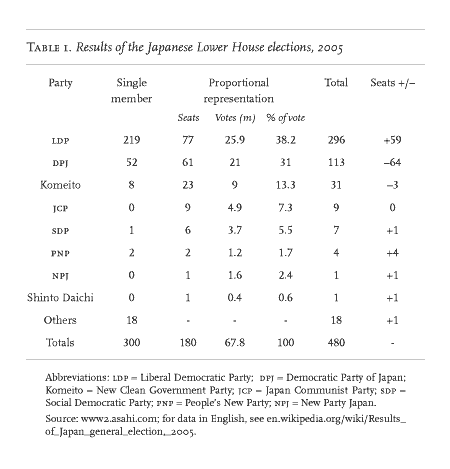
This was the system that delivered Koizumi’s landslide. On the proportional list, the ldp won 25.9 million votes, or 38.2 per cent of votes cast (slightly better than Blair a few months earlier); but thanks to the brazen inequities of the first-past-the-post system, it gained 62 per cent of the seats: 296 in a 480-seat House. Koizumi’s coalition partner, the Buddhist Komeito (Clean Government) Party, with 13.25 per cent, took an additional 31 seats, giving the governing coalition a two-thirds majority of 327 seats. (Without the support of the Buddhist vote, few of the ldp candidates would have been able to carry the single-member urban constituencies.)
By contrast the dpj, despite its 21 million proportional-list votes (31 per cent), saw its representation slashed from 177 to 113 seats. In the first-past-the-post section its share of votes declined by only 1 percentage point, from 37 to 36 per cent, but its seats were halved from 35 to 17 per cent. If the overall number of votes had been simply translated into seats on a proportional basis, the ldp would have got 183 to the dpj’s 149: certainly no landslide. Meanwhile, the Japan Communist Party, with 7.25 per cent of the national vote, got 1.9 per cent of seats, and the Social Democratic Party with 5.5 per cent of the vote secured 1.5 per cent of seats. (Turnout was 77.5 per cent, slightly up on the lows of the 1990s.)
As noted, the largest swings to the ldp from the dpj were in the metropolitan regions. In urban Tokyo, the balance between the two parties in the single-member seats shifted from 12–12 to 23–1, with two ldp postal rebels ousted. In the suburbs of Chiba and Kanagawa in the Minamikanto region around Tokyo Bay, the ldp took 14 seats from the dpj. In Kitakanto, where the urban sprawl of northern Tokyo peters out into countryside, the ldp took 5 seats and defeated a postal rebel. In industrial Osaka, the ldp reduced dpj seats from 9 to 2.
Yet swings to the ldp in the small towns of Tokai, for example, were far less marked. Rebels did well in rural Kyushu, in the far south, though the ldp made compensating gains from the dpj in the island’s main urban centre, Fukuoka. A similar pattern held in rural Tohoku in the north, where a postal rebel held his seat, while the ldp made gains from the dpj in Sendai, the district’s largest city. In the rural west, as in Hokkaido and Shikoku, there was little change. In the traditional rural strongholds of Chugoku, in the southwest, postal rebels made gains from both parties. Again, it should be emphasized that 35 per cent of Japanese live in small towns and country districts, a far higher proportion than in most oecd countries. All in all, seventeen ex-ldp ‘rebels’ and one other independent were successful and now sit in the remotest corner of the Lower House, either as independents or under the banner of one or other of the small new parties.
Manipulating discontent
Koizumi emerged on 11 September with a virtually blank cheque to run both the ldp and the country. As the new Diet assembled, he could contemplate a legislative dominance comparable to that of the Imperial Rule Assistance Association during the war years. The paradox of his electoral victory is that, born of insecurity, déclassement and social fear, it ensures that insecurity will be deepened, déclassement intensified and the most retrograde social tendencies strengthened. As well as paving the way to the stock-marketization of the Japanese people’s savings, it will be used by the government as a mandate for its ‘Britain of the Far East’ foreign policy as Washington’s Asian relay. This will entail a further expansion of the sdf (military spending, at 1 per cent of Japan’s vast gdp, is the second highest in the world) to play a forward role in the East’s us-led ‘mini-nato’ aimed at the containment of China.footnote9 The sdf’s blooding in Iraq, and the tacit acceptance of the constitution-breaking this has involved, have been important ideological steps in this process. That Iraq was kept even more firmly out of Japan’s 2005 election campaign than out of Britain’s has been a further victory for neo-conservatives, both in Washington and Tokyo.
The smoke and mirrors of Koizumi’s campaign created multiple illusions. The ldp presented itself as a ‘new’ force, pitched against entrenched ‘bureaucratic’ interests, and headed by a vigorous, iconoclastic leader. Yet 30 per cent of ldp candidates were second or (like Koizumi) third generation politicians, and over a sixth of them were ex-bureaucrats. The ldp has also continued to depend—before, during and after the election—on the support of a religious party. Despite the attention-getting ‘ninjas in lipstick’ sent to stand against the postal rebels, the ldp presented only 26 (out of 346) female candidates, far fewer than the dpj, and is committed to revising the constitutional guarantee in Article 24 of equality between the sexes.
With the word ‘reform’ always on his lips, Koizumi is on the brink of realizing the long-held dreams of the ldp’s most reactionary wing. What he meant by ‘reform’ was privatization and further subordination to neo-imperial design. What he meant by ‘getting rid of factions’, or ‘destroying the ldp’ was getting rid of other factions, exorcizing the Kakuei ghost from the ldp machine. Where former leaders had been restrained by the realities of Diet politics or the factional balance within their own party, Koizumi can now forge ahead. During the 1980s, Nakasone was persuaded to desist from worshipping at the Yasukuni Shrine. Koizumi feels no such inhibition, compensating for his prostration before Washington by flaunting his disdain for the Chinese or Korean victims of Imperial Japan. Revision of the Constitution and the Fundamental Law on Education—to ‘remove the stains on Japanese history’ and restore ‘national pride’—are key elements of this agenda. School students are now graded termly on their patriotism.
The tensions between Koizumi’s neo-nationalist posturing and his virtually unconditional commitment to Washington are nearly always resolved in favour of the latter, however. Where the us officials who descend upon Tokyo to dictate policy used once to arouse bureaucratic and even some political opposition on nationalist grounds, under Koizumi those who lecture their Japanese opposite numbers on everything from the ‘need’ to get troops on the ground in Iraq to stepping up imports of American beef are acclaimed as ‘pro-Japanese’. Koizumi, for his part, rarely seeks any favour in return. On the two occasions on which he is known to have tried—his suggestion that Bush respond to Kim Jong Il’s overture for a meeting, and his request for a permanent Japanese seat on the un Security Council—Koizumi has made no headway. On the former, he was met with a ‘stony silence’, and on the latter, he was treated to an extensive lecture on the need for Japan to relax restrictions on the import of American beef.footnote10
Calls for ‘reform’ have been a constant of Japanese politics for the past two decades, but their outcomes have always been manipulated, frustrated or denied. The reform wave that began in the late 1980s was fed by anger and disgust at ldp corruption exposed in the Recruit and other scandals, but bore the bitter fruit of the 1994 electoral system. This succeeded in sidelining the left opposition forces and creating the simulacrum of a two-party system, which really amounts to a confrontation between two wings of a single conservative party. Consensus prevails on the priority of us demands for security cooperation, and on neoliberal social and economic policies. In the current wave, popular dissatisfactions born of the ‘lost decade’ of 1990s stagnation have been cynically channelled into the campaign for postal privatization. Koizumi’s electoral coup has ensured that, from 2017, global finance capital will have a powerful new say in the direction of Japanese savings, interest rates and public expenditure.