The reign of Brazil’s longest continuous ruler since the Second World War is drawing to a close. Elected in 1994, Fernando Henrique Cardoso engineered the lifting of a constitutional prohibition on Presidential re-election—dating back to the foundation of the Brazilian Republic in the late nineteenth century—to roll over his tenure for another four years in 1998. Today, as the economic horizon darkens, and he seeks to install a Gore-like successor, a historical verdict on the experience sometimes hailed by admirers as the equivalent of a tropical social-democracy is approaching. Cardoso entered political life as a high-profile critic of ‘dependent development’, famous for arguing that, while the bourgeoisie in Brazil was incapable of leading a successful programme of independent industrialization, the association of national with international capital in the periphery of the world system—which he implied was inevitable, short of a social revolution—would not lead to convergence of Third World with metropolitan societies. It would on the contrary perpetuate deep social and economic inequalities, loss of control over the direction of national development, and vulnerability to external financial shocks.footnote1 Such were the axioms of sociologist. What have been the lessons of the politician?
When Cardoso first set out his theory, Brazil was under a military dictatorship dedicated to fast growth along import-substitution lines—the path set by the Revolution of 1930 that first brought Vargas to power. Amidst tough repression, industrialization proceeded at a cracking pace behind high tariff barriers through the late sixties and most of the seventies. From the mid-sixties onwards, however, the pattern of development in Brazil diverged in certain crucial aspects from the traditional import-substitution road. For this was a period in which the rise of the Eurodollar market opened up huge, previously non-existent opportunities for governments to recur to rapidly expanding private sources of lending. The Brazilian military could, for the first time since the war, embark on a gigantic borrowing spree on world-capital markets, contracting loans particularly from core-zone banks—rather than, as in the past, from governments or semi-official lending institutions—to drive development. Indeed, in the midst of a world recession, the Geisel government of 1974–79 launched an ambitious state-sponsored ISI programme in the area of heavy industry, with the declared aim of moving Brazil into the status of a developed country before the end of the decade.footnote2
The onset of record-high real international interest rates after 1980, which simply demolished most of the periphery, brought this model of debt-driven development to an abrupt end. Pressure from all sectors of society soon led the weakened military regime to withdraw to the barracks, thus ushering in the ‘New Republic’ in 1985. For a decade, as a burgeoning labour movement arose outside a conservative civilian establishment, the weak Presidencies of Sarney and Collor attempted to revive growth, the first by timid measures of social redistribution, the second by preliminary doses of neoliberalism—principally trade liberalization and deregulation—imposed as a condition for restructuring the country’s foreign debt under the Brady Plan.footnote3 Neither was able to halt ever-accelerating inflation. By the time Collor was impeached and his Vice President Itamar Franco took over, prices had exploded into hyper-inflation—an increase of over 2,000 per cent in 1994.
The Plano Real
It was in these drastically altered conditions that Cardoso carved his path to power. Appointed Finance Minister by Franco in May 1993, he assembled a team of Ivy League technocrats who devised a stabilization plan submitted to the President in December 1993. The Plano Real, however, was much more ambitious in conception than a mere scheme for stabilization. From the outset, its central premise was that only by slashing inflation could an attractive investment climate be created for foreign investment by multinationals in Brazil, and only massive inflows of such productive capital from abroad could provide a new and sound basis for long-term domestic growth. Technocratic doctrine held that FDI would perform multiple services to the country: it would help finance balance-of-payments deficits, modernize industrial structures, develop advanced technology, promote productivity and boost the international competitiveness of Brazilian exports. In fact, a central section of the stabilization plan advocated modernization of the economy with the help of foreign capital. To this end, Cardoso recommended elimination of the barriers to foreign companies in the exploitation of natural resources, and to enable multinational corporations to participate in the privatization of strategic state enterprises in the infrastructure sector.footnote4
But it was the capacity of the stabilization strategy to restore confidence and credibility abroad that would determine the massive inflows of long-term productive capital Cardoso’s team expected to attract. It therefore encouraged the entry of short-term speculative funds into Brazil, by an unprecedented liberalization of the capital account and huge interest-rate differentials with the rest of the world, with the aim of rapidly increasing foreign-exchange reserves to clinch the success of monetary stabilization.footnote5 When the new currency, the real, was launched in July 1994, and with much fanfare pegged at parity with the dollar, Brazil already had $40.3 billion in foreign exchange reserves, 70 per cent accumulated since Cardoso was appointed Finance Minister—suggesting that from the start he expected to rely on a steady stream of external finance to help him stabilize the country. Two years later, he was telling an interviewer: ‘We have something that neither Marx nor Weber nor anyone else imagined—they couldn’t have done: capital has internationalized rapidly and is available in abundance. Some countries can take advantage of this excess of capital, and Brazil is one of them’.footnote6 Foreign capital became central in a strategy based on an overvalued exchange rate and import liberalization, seeking to emulate the initial ‘success stories’ of neoliberal stabilization in Mexico and Argentina.
Intellectual justification for this course of action was in plentiful supply. Economist Gustavo Franco, Director of International Affairs at the Central Bank between 1994 and 1997 and then its President until January 1999, the chief neoliberal ideologue of the regime and architect of the overvaluation of the currency, was an ardent proponent of import liberalization and the ‘strategic value’ of external deficits. Throughout the years of the Plano Real, Franco insisted, in academic papers as well as in the media, that since import liberalization increases efficiency, productivity and competitiveness, current-account deficits are a means by which ‘foreign savings contribute to economic development’. According to Bernardo Kucinski, ‘Cardoso considered Franco’s ideas as a kind of Copernican Revolution’. Those who criticized this strategy, and warned that it would make the economy increasingly vulnerable to international shocks, were labelled by Cardoso and his advisers as so many ‘catastrophists’, ‘alarmists on duty’, or ‘grave-diggers of the real’. The President himself coined a neologism to ridicule anyone who disagreed with his policies. They were neobobos—that is, neofools.footnote7
First fruits
On the surface, Cardoso’s confidence in the descent of manna from the North was more than vindicated. In net terms, total inflows of foreign capital jumped from $14.3 billion in 1994 to $34.2 billion in 1996.footnote8 Volatile portfolio investment played a major role in this influx, accounting for some 46.5 per cent in 1993, 58 per cent in 1994, 45.9 per cent in 1995 and 32.4 per cent in 1996. Later, after Congress removed various constitutional impediments to their operations in 1995, massive inflows of foreign direct investment by multinational corporations began to enter the country. Annual net FDI leapt from $3.9 billion in 1995 to $9.6 billion in 1996, $17.8 billion in 1997, $26.3 billion in 1998, $29.9 billion in 1999, reaching $30.5 billion in 2000. According to UNCTAD, the stock of foreign direct investment in Brazil grew from $42.5 billion (6 per cent of GDP) in 1995 to $197.7 billion (21.6 per cent of GDP) in 1999.footnote9 But throughout the Plano Real, Brazil also relied on inflows of short-term speculative funds amounting to a net total of some $23 billion. To attract this hot money, the government offered investors not only one of the world’s highest interest rates, but also the ability to move their funds out of the country at any time, through highly advantageous tax-exempt mechanisms known as CC5s—bank accounts for non-residents with free access to floating exchange rates. Investors were further lured with hedge mechanisms, such as exchange-indexed government treasury bonds, to insure that they would retain the value of their assets when they left.footnote10
Fortified with this barrage of foreign capital, the architects of the Plano Real were able, as they had predicted, to keep a tight grip on prices. Inflation dropped from a monthly rate of 50 per cent in June 1994 to 6 per cent by the end of July. From this trampoline, Cardoso vaulted with ease into the Presidency in October, winning 54 per cent of the votes in the first round. Annual inflation thereafter fell steadily, from 23.29 per cent in 1995 to 10.03 per cent in 1996, 4.82 per cent in 1997 and 1.79 per cent in 1998. Brazil had joined the ranks of the neoliberal achievers—Mexico, Chile, Argentina. Trade liberalization, already initiated by the Collor administration, played—as intended—a complementary role in controlling prices. Between 1990 and 1994, average tariff levels were slashed from 32.2 to 14.2 per cent.footnote11
The result was a dramatic increase in imports, which rose by 52.7 per cent in the first six months of the Plan alone, from $13.1 billion in the first half of 1994 to $20 billion in the second. The import boom in turn was powerfully driven by overvaluation of the currency. As foreign capital started to flood into the country, upward pressure on the exchange rate was not checked by Gustavo Franco at the Central Bank, who deliberately allowed the currency to appreciate between 20 and 30 per cent in real terms. The resulting over-valuation made imports cheaper, operating for a time as what critics dubbed a kind of ‘exchange-rate populism’. From the start this element in the official package was perceived even by some of its admirers as tempting fate.
Through until at least March 1995, Cardoso’s strategy for recovery appeared to have worked wonders. GDP grew 3.4 per cent in the third quarter of 1994, 3.5 per cent in the fourth, and 2.8 per cent in the first quarter of 1995. Domestic capital enjoyed a sudden windfall of more than nine million ‘additional’ consumers, as an initial effect of monetary stabilization was a sharp reduction of absolute poverty. The average real wage increased dramatically, particularly for those at the bottom of the social pyramid, with the numbers of Brazilians in absolute poverty, in official figures, falling from 41.7 per cent of the population (59.4 million people) to 33.9 per cent (50.2 million).
Perverse logic of the model
Thus, once Cardoso was in power, the question of dependency and development was turned on its head. As President, Cardoso sought explicitly to make the Brazilian economy as dependent as possible on the multinationals and financial institutions of the core in order to develop the country. But in doing so, he invited multiple contradictions, which as a theoretician he should have foreseen could not but undermine his whole project. The first of these was inexorable rise in Brazil’s trade deficit. Imports surged when protectionist barriers were further dropped in 1994. As Table 1 indicates, Brazilian trade surpluses—still running at $10–15 billion a year in the early nineties—were transformed into substantial deficits, rising to some $8.3 billion by 1997. This deterioration was a direct product of the Plano Real. For while a pegged exchange rate can fight inflation in the short run, it invites disaster in the long run, by undercutting what is already the weak link in the periphery—international competition in manufactures. If an overvalued currency is bane enough for the US or Japan, it spells little short of ruin for Brazil or Argentina. Once the exchange rate is forced up, as sooner or later the peg insures it will be, imports automatically become more competitive, and exports less so. Thus from 1995, when the US was forced to revert to a high dollar, the real could not help but follow it up. The result was to devastate the Brazilian trade balance. In the early 1990s, with the dollar and the cruzeiro low, exports had increased by 50 per cent. But from 1995 to 1999, they barely rose at all.
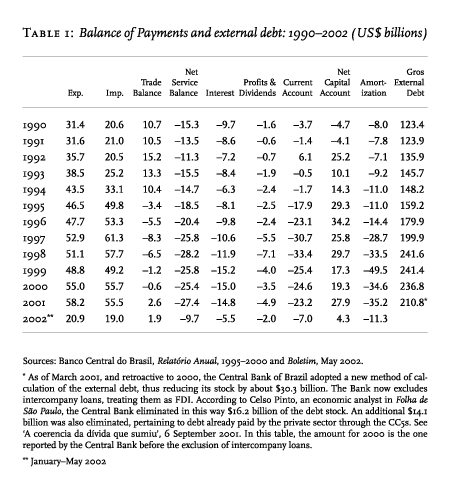
The combination of a widening trade deficit, and the need to build up foreign reserves to protect the overvalued currency against speculative attacks, required the support of massive inflows of foreign capital. But these in turn led to a dramatic increase in the current-account deficit, which of course included interest payments, repatriation of profits and dividends of the very capital needed to shore up the real. Thus, as Table 1 illustrates, the deficit on the current account soared from $1.7 billion in 1994, when it was 0.3 per cent of GDP, to $33.4 billion in 1998, by which time it was 4.25 per cent of GDP, and required $8.9 billion of Brazil’s reserves to cover the gap between it and net inflows of capital. In 1999, after the collapse of the currency, the deficit hit $25.3 billion, or 4.79 per cent of GDP, the highest level since 1982 when the foreign-debt crisis and the ‘lost decade’ began. In 2000, the deficit was still running at 4.15 per cent of GDP, rising to 4.61 per cent in 2001—rates much higher than in Argentina (3.1 and 1.6 per cent), Chile (1.3 and 1.5 per cent), and Mexico (3.1 and 2.8 per cent).
It had become obvious, in other words, that the more inflows of foreign capital were required to finance the deficits generated by the Plano Real, the larger the deficits themselves became, since foreign capital could not but aggravate the negative balances it financed. The result was ever greater requirements for new inflows, inaugurating another cycle of foreign indebtedness to meet the country’s external financial obligations. Table 1 shows the enormous transfer of resources in the form of interest, amortization, repatriation of profits and dividends that began in 1995, and saw Brazil’s foreign debt increase from $148.2 billion in 1994 to $241.6 billion in 1998—a $100 billion addition during Cardoso’s first term. Of this, $145 billion was owed by a private sector encouraged by the government to borrow abroad, as domestic interest rates remained high in order to increase international reserves and defend the real. If we add the total foreign debt to the stock of FDI, Brazil’s external liabilities today are an incredible $400 billion.
Such an extreme dependence on foreign capital—the current-account deficit and amortization of the debt require more than $50 billion a year—inevitably made the Brazilian economy highly vulnerable to international shocks. For conditions on the world-capital market are obviously determined by the players who do most of the business there, and these are located in the core. Brazil’s access to overseas funding ultimately depended on the demand and supply of capital in the North and, in particular, on the cost of borrowing they set. Movements on financial markets in the centre are so huge that developments in the periphery are dwarfed by them. In practice, this meant that the Brazilian economy was at the mercy of international developments triggered by the opportunities or dangers facing core investors.
A chain of shocks
The result was a series of ever-worsening domestic crises, following the same inexorable trajectory—flight of foreign capital from Brazil; imposition of super-high interest rates and tougher fiscal austerity to attract it back; collapse of domestic investment and consumer demand, leading to recession; rising unemployment, greater poverty and worsening income distribution. The outcome was to bring about a more or less continuous fall in the growth of domestic demand, to complement the stagnation of overseas demand for the country’s exports. The excruciating pressures to which the Brazilian economy was subjected by its deepening ensnarement in the debt trap ultimately became impossible to endure, and the Plano Real collapsed as Brazil’s fundamental incapacity to determine its access to world capital-markets, no matter what it did, became clear.
In the euphoria of 1994, as Cardoso crushed inflation and coasted to electoral triumph, few paid much attention to the North. But in the United States, the Federal Reserve was doubling interest rates, from 3 to 6 per cent in twelve months. The result was a world bond-market crash, and the collapse of the Mexican peso at the end of the year. This was to be the first sign that Cardoso and his economic team could only halt outflows of short-term speculative capital by sacrificing development. The Central Bank lost $9.8 billion of foreign reserves between the fourth quarter of 1994 and the first quarter of 1995, as net capital inflows were insufficient to finance the current-account deficit, and suffered the first speculative attack on the currency in March 1995 after a clumsily implemented mini-devaluation.footnote12 The cornerstone of its defence of the real was an increase of interest rates from 42.4 to a stratospheric 64.8 per cent in the first half of 1995, provoking an immediate economic recession and ending the consumption boom the currency had initially triggered. Alarmed by the Mexican crisis and its repercussions throughout Latin America, the US reversed direction and lowered interest rates from summer 1995 through early 1996, helping to ease the situation. International confidence was restored when the Brazilian Congress bowed to pressure from Cardoso and amended the Constitution to accelerate privatization. Foreign reserves shot back up from $29 billion in April to $51.8 billion in December 1995. Danger had been averted.
Two years later it returned, in more menacing form. In early 1997 the US Federal Reserve raised interest rates again as the first step in a traditional anti-inflationary round, setting off panic and capital flight in Thailand, and then throughout East Asia. In October the ripple effects of the Asian financial crisis struck Brazil: $17.5 billion fled the country and $8.5 billion of foreign reserves were spent defending the real against the speculative attacks.footnote13 Interest rates were again jacked up, from 22 to 43 per cent, to reverse outflows of foreign capital, and the fiscal screw tightened with a wage freeze and job cuts in the state sector, throwing the economy into recession and increasing unemployment. But once more international capital responded well: foreign reserves rose from $51 billion in December 1997 to a historic high of $74 billion the following April.
Then came the Russian default in August 1998, and the plunge on Wall Street that autumn: Brazil’s foreign reserves were slashed in half to defend the real, in just two months. Interest rates went back up to 49.75 per cent in September in a desperate attempt to staunch a haemorrhage of speculative funds, which reached $31.2 billion by the end of the year. This time international confidence was only restored—temporarily—when the US orchestrated an IMF bail out of $41.5 billion to postpone the now inevitable collapse of the currency till after Washington had made sure of Cardoso’s re-election in October.footnote14 Predictably, however, the IMF’s intervention exacerbated the underlying situation. The Fund represents above all lenders from the leading financial institutions of the core, and is first and foremost concerned that they get their money back, while also seeking to remake the world in the American image through the enforcement of neoliberal policies. As Joseph Stiglitz has recently reminded us, when the IMF comes in to bail out a Third World economy, it virtually always calls for austerity, to force a deflation that will enable the country to earn foreign exchange and run a government surplus, in order to pay back its debts.footnote15 It does everything possible to prevent a reflation of demand to raise employment and alleviate popular suffering, since this would tend to make for bigger government and public-sector deficits. Needless to say, the US and other core economies do exactly what the IMF forbids when they go into recession.
In Brazil, the reckoning was not long in coming. A ferocious speculative attack on the real in mid-January 1999, with billions of dollars a day pouring out of the country, forced the government to abandon the defence of the currency and allow it to float on world markets. The exchange-rate anchor that had been the centrepiece of the Plano Real was blown away, and with it $50 billion in foreign reserves wasted on its defence since August. After the adoption of a flexible exchange rate on January 15, the currency plummeted, losing over two-fifths of its value against the dollar. The premises of Cardoso’s economic strategy lay in ruins.
Downward spiral
But for a year, Brazil enjoyed a temporary respite from its troubles, as the Federal Reserve lowered interest rates dramatically, to ward off the effects of the Asian financial crisis and prop up the US stock market. After failing to grow at all in 1998 and 1999, on the back of devaluation Brazilian GDP growth leapt to 4.4 per cent in 2000. Yet by the summer of that year, Wall Street was in sharp decline, bringing to an end the American boom of the nineties, and setting off a recession that has still not ended. The economies of Europe, Japan and East Asia followed the US downwards. When the core sneezed, Brazil could hardly avoid falling sick.
Up to this point, a generally favourable international economic environment had encouraged expectations that, despite sporadic difficulties, the country would eventually embark on sustained growth, and foreign investors had responded well to Cardoso’s fiscal policies. But from late 2000, as Brazil was hit by a series of international shocks—the deteriorating global conjuncture, looming default in Argentina, a domestic energy crisis triggered by investment cuts and a misbegotten privatization programme—the inflow of foreign capital contracted sharply and the currency fell further. The government responded by raising interest rates again in early 2001, and begging the IMF for further support to restore the confidence of international financial markets. In August 2001 a new fifteen-month Stand-By Agreement was signed with the IMF, to the tune of $15 billion, with an immediate tranche of $5 billion to bolster foreign reserves—conditional on an increase of the primary budget surplus from 3 per cent of GDP in 2000, to 3.35 in 2001 and 3.5 in 2002.footnote16
This package temporarily rallied the bond markets, amidst a perception among analysts and policy-makers that Brazil had successfully ‘decoupled’ from the Argentine crisis. In Buenos Aires the government of Fernando de la Rúa, unable to implement further draconian austerity measures to secure its own rescue by the IMF, was toppled by violent mass protests. Argentina defaulted on its $150 billion foreign debt in December 2001 and in January finally abandoned the strait-jacket of convertibility that had devastated the country’s exports, particularly since the Brazilian devaluation of 1999. But the celebration in Cardoso’s entourage and international financial circles that Brazil had escaped Argentina’s fate was premature. The economy deteriorated markedly in 2001. GDP growth fell from 4.4 per cent in 2000 to 1.5 per cent. Even with the seal of IMF approval, the influx of foreign capital dropped by a third with the slowdown of the American economy, following September 11.footnote17
By the end of 2001, FDI was down to $22 billion. Despite a primary surplus that actually exceeded the IMF target, the real had lost 44 per cent of its value between January and October; foreign-exchange-indexed debt had to be sold to facilitate its roll-over; interest rates were hoisted once again. The result was a further escalation of the internal public debt, which rose from 49.4 to 53.3 per cent of GDP—R$563 to R$661 billion—and of the operational deficit, which jumped from 4.5 to 8 per cent of GDP in 2001. If the depth of the slow-down and scale of devaluation cut imports, generating the first-ever trade surplus since the Plano Real was proclaimed, there was no improvement of note in the current account. Earnings of $2.6 billion on the trade balance were dwarfed by Brazil’s debt-service obligations. The unsustainability of Cardoso’s neoliberal model had never been so plain.
Roots of the crisis
Today, as in 1999, establishment analysts blame the present crisis on domestic political constraints—uncertainty as to whether Cardoso can shoe in his lacklustre successor José Serra in the October elections. But its roots lie much deeper, in the fundamental strategy of dependent development adopted during Cardoso’s double presidency. In 1998 and early 1999, international financial markets understood this very well and fled. They were aware of the extreme fragility of Brazil’s financial situation, since the stratospheric interest rates needed to prop up the currency could only lead to a dramatic rise in the servicing costs of the domestic public debt. Investors thus had every reason to fear that the government might be unable to keep up interest payments and be forced to ‘restructure’ (ie: default on) its domestic debt, with knock-on effects on its dollar-denominated debt. Their apprehensions persist today. Whoever wins the election in October 2002 will inherit a grave financial crisis, the fruit of eight years of Cardoso’s ultra-neoliberal mismanagement of the economy.
The public deficit that the IMF insists be reduced is not fiscal, but monetary. As even the Economist noted in its Survey of Brazil in 1999: ‘Strip out interest payments on the government debt, and the public-sector deficit has remained below 1 per cent of GDP a year’.footnote18 In 1995 the public sector had a primary surplus (ie: before adding debt service to expenditure) of 0.36 per cent of GDP, but an operational deficit of 4.88 per cent as interest expenditures reached 5.24 per cent. In 1996, the primary balance moved to a deficit of 0.09 per cent of GDP, the result of a massive bail out of domestic private banks to the tune of R$20.8 billion through PROER, Cardoso’s programme for strengthening the national financial system through mergers and acquisitions; in the same year interest payments were 3.66 per cent of GDP. By 1998, the deficit had climbed to 8.02 per cent, consisting entirely of interest payments.
Although the bulk of the public debt is internal, an increasing proportion of it has come to be owned—directly or indirectly—by foreign investors, receiving interest payments at the domestic overnight rate. Moreover, to secure its roll-over after the Asian and Russian crises, about a third of this debt, paid at the overnight rate, is now indexed to the dollar. According to the IMF, by May 2002 over three-quarters of the domestic public debt was linked either to the overnight interest rate or to the exchange rate. Even more problematic has been the Central Bank’s use of bonds to regulate the financial markets and facilitate monetary policy, which ensures that large-scale inflows of foreign capital become one of the most important forces behind the rise of the internal public debt—the more external funds are converted into reais, the more the government sells treasury bonds to withdraw part of the money in circulation, to avoid an excess of liquidity. The growth of the public deficit is thus just one more consequence of the external vulnerability of the Brazilian economy.
Securing the primary surplus
Notwithstanding the evidence, neoliberal ideologues continue to maintain that the origin of the deficit is fiscal, and Cardoso has clung to the Washington Consensus’s first commandment: fiscal discipline, ‘which typically implies a primary surplus of several percentages of GDP’footnote19—intended, of course, to offset the impact of interest payments on the public deficit and restore the confidence of foreign and domestic investors in the ability of the government to honour its financial obligations. From the beginning, the Plano Real’s ‘other’ anchor was designed to be fiscal: a commitment to slash public expenditures and raise revenues, where necessary by major constitutional amendments—reforms of the civil service and pension systems to cut personnel and retirement benefits, and privatization of strategic state enterprises in the infrastructure and service sectors. Cardoso was able to mobilize Congress to restore creditors’ confidence with these austerity packages after the speculative attacks on the real. But it was only after the collapse of the currency, when the IMF took control of economic policy-making as a condition for the 1998 bail out, that large primary surpluses began to be generated above and beyond IMF targets, through indiscriminate tax increases and cuts in essential public investment, legitimated by a Law of Fiscal Responsibility (May 2000). Taxation jumped from 28 per cent of GDP in 1995 to 34 per cent in 2001, the highest level in Latin America—comparative figures for Argentina are 22–24 per cent, and for Mexico 14–16 per cent.
The dramatic increase in tax collection in Brazil is explained by a rise in both direct taxation, hitting the working and middle classes, and indirect taxation, which weighs heavily on the competitiveness of national products, at home and abroad. The social impact of indirect taxation on goods and services transactions is also highly regressive. Thus while families that have a monthly income of up to two minimum wages lose 26.48 per cent of their income in indirect taxation, families whose income is above 30 monthly minimum wages lose only 7.34 per cent. This is in a country where a basic food-basket costs 9.81 per cent of the monthly disposable income of families with up to two minimum wages, but only 1.48 per cent of higher income groups. In 2001, the CPMF, PIS and COFINS, taxes not shared with states and municipalities, corresponded to 38 per cent of total gross federal-government revenues, and the income tax to 33 per cent.footnote20 This increase, needless to say, did not go to improve public services, the major victims of fiscal adjustment—as the deteriorating state of infrastructure, health, education and public safety in Brazil clearly show—but to foot the bill presented by finance capital, the major beneficiaries of Cardoso’s eight years of neoliberalism.
With this fiscal pressure, the government was able to produce the requisite primary surpluses to differentiate itself in the eyes of foreign investors from an irrecuperable Argentina: R$31.1 billion (3.2 percent of GDP) in 1999; R$38.2 billion (3.5 per cent) in 2000, and R$43.6 billion (3.7 per cent). But these still covered only half the interest payments on a public debt that continued to grow remorselessly, from 28.1 per cent of GDP (R$192 billion) when Cardoso came to power in 1994 to 56 per cent by May of this year (R$708.5 billion). By any measure, Brazil is now one of the most severely indebted countries in Latin America—its ratio of foreign debt to exports (437 in 1999, 366 in 2000 and 336 in 2001) placing it behind only Argentina (524, 473 and 452) and Nicaragua (781, 707, and 706).footnote21 The IMF’s World Economic Outlook for 2002 reveals that between 1996 and 2000 Brazil’s overall interest payments amounted to 8 per cent of GDP and 20.5 per cent of total public expenditure. No other Latin American nation covered in its survey—Argentina, Chile, Colombia, Mexico, Peru and Venezuela—equalled these figures: the average public-debt burden of these countries was 2.6 per cent of GDP and 10.9 per cent of total public expenditure. The IMF itself, despite media-targeted apologias for its disciplined pupil, has pointedly warned the Cardoso government of the vulnerabilities of the Brazilian economy. In June of this year, after acceding to the pleas for the release of further funds, Anne Krueger, the First Deputy Managing Director stated: ‘Over the medium term, the authorities will need to continue to work to reduce Brazil’s large external borrowing requirements and the borrowing requirements of the public sector, as well as to reduce the large share of the public debt that is contracted at floating rates or linked to the exchange rate.’footnote22
Balance sheet: denationalization
What, then, is the balance sheet of Cardoso’s eight years in office, during which the theorist and critic of dependent development has enjoyed wider powers than any elected ruler of the past half-century? Is Brazil today less dependent than when he entered the Presidential Palace? Has it achieved more development than under his predecessors? The record can be considered from two angles: national and social. Cardoso promised voters that his programme, associating domestic and international capital in a common effort to modernize the nation, would enhance Brazil’s real independence as a major regional power in the global economy, and bring its citizens a greater degree of social progress and justice than they had ever known before. What have been the results?
The basic gamble on which the Plano Real rested—Brazil’s ability, if the right conditions were created, to attract unprecedented amounts of foreign capital—was not a miscalculation. Table 2 shows that FDI expanded dramatically in Brazil, above all between 1996 and 2000, as the country displaced Mexico as the most important magnet for overseas investment in Latin America. What drew this wave of international capital into the country? Privatization of state enterprises, and mergers and acquisitions, were two key attractions. Between 1996 and April 2002, $30.9 billion of FDI went into the purchase of privatized state companies in the electricity, telecommunications, gas, financial and other sectors—a figure that would be higher if transactions financed with Brazilian resources were included, as the BNDES (National Bank of Economic and Social Development) has financed many foreign acquisitions of privatized state firms at very low interest rates through a presidential decree of 24 May 1997. For its part, the government claims to have received total revenues of nearly $90 billion from its auction of public assets.footnote23
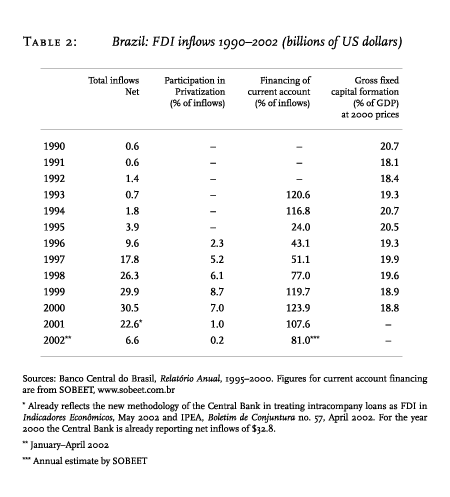
But the consequences of this influx have not been those its architects expected. For most overseas investors, responding to the incentives offered them, have not geared their strategies to building new plants, so expanding production and boosting employment, but rather to acquiring existing ones, either by taking over private firms or buying up state enterprises put on the auction block. The evidence suggests, in fact, that the updating of dependent development by its theoretician has led more to the destruction of local capital than its association with international capital.
The extent of the denationalization of the economy via the privatization of state enterprises can be gauged from the degree of ownership acquired by foreign capital in these forms. Between 1995 and 1998 FDI accounted for 42.1 per cent of the accumulated value of privatizations. The figures would be even higher, if subsequent sales of their shares by Brazilian partners were included—as for example, in the case of the state phone company Telebras, where the original foreign stake was 66.7 per cent, but Globo and Bradesco then disposed of their share to Telecom Italia. Where necessary, the Cardoso regime has actively assisted this displacement of domestic capital: in 1999, for instance, the BNDES advanced half the purchase price ($360 million) of the São Paulo energy company CESP-Tietê to the American Company AES, cutting out the Brazilian group Votorantim controlled by Antônio Ermírio de Moraes, once described by a US scholar as a ‘one-man national bourgeoisie’. At least R$7.5 billion will be returned to both foreign and local companies by the national treasury, over time, in the form of reduced taxation, and the difference between the minimum price and the actual amount paid.footnote24 Further generous incentives are now being extended by the BNDES to the privatized electricity sector in the wake of the energy crisis, and the government has allowed the companies ‘special’ price increases as compensation for the rationing period, hitting working and middle-class consumers as well as national industry.
Mergers and acquisitions of private firms have been equally central to the restructuring of the Brazilian economy promoted by Cardoso, and have operated as the other mechanism of denationalization. A recent study shows that between 1995 and 1999 there were 1,233 mergers and acquisitions in which multinational corporations acquired control or participation in Brazilian industries—the devaluation of the real since 1999 making such purchases cheaper. A KPMG survey reveals that 70 per cent of all acquisitions in Brazil during the same period were undertaken by multinationals, to the tune of some $50 billion of FDI inflows.footnote25 Rapid import liberalization and sky-high interest rates have been the most important factors in the displacement of local capital, forcing large numbers of Brazilian firms, including major industrial groups, either to close down, ally with or sell out to multinationals.
Foreign acquisitions were particularly intense in such variegated sectors as autoparts, banks, steel, food, drinks, dairy products, hygiene and cleaning, electronics and chemicals. Between 1995 and 2000, many a traditionally powerful Brazilian trust disappeared: Metal Leve of the Mindlin family was bought out by the German firm Mahle, the autoparts concern Cofap by the Italian Magneti Morelli, the steel company Villares by the Spanish Sidenor; while in the banking sector, Excel Economico was picked up by the Banco de Bilbao, Garantia by Crédit Suisse, Bamerinduis by HSBC, Real by the Dutch ABM-Amro. Such local brand names as Arisco, Pullman, Lacta, Aymore, Cica or Café Pilão in the food industry have disappeared, annexed respectively by Goldman Sachs, Bunge International, Philip Morris, Danone and Sara Lee; in the electrodomestic, supermarket and clothing sectors, it has been the same story—Arno, Eldorado, Pão de Açucar and Renner falling to the French firms Seb, Carrefour, Casino and J. C. Penney. As Veja, an unflagging supporter of Cardoso’s regime, puts it: ‘The history of capitalism has seen very few transfers of control as intense as this, over a short period of time.’
A select group of Brazilian interests, industrial and financial, have at the same time acquired monopoly positions in association with foreign capital during the course of the privatization process. An outstanding case is the largest Brazilian private group, Steinbruch, which bought a majority stake in the profitable state mining giant, Vale do Rio Doce, in partnership with overseas capital and financial support from the American NationsBank. Odebrecht and Mariani in petrochemicals, Vicunha in steel, and Bradesco, Itau and Bozanno in the financial sector, are similar representatives of a newly internationalized bourgeoisie that has profited hugely from the privatization programme.footnote26 But these are the exceptions that do not outweigh the rule. Displacement of local by foreign capital, rather than association with it, has been the hallmark of the Plano Real.
Modernization?
How far has this denationalization been compensated by a productive modernization of the Brazilian economy? The import-intensive service sector offers one answer. In the late nineties this was the principal magnet for foreign capital—its share of total FDI increasing from 43.4 per cent ($18.4 billion) in 1995 to 76.6 per cent between 1996 and February 2002, or $97.3 billion of the $127 billion invested in Brazil in these years. The typical upshot of the deregulation and privatization of electricity and telecommunications, and the unleashing of a torrent of acquisitions and mergers, was abandonment of local research and development for intra-company technological imports. The bill for capital goods from abroad jumped from $7.5 billion in 1994 to $14.8 billion in 2001, and for intermediate goods from $15.6 to $27.3 billion for the same years. Since Telebras was privatized in 1998, multinationals have been importing 97 per cent of the components required to upgrade Brazil’s antiquated phone system, as the government, to cajole the new owners, backed down from its initial demand that they utilize at least 35 per cent of national products. The price-tag for electronic components alone—especially chips—reached $5 billion in 2000. As one economist has remarked: ‘While the consumption pattern of information technology in the developed countries was diffused in Brazil in the nineties, there was an undeniable regression in production.’footnote27
The strategy of foreign corporations in Brazil has been perfectly rational; however, it has exposed the error of relying on multinationals to perform the role of leading agents of national development. ECLAC economist Michael Mortimore’s case study of FDI in Brazil’s service sector shows that the major goal of multinationals is usually to gain access to the national market, not to maximize export, let alone employment, and is achieved primarily by purchasing existing assets, not creating new ones. Assessing attempts by Latin American governments to convert FDI into an engine of growth, he concludes: ‘While the objectives of corporate strategies were for the most part met, the growth and development goals of the host countries were not.’ Rubens Ricupero, Secretary-General of UNCTAD, echoes him: ‘the commercial objectives of TNCs and the development objectives of host economies do not necessarily coincide’.footnote28
In the case of the automotive and autoparts industries, Ricupero notes that major national enterprises known for their capacity for technological innovation—Metal Leve, Freios Varga, Cofap—suffered immediate degradation after being sold to multinationals. Here the coefficient of import penetration rose from 8 per cent in 1993 to 25 per cent in 1996. The story has been the same in the telecommunications and computer sectors, where multinationals have largely suspended local research and development and transferred engineers from labs to marketing, production, sales and technical assistance. In these conditions, Ricupero comments, ‘it is not surprising that the coefficient of import penetration jumped from 29 per cent in 1993 to 70 per cent in 1996’. Another study has found that between 1994 and 1997, local production of capital goods fell overall by 10 per cent. Denationalization, in other words, has been accompanied by a real measure of deindustrialization.footnote29
Meanwhile, Brazil’s exports remain concentrated in traditional commodities—agricultural, agroindustrial and mineral—and the country has been unable to increase its share in world-manufacturing exports. A recent UNCTAD study shows that between 1980 and 1997, Brazil’s share in world exports of manufactures remained the same, 0.7 per cent, and, significantly, that its share in world manufacturing value-added (income) fell from 2.9 per cent to 2.7 percent. Comparatively, while Chile and Mexico were able to increase manufacturing exports during the same period, 0.0 to 0.1 per cent and 0.2 to 2.2 per cent, respectively, Chile’s value-added remained the same, 0.2 per cent, and Mexico’s fell from 1.9 to 1.2 per cent.footnote30
With the exception of East Asian countries—Korea, Taiwan and, of course, Japan, which successfully achieved a rapid expansion of technology and skill-intensive exports—none of the developing countries that have rapidly liberalized trade and investment in the past two decades have achieved a significant increase in their share of world-manufacturing income, as their exports continue to be concentrated in resource-based, labour-intensive products. As the same UNCTAD report notes: ‘While the share of developed countries in world-manufacturing exports fell between 1980 and 1997, their share in world-manufacturing income rose significantly. In other words, in relative terms, industrial countries appear to be trading less but earning more in manufacturing activity.’
Most significant of all, despite the huge inflow of foreign capital to the country under Cardoso, the rate of fixed-capital investment in Brazil has been miserable—well below the level of the supposedly disastrous eighties, when it ran at some 22.1 per cent of GDP. By contrast, as Table 2 indicates, in 1999, when FDI hit an all-time peak of $30 billion, it was no more than 18.9 per cent. There has been nothing accidental about this. The extra-high interest rates needed to attract foreign lenders, so as to cover the current account and keep up the real, depressed domestic investment from the start. In fact, if we compare Brazil with Argentina, Chile and Mexico, the three other Latin American countries where privatizations, mergers and acquisitions went furthest, the rate of investment in 1980 was 27.8 per cent in Brazil, 28.8 in Argentina, 19.8 in Chile and 24.2 in Mexico. Between 1997 and 2000, by contrast, the annual average rate was 20.5 per cent in Brazil, 19.1 in Argentina, 22.3 in Chile and 21.6 in Mexico. In other words, in every country except Chile, there has been a marked decline in rates of investment compared to levels prior to the debt crisis. ECLAC’s comment speaks for itself:
The instability of external financing has had a discouraging effect on investment. This is undoubtedly one of the reasons why the investment rate remains below pre-debt-crisis levels. The decline in the investment coefficient compared to the 1970s has been more pronounced in the larger countries, since these also have greatest exposure to private capital flows.footnote31
The modernization of the Brazilian economy under the leadership of multinationals has not promoted higher rates of capital accumulation nor greater international competitiveness. The large trade surpluses the country badly needs, even after two rounds of devaluations in 1999 and 2001, are wanting. Will multinationals continue to finance current-account deficits they themselves help to produce, apparently their principal task during Cardoso’s double presidency? The exhaustion of privatizations in Brazil, and the deteriorating economic environment in the North, suggest that this role may be coming to an end. From $30.5 billion in 2000, FDI is expected to fall to perhaps $17 billion this year—hence the urgency of the Stand-by Agreement with the IMF, and accelerated drawing down of its credit-line. But as in the case of Argentina—where FDI cascaded from $22.6 to $3.5 billion in the space of two years—once confidence weakens, foreign capital can abandon any country to its fate virtually overnight.
Social record
What, finally, of the most important test of all—the indices of social progress under Cardoso’s rule? Eagerly associating himself with Clinton and Blair as a companion spirit in the South, Cardoso—who in the eighties had spoken of himself as a social-democrat, and headed a party (the PSDB) calling itself such—preferred the vaguer recipes of the Third Way once in power. Few have many illusions in the Anglo-American versions of this nostrum, now widely discredited in its homelands. In the very different conditions of Brazil, has it acquired more substance?
Table 3 compares the rates of growth and industrialization under Kubitschek and the ‘miracle’ years of military rule, with those under Cardoso. The contrast is arresting. In the former, GDP per capita grew at an average rate of 6.1 per cent between 1957–61 and 8.4 per cent between 1968–73, whereas between 1995 and 2001 Cardoso’s neoliberal experiment delivered an average growth of GDP of 2.4 per cent, and per capita of just 1.0 per cent.
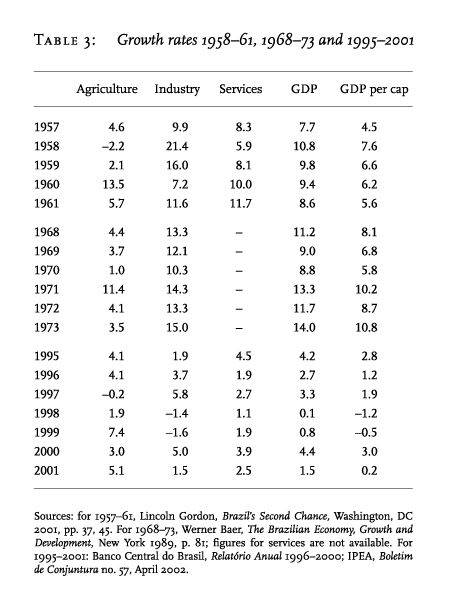
Comparing not periods but countries, the results are also striking. Of the four main neoliberal experiments in Latin America, Brazil certainly did better than Argentina, where the model eventually collapsed, yielding overall figures of 0.9 and –0.3 per cent. But it did markedly less well than the other two stars of neoliberalism: Chile registered GDP growth of 4.8 and per capita of 3.4 per cent, Mexico 3.1 and 1.4 per cent. More starkly still, under the successive impact of the Russian crisis, the collapse of the Plano Real in 1999, and initial contagion from the Argentine crisis of 2001, per capita income in Brazil fell in dollar terms from $4,940 in 1997 to $2,920 in 2001—a regression to the levels of the 1980s; while GDP itself dropped from $807 billion to $503 billion, demoting the country from its rank as the eighth largest economy in the world, and placing Mexico as the first in Latin America in total economic output, with a GDP in 2001 of $618 billion.footnote32
The inevitable consequence of such sluggish long-term growth, as elsewhere in Latin America, has been massive urban unemployment. According to official figures, which systematically underestimate the real rate, open unemployment rose from 4.6 per cent in 1995 to 7.6 per cent in 1998 and 1999, and 9 per cent by March 2000.footnote33 Other estimates reckon that open unemployment in São Paulo, the industrial heartland of Brazil, rose from 13.2 per cent in 1995 to 19.3 in 1999, and reached 20.4 per cent in May 2002, higher than the official 17.4 per cent reported for Argentina in 2001 just before its collapse.footnote34 This social failure has been a direct result of the massacre of small and medium enterprises, under the twin pressures of very high interest rates and sweeping trade liberalization. Such unemployment figures reveal a depth of social exclusion that does much to explain the rise of urban violence in Brazil during the Cardoso presidency. The latest data show that Brazil has climbed the ranks of Latin American countries for homicides to near the very top, with a coefficient of 19.12 per 100,000 inhabitants in 1992 rising to no less than 26.18 today.
If we turn to education, Cardoso has made some progress in reducing illiteracy in Brazil, according to official definitions, from 18.3 per cent of the population in 1990 to 14.7 per cent in 2000; although some 18 million Brazilians still cannot read or write and the average number of years of schooling of the economically active population is only 5.5, putting Brazil alongside Guatemala and Nicaragua. Argentina, Chile, and even Mexico come off much better, with illiteracy rates of 3.1, 4.3, and 9.0 respectively, and much higher average number of years of schooling: 10.1, 9.0 and 7.4. Infant mortality has also fallen, from 38.4 per cent in 1994 to 29.6 per cent in 2000, to the credit of the regime. But the Northeast, the poorest region of the country, continues to suffer from the appallingly high rate of 44 per cent. If infant mortality in Argentina and Chile is lower, 24.3 and 14 per cent, in Mexico it is higher than in Brazil, at 34.0 per cent. Set against these modest gains are the reverses of Cardoso’s second term. Between 1999 and 2001 average real wages fell 10 per cent, and government researchers themselves estimate that by 1999 absolute poverty had increased to 34.1 per cent of the population, some 53 million people, with another 22.6 million, or 14.5 per cent of the population, condemned to indigence. If Brazil does not compare well in these respects with Argentina or Chile (19.7 and 4.8, and 20.6 and 5.7 per cent), absolute poverty is more widespread in Mexico, 46.9 per cent in 1998, and indigence stands at 18.5 per cent.footnote35
Lastly, what of income distribution? Despite claims by Cardoso and his economic team that currency stabilization was the best social policy, inequality remains one of the most scandalous in the world—the countries with the four highest Gini coefficients are, in rank order, Nicaragua, Brazil, South Africa and Malawi. As Table 4 illustrates, in 1999 the richest 10 per cent of the population enjoyed 47.4 per cent of the national income and the poorest 40 per cent a mere 8.1 per cent.
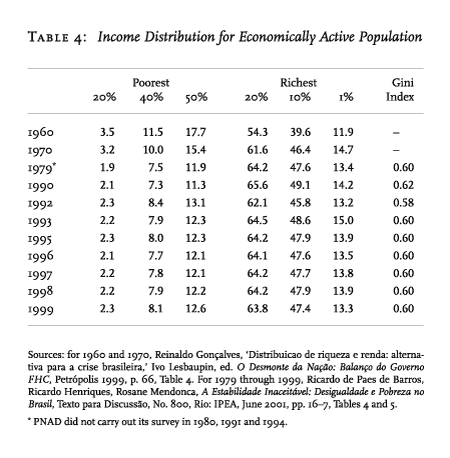
In fact, the neoliberal model in Latin America has increased inequality everywhere, the Gini coefficients in Argentina, Chile and Mexico all rising through the nineties. But according to ECLAC, in 1999 Brazil was the only country in Latin America in which more than half of the population had less than 50 per cent of the mean income.footnote36 Modest progress in literacy, health and reduction of poverty have not been able to redeem mediocre growth rates, high unemployment, vertiginous inequality and spreading urban violence and criminality.
Prospects
Today, as the situation in Argentina and in the world economy continues to deteriorate, and opinion polls suggest that PT candidate Lula—twice defeated by Cardoso—has a chance of winning the Presidency in October, private investors are increasingly nervous about the prospects for Brazil. Their fear, naturally fanned by Cardoso and his technocratic team, is that if Lula were elected, he might swerve from the task of maintaining large primary surpluses, or even follow Argentina’s example and allow a massive default. By June of this year, risk agencies had downgraded Brazil’s credit rating to the levels of Nigeria and Argentina, speculators were starting to dive out of the country’s currency and bond markets, and the Central Bank was forced to shorten maturities on the public debt. With the value of the real lower than at the point when the stabilization plan collapsed in 1999, the government, desperate to reassure investors, requested permission from the IMF to draw down the remaining $10 billion of its Stand-By Agreement and reduce its net international reserve floor by another $5 billion, to buy back external debt. The IMF’s condition was that the government increase its primary surplus yet further, from 3.5 to 3.75 per cent of GDP—another tightening of the screw to which Lula himself hastened to agree.footnote37 On the showing of the government’s own poverty experts, the sums now sequestered to placate the IMF could have been used to attack the still appalling levels of destitution in Brazil, rather than satisfy foreign bond-holders.footnote38 The Brazilian case constitutes a laboratory experiment demonstrating how and why the injection of the neoliberal virus, especially that strain which includes a pegged exchange rate, tends to polarize society and ruin an economy. The upshot of the Plano Real has been a sluggish growth of GDP throughout Cardoso’s presidency and a deepening recession as his reign draws to a close. Whoever wins in October faces a bleak inheritance.
None of this was necessary. As we have seen, the destructive logic of neoliberalism, dressed up as a Third Way, was predictable from the start. Even impeccably moderate voices have begun to acknowledge this. Cardoso’s own former Minister for Science and Technology, Luis Carlos Bresser Pereira, has recently disavowed ‘the naive policy of liberalization and withdrawal of the state from the economy, opening the country for imports and foreign capital, privatizing state enterprises because “the rest will be done by the market”’, while the employers’ federation of São Paulo, FIESP itself, has plaintively called for national industries to be strengthened.footnote39
The comparative performance of state-led development in Brazil, as we have seen, is clearly superior to the neoliberal version. Historically, of course, even its success was more limited than that of Japan or East Asia, where significantly faster and more durable industrialization was achieved by setting up high protectionist barriers against imports, gradually lifted only as sectors became competitive; by controlling not only capital exports but also capital imports, with the government regulating borrowing from abroad and limiting the penetration of MNCs; by preventing the emergence of equity markets in corporate control—through cross-shareholding, as in Japan; and by exposing domestic producers to competition not in the home, but in overseas markets, with ample subsidies to exporters. That such policies were never even contemplated by Cardoso’s regime is sufficient testimony to its timid provincialism. The bill for its blindness has been paid by the Brazilian people. In a former incarnation, it was Cardoso himself who once wrote:
Dependent development occurs through frictions, agreements, and alliances between the state and business enterprises. But this type of development also occurs because both state and business pursue policies that create markets based on concentration of income and social exclusion of most of the population . . . The conflicts between the state and big business are not as antagonistic as the contradictions between the dominant classes and the people.footnote40