The collapse of Enron has cast revealing light not just on the venality of business leaders, auditors and politicians but on the contours of deregulated ‘Anglo-Saxon’ capitalism as it has emerged from the stock-market bubble. It has highlighted, too, the vulnerability of the broad layers whose pensions are tied up in the savings regime so integral to the neoliberal economy. The debacle has affected not only Enron’s employees but tens of millions of holders of 401(k) and defined-benefit retirement schemes. The greed of the Houston-based directors, and their willingness to cash in huge stock options as the company went down, was matched by many senior executives elsewhere—perfectly illustrating that the capital which they and other major shareholders dispose of possesses different rights and qualities to the savings of their employees. The impotence of Enron’s workers, and of all those whose pensions were tied up in the company’s shares and bonds, was part of the normal working of today’s savings regime.
Enron’s demise was significant not just because of its size—other concerns failing at the same time, such as K-Mart or LTV, had more employees and pensioners—but because it had represented the cutting-edge of neoliberal corporate strategy, living proof that financialization and deregulation were the wave of the future. It was this that made a tireless booster of neoliberalism such as Paul Krugman so proud to be on the company’s payroll (see below). Enron was far more interested in maximizing trading opportunities than in the unexciting business of producing electricity. Its momentum came not from productive investment, innovation or even skill in arbitrage, but from financial engineering. By 2001, however, the profits it was making even on its trading activities were being squeezed by rivals—the result, perhaps, of having been first in the business. Its relentless pressure for deregulation reflected a wish to escape competition by opening up new pastures.
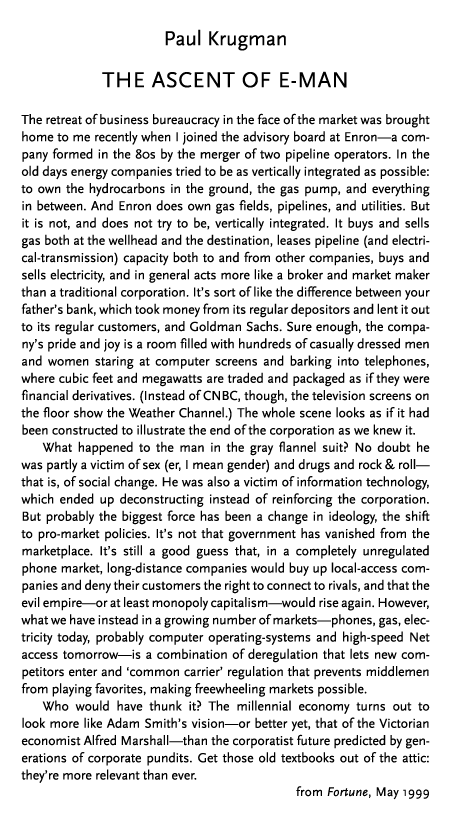
Formed from a 1987 merger between Houston Natural Gas and Internorth, two natural-gas pipeline companies, Enron lobbied for and profited from the 1990s deregulation of gas and electricity prices, transforming itself from power provider to energy broker in an operation that stretched across four continents. By the end of the decade Enron dominated the energy ‘spot’ and futures markets, as well as offering over 3,000 other futures and derivatives contracts on everything from fibre-optic cable capacity to the weather. In July 2001 Fortune ranked it as the seventh largest US corporation by turnover, based on reported revenues for the previous year. After the new technology boom failed, Enron’s stock continued to rise on the basis of its apparently strong revenues and profitability. It now appeared to combine the best of ‘old’ and ‘new’: not a dot.com start-up but a company that owned tangible assets—pipelines, power stations, reservoirs and the like—as well as enjoying vast revenues from its trading business.
It was Enron’s extensive political connexions, meshed with those of its auditors-cum-consultants Arthur Andersen, that ensured the smooth passage of a series of deregulations throughout the 1990s. Kenneth Lay, the company’s chairman, famously distributed largesse to politicians of all parties. In January 1993, during the dying days of the first Bush administration, Commodity Futures Trading Commission chief Wendy Gramm, wife of Senator Phil Gramm, pushed through at Enron’s request the rule change that explicitly excluded energy derivative contracts and interest-rate ‘swaps’ from government supervision, opening the way for the company to speculate freely in energy futures. Ms Gramm was given a seat on Enron’s board. Under the Clinton administration, donations of nearly $2 million to Democrat causes won the company over $1 billion in subsidized loans. Lay—who played golf with the President and slept in the Lincoln Bedroom—was hailed by Clinton at a White House function in May 1996 as a good ‘corporate citizen’ on the basis of his company’s enlightened personnel policies, which included profit-sharing of Enron stock and generous health and pension benefits.footnote1 On 12 November 1999 Clinton signed into law the Gramm–Leach–Bliley Act, the culmination of the financial deregulation process, repealing the Glass–Steagall Act of 1933.
George W. Bush, in turn, received half a million dollars in campaign contributions. Senior members of his administration, including his economic adviser and Army Secretary, were also on Enron’s payroll. In the wake of the 2000 California energy crisis, Bush set up a task force on energy policy with the Vice President at its head. Cheney—with the President’s endorsement—is currently refusing to turn over documents about his engagement with Enron, but other sources have revealed that company officials met with the task force on six different occasions, and played a key role in shaping its conclusions. (Sample: ‘Direct the Energy Secretary to work with the FERC [Federal Energy Regulation Committee] to relieve transmission constraints by the use of incentive rate-making proposals’.) Kenneth Lay supplied a list of nominees to serve on the FERC, two of which were duly appointed, one of them as chair.footnote2
When the US Congress came to investigate the company’s collapse it transpired that, of the 248 members of Congress who sat on the eleven House or Senate committees involved in the inquiry, no fewer than 212 had been in receipt of money from either Enron or Arthur Andersen.footnote3 The latter, too, had lobbied energetically and successfully in both Washington and London to block legislation that would have forbidden auditors to earn consultancy fees from their clients—with help from, among many others, Senator Joseph Lieberman. In the UK, Arthur Andersen composed a highly positive report on New Labour’s cherished Private Finance Initiative for the Treasury and subsequently received a large contract for a government-sponsored PFI to break up the London underground system (a project strongly opposed by the capital’s elected mayor).
These two companies were held in the highest official esteem not despite, but because of, their skilful practice of crony capitalism. Together they helped make the political weather. Why then, when Enron filed for bankruptcy in December 2001, was no attempt made to organize a bail-out similar to that mounted for Long Term Capital Management in 1998?
Learning from LTCM
Though the company acted like a financial corporation, it was subject neither to the reporting standards of a brokerage nor the deposit conditions of a bank. Enron’s own bankers, however—among them the giant conglomerates JPMorganChase and Citibank—must have been keenly aware of the lax regime enjoyed by their client and would have had sources of information other than audited accounts. Nevertheless, these banks issued large loans to the company. They could do so because they would then lay off much of the risk through a complex process of financial engineering. This involved the creation of two highly complex instruments: collateralized debt obligations (CDOs) and the pooling of loans in asset-backed securities (ABS). Those who purchased these loans—pension and mutual funds among them—stood to gain if they were redeemed in a timely way, but were exposed to heavy losses in the case of default.
As a Financial Times report explained, these ‘credit derivatives’ became very popular with insurance houses and fund managers in the 1990s:
The Bond Market Association estimates the asset-backed securities market in the US alone grew from $315 billion in 1995 to $1,048 billion in 2001. Collateralized debt obligations grew from $1 billion globally in 1995 to $300–400 billion last year [2001] . . . It is now becoming clear that existing accounting and regulatory regimes were unprepared for the explosion in financial engineering . . . Enron was a classic case . . . The FSA’s concern that insurance companies may not have known fully what they were doing in buying such instruments is plausible. Even sophisticated financial companies have admitted that they had trouble understanding the complex instruments marketed by Wall Street . . . Because some of the risk-transfer products such as CDOs are weak credits dressed as strong ones, some pension funds and mutual funds may have invested in products that have exposed them to unwanted risk and volatility.footnote4
Some in the financial community say that the lesson of LTCM had been learnt and precautions taken. In 1998 the Federal Reserve Bank of New York supposedly acted because, had it not done so, the hedge fund’s collapse would have had a devastating impact on the financial system. Many banks, even some central banks, were using LTCM to hedge their positions; if it had been allowed to go under it could have taken them down, too. Partly because of this it was possible for the Fed to persuade fourteen banks to put up $3.6 billion as part of the bail-out. Enron’s situation was quite different. Its crash certainly brought total losses on a huge scale—perhaps as much as $60 billion. But this time the banks were careful to play pass-the-parcel with the debt.footnote5 The losses were passed on to the tens of millions of employees whose 401(k)s or pension schemes were invested in Enron shares; or, via the Osprey fund, in Enron bonds; or in credit derivatives or ‘special purpose entities’ like Jedi II and LCM II—as well as to the company’s own employees. When Clinton’s Treasury Secretary Robert Rubin, now at Citigroup, rang up his old department to suggest a salvage operation he was told that the administration ‘did not think it necessary’.footnote6 Enron’s collapse did not bring down any major concern, financial or otherwise.footnote7
It did, however, cause serious pain to many small savers. Pension funds are suing Enron and Andersen as shareholders, but those who purchased Enron-related credit derivatives also took a heavy hit. Altogether the public pension funds lost between $5 and $10 billion; private ones probably suffered even more. The Florida state employees’ retirement scheme had $325 million wiped off its share account, with the fund manager continuing to buy as Enron stock plunged. State employees’ pensions were also hit in Ohio, New York City and Georgia, while the pension and endowment fund of the University of California lost $145 million.footnote8 Generally these funds will have taken care that their holding in any one company’s shares would not be large enough to dent their overall performance by more than a few percentage points. But some will also have had exposure to Enron-related CDOs, or to stock declines in concerns that suffered from ‘Enronitis’—including the company’s banks, other energy traders, and other companies with suspect accounting practices—with a consequent deterioration of their risk profile.
Enron notoriously encouraged its own employees to become investors on a large scale. As the company imploded, many discovered they had lost their savings as well as their jobs. At the close of 2000 more than half of the $2.1 billion of assets in their 401(k) retirement plan was invested in Enron. About 57 per cent of Enron’s 21,000 workers were members of the plan. While board members sold stock worth $117 million in the period January to August 2001, many employees found that their holdings were frozen—either because of a two-week technical overhaul of the 401(k) programme or because they had not reached the age of fifty and thus did not satisfy the plan’s vesting conditions. True to its reputation as a communal benefactor and considerate employer one Enron concern, Portland General Electric, hired grief counsellors to console its stricken workforce. Meanwhile, as the New York Times reported, drastic stock plunges had also wiped out the savings of many employees of the Nortel Networks Corporation, Lucent Technologies and Global Crossing because they were too heavily invested in their employer’s stock.footnote9
Some pension funds—the California Public Employees’ Retirement System (Calpers) and the Arkansas Teachers’ pension scheme among them—also invested in Enron’s infamous off-balance-sheet partnerships or ‘special purpose entities’, the so-called ‘Raptor I, II and III’, or ‘Jedi I and II’. The SPEs hid liabilities and allowed Enron to practice self-dealing. At the October 2001 meeting of the LJM partnership it was reported that all but 11 per cent of its transactions had been with Enron or its affiliates. Why were pension-fund managers prepared to risk their members’ savings in such patently unsafe measures? Some seem to have been flattered to be offered the chance to invest in what they saw as a leading-edge enterprise: Calpers earned a 23 per cent return on the $250 million it contributed to the formation of Jedi I in 1993 but had problems when it sought to reclaim its capital stake three years later; it was eventually persuaded to convert its claim into a $500 million stake in a new Raptor-style vehicle.footnote10 Others will have been reassured by the involvement of highly respected financial partners: ‘Merrill Lynch handled the sales pitch for one such concern, LJM2 Co-Investment. According to claims and counter-claims filed in a Delaware court this month, many of the most prominent names in world finance—including Citigroup, JPMorganChase, CIBC, Deutsche Bank and Dresdner Bank—were still involved in the partnership, directly or indirectly, when Enron filed for bankruptcy.’footnote11
Profit maximization and financialization
The pressure on Enron to embellish its results came in part from the exorbitant profit expectations that grew up in the course of 1980s and 1990s. To aim for anything less than double-digit annual returns looked wimpish in the extreme. But if the speculative bubble allowed for some real investment in new technology, everywhere else the share-buying frenzy killed more projects than it kindled. In the public-utilities sector this approach led to the use of inappropriately high hurdles for investment projects: capital put into a new power station or an upgrade to the electricity grid might take over a decade to pay off and then only at half the rate that the financial engineers regarded as interesting. The California energy crisis of 2000 was the direct result of this. The FT commented: ‘That California’s energy deregulation has gone awry is beyond doubt . . . Economists see the crisis as a further sign that, after years of low investment, the state’s infrastructure is in no condition to sustain growth’.footnote12 In December 2000, with a third of the state’s generators closed for repair, the major electricity suppliers Edison and PG&E (now bankrupt) announced that they wanted to raise prices by 20 per cent. The state attorney has since entered a lawsuit accusing PG&E’s holding company of having siphoned off over $4 billion from its generating business since 1996.footnote13
Experiencing poor profitability in their core businesses, many companies have turned, Enron-style, to financialization, allowing them both to practice cosmetic accounting and to tap into the profits to be made on low-grade debt. Credit derivatives can be based on consumer as well as corporate debt, and the former yields particularly high interest rates. General Electric, via its subsidiary GE Capital, makes almost as much from consumer credit, corporate debt and leasing arrangements as it does from producing aero-engines and consumer durables. Citigroup, which adroitly off-loaded much of its Enron exposure, purchased Associates First Capital in September 2000 for the impressive sum of $31 billion. Eyebrows were raised that a financial giant like Citigroup—America’s largest bank—should be interested in a concern notorious for its ‘predatory lending’ to the poor, an outfit that had waxed fat by deploying, as the Economist put it, ‘the tactics of the loan shark and the con man’.footnote14 Citigroup’s acquisition allowed it to loan out at 20 per cent the money given to it by its depositors. During the years of the bubble many consumers, encouraged by the rising value of their 401(k)s, got themselves into debt by splurging out on new consumer goods. While the majority may have kept out of the clutches of Associates First Capital, many ran up credit-card bills that also cost close to 20 per cent to service per year. With consumer debt rising to 116 per cent of income by 2001, the financial sector had tangible compensation to offset other losses.footnote15
Shareholder ideologies
Some writers have argued that a decade of widespread infatuation with the stock market has created a ‘mass investment culture’, internalized by broad layers of the population and leading them towards individual, market-based solutions to every question. Thus Adam Harmes warns that it is not so much the diffusion of share ownership as the ‘naturalization of the stock market in everyday life’ that has changed the values and perceived interests of employees and voters, fostering a readiness to go along with privatization and deregulation. He points out that publications like Business Week and Fortune have won a wider readership, and business channels have blossomed on TV. In this way the ‘norms and practices of finance capital’ have become deeply embedded among savers and pension-holders ‘in a way that a downturn in the stock market cannot destroy’.footnote16
There can be little doubt that there has indeed been a diffusion of ‘investment culture’; but under the conditions of what I have called ‘grey capitalism’, Harmes’s conclusion is too pessimistic.footnote17 The popular outcry in the months following Enron’s collapse spared neither institutions nor individuals. The bankers and auditors who had allowed the company directors to raise huge loans and imperil the retirement funds of their own—and many other—employees were the subject of vituperative abuse (JPMorganChase have also been threatened with lawsuits for misrepresenting their dealings with Enron). Few sought to ‘naturalize’ the workings of executive stock-options or the succession of accounting scams revealed. It was widely acknowledged in the financial press that the malpractices of Enron’s management were to be found in many other companies; that they had only been possible because of the complicity of its auditors, lawyers and bankers; and that the company had been able to buy influence with almost every leading politician.
The debacle highlighted a series of other cases where the financial services industry had been found wanting. Lax auditing had contributed to failures at Cendant, Sunbeam, Waste Management and Global Crossing (for every $1 which the ‘big five’ accountants earn from their audit work, they earn $2.69 from consultancy fees).footnote18 The New York office of Credit Suisse First Boston was fined $100 million for taking kickbacks from clients during the share bubble. Goldmann Sachs was hauled over the coals by the Tokyo stock exchange for 8,000 illegal trades. In London, Merrill Lynch Investment Managers paid £70 million in an out-of-court settlement to the Unilever pension fund to compensate for chronic mismanagement and underperformance. In the four years prior to Enron’s collapse over 700 US companies had been forced to restate their accounts.footnote19
The Enron affair has also prompted a raft of proposals aiming to hold boards of directors to account, establish new regulatory structures, reduce workers’ exposure to their company’s fate, tighten reporting standards, guarantee the independence of auditors, and so forth. While the legislative consequences are likely to be modest in the extreme, the issues ventilated have far-reaching implications. By calling into question the working of nearly every key institution and practice of corporate America, the end-result of Enron has not been to ‘naturalize’ the workings of the system but rather to present a stark portrait of the cynicism and greed of the elite as they sacrificed and misappropriated the savings of millions of employees. Many prestigious institutions were caught up in the venality and obfuscation, along with a swathe of politicians.
Insiders and outsiders
Enron has crystallized other, widespread anxieties about the prospects for pension funds and 401(k)s. When big companies such as Global Crossing, K-Mart and LTV filed for bankruptcy around the same time, their employees’ retirement plans were also hit. Even those whose employers were far from bankrupt could still be left with a much smaller pension fund. The business press sought to console fund holders with the thought that a recovery was on the way; but, aware that this might be a long time coming, they too lambasted the people and institutions that had allowed the disaster to occur. The sense of bitterness ran deep enough to suggest new alignments. ‘For a long time we thought that the fundamental conflict in capitalism was between owners and workers’, wrote one commentator. ‘Enron proves that the real conflict is between insiders and outsiders. The losers in the Enron case are both stockholders and workers.’footnote20
The insiders would certainly include JPMorganChase and Citibank, who offloaded their risky Enron loans on to insurance houses and fund managers—and, ultimately, vast numbers of pension-plan holders: the outsiders. Millions of workers are now indirect or small-scale shareholders but, again, their ‘outsider’ status is preserved by their lack of real control over the assets lodged in their name, whether these are in a 401(k) or a defined-benefit scheme. The 401(k)s may be heavily invested in the employers’ shares, as with Enron. Even if they are not, employees are generally asked to pick from a selected menu of funds, restricted to the major commercial suppliers, and it is the latter who can decide to use or ignore the workers’ voting power as shareholders in the fund.
In company schemes the employer usually appoints the trustees, often including a financial officer of the company, who then select the fund managers. The trustees are legally obliged to invest the money as a ‘prudent expert’ would; but since the standard of prudence and expertise required is that of the financial services industry itself, the end result is a further boost to the power of the huge financial corporations that offer fund-management services—Morgan Stanley, Merrill Lynch, Fidelity, State Street, Barclays Global Investors and so forth. These giants need non-financial corporations to give them business so they do not often make aggressive use of their power as proxy shareholders. The banks anyway make more money from underwriting, and help with mergers and acquisitions, than they do from fund management.
As for the policy holders, they have precious little leverage over trustees and still less over fund managers. Most public-sector funds, and a few private-sector schemes, give some representation to trade unions, but they are still bound by the ‘prudent expert’ rule. In the great majority of schemes employers call the shots and cut deals with the financial corporations. The fund-management services offered by the latter are supposedly separated by ‘Chinese walls’ from the investment-banking services they may also supply. But the overall effect is what Allen Sykes terms a ‘double accountability deficit’, at the expense of the pension-plan holder and (nominal) shareholder.footnote21
That large corporations and financial institutions should use the leverage of finance capital to deploy the holdings of small savers is not itself novel—Rudolf Hilferding noted a similar phenomenon a century ago in his classic study—but today, pension funds supply the main source of ‘little people’s’ savings. And if the individual sums accumulated by most employees are minute, put together they comprise a hefty chunk of share ownership. The assets of US pension funds in December 2000 stood at a little over $7 trillion—just $0.3 trillion behind the total wealth of the country’s millionaires. It would be wrong to think that shareholders lack real power. In the 1980s and 1990s they were able to establish ‘shareholder value’ as the overriding corporate goal and also to secure the removal of CEOs at a string of major companies (GM, Coca-Cola, etc). But in the tug-of-war between top executives and large shareholders the former have proved able to secure such inordinate ‘compensation’—in the shape of stock options as well as salary—that it has sometimes even damaged the share price. Since the financial institutions are often unwilling to hold executives to account, the most effective ‘activist’ shareholders have been public-sector pension funds like Calpers or the Arkansas Retirement System who field their own teams of analysts. Paradoxically, it has thus often been these funds that have insisted on the most stringent capitalist standards.footnote22
In February 2002 Business Week ran a cover story on ‘The Betrayed Investor’ in which it reported that 81 per cent of investors lacked confidence in those running ‘Big Business’ and were ‘angry and disillusioned’.footnote23 The report tended to elide the difference between avid day-traders, punished for their speculations, and the great mass of those holding 401(k)s and similar plans who were saving for their retirement and had no intention of ‘playing the market’. The great majority of the 45 million 401(k) holders never change their provider and rarely alter the balance of their portfolio. (One of the reasons the pension funds spend so exorbitantly on advertising is that they know that if they can win a new customer they should be able to retain him or her for life.) It is these people who now feel robbed by those in charge of their savings. Business Week nervously observed that many of these people are ‘baby boomers who grew up in the era of protests and social activism’. The journal reported a poll of ‘professional investors’ which revealed that, even among those working for the fund industry, 43 per cent were ‘extremely concerned’ at the potential for ‘widespread reporting fraud’. The truth would probably be that they were themselves mostly only half-insiders, aware that something was amiss, hoping to gain anyway and comforted by the thought that everyone else was so heavily committed.
As the Enron scandal unfolded much was made of the fiendish complexity of the company’s ‘aggressive’ accounting strategies. Certainly there were complex aspects to its business; but for the most part the deceptions practised by its executives, and condoned by its auditors and bankers, were among the hoariest ruses known to the financial fraudster. One would expect any half-way competent and independent analyst to spot the large gap between reported revenue and actual cash-flow; to suspect that ‘hollow swaps’ and ‘gain-on-sale’ accounting were artificially boosting turnover; to worry about the purpose of the off-balance-sheet partnerships; to wonder whether it was right to book loans as hedges or trades. Half of Wall Street was involved in selling stakes in Raptor, Chewco, Jedi, LMJ and the rest, or in off-loading Osprey bonds.footnote24 It was greed and safety in numbers, not devilish cunning, that explained Enron’s success in duping so many.footnote25
A shift to social investment?
Even ‘activist’ retirement funds in a good position to know what was happening at Enron chose not to become whistle-blowers at the time. As we have seen, Calpers knew something was wrong with the off-balance-sheet partnerships when it had difficulty withdrawing its capital in 1996. It knew that Enron’s CFO Andrew Fastow was also an officer of LMJ3 and decided in December 2000 not to take a stake in the partnership. But despite its reputation as an outspoken critic of big-company management, Calpers did nothing to publicize its concerns. In the wake of the Enron scandals, however, the pension fund clearly decided that it needed to clean up its image. In February 2002 it announced that it was going to pull out of all its investments in Thailand, Malaysia, Indonesia and the Philippines due to concerns about social conditions in these countries. A report explained: ‘Calpers’s latest move follows a review of its “permissible countries” criteria which, for the first time, gives equal weight to issues such as labour standards as well as market regulation, investor protection and accounting transparency.’footnote26 Another report added that the pension scheme would now use ethical screens for US companies as well, and pointed out that its earlier announcement had sent stocks falling in the Philippines, Thailand and Malaysia.footnote27
Whatever Calpers’s motives may have been, its lurch to a socially responsible stance will be important. It is one of the largest pension funds in the world, managing $151 billion assets itself as well as employing other fund managers. The decision is not unambiguously positive. Can Calpers be held to a policy of using its influence in the interests of workers in Southeast Asia? Is its stance tokenism or disguised protectionism? These and other questions need answering but nevertheless, Calpers’s action is a striking victory for the movement for social responsibility in investment and one which, if followed up, could well be refined and improved. The countries targeted maintain special export zones where protection of the workforce is practically non-existent. Altogether there are believed to be some 27 million workers toiling in perhaps a thousand SEZs worldwide.footnote28 The ban on labour organization in these zones has been a central concern of the anti-sweatshop movement, and Calpers’s decision is certainly a success for this campaign, though one whose exact implementation and further consequences will have to be carefully watched.
As a by-blow of Enron, social investment has claimed at least a symbolic victory. Calpers’s decision, it should be noted, came at a time when Southeast Asian countries were starting to attract new investment, after the 1998 crash. It is sometimes thought that pension-scheme members will insist on the highest rate of return, regardless of the source of profits. But there is no hard evidence for this. Workers in dangerous or dubious industries, on the other hand, will often defend what they are doing against all attacks—their livelihood is at stake, not simply a notional percentage point or two on money they will get when they eventually retire. Similarly, it is consumers who are often the strongest champions of arctic oil-drilling and low fuel taxes, whereas pension funds have other alternatives to choose from. Share boycotts are less effective than using a shareholding to campaign for better practice; the ICEM group of energy and mining trade unions has mobilized the power of pension funds to change the policies of RioTinto, with initially promising results.footnote29
Planned underfunding
Predictably, the Wall Street Journal’s enthusiasm for 401(k)s—‘one of the great inventions of modern capitalism’—remained undimmed as they sagged in the wake of the Enron debacle:
There are risks to any investment that seeks to benefit from America’s capitalist prosperity. The old fixed pension arrangements so favoured by the anti-401(k) brigades carry the risk that the entire company, or industry, can get into trouble. Those pension obligations then become ‘unfunded’, which is worse for workers who have no diversification choices at all. Just ask America’s steelworkers.footnote30
Here the WSJ had a point, though it was cold comfort to the 40 million or so members of defined-benefit schemes. The plight of tens of thousands of US steelworkers, trapped in the rustbelts of West Virginia and Ohio, was at least as bad as that of Enron’s ex-employees. They found that the defined-benefit members’ claim on company assets was impossible to exercise in the one situation where they really need it—when their employer goes bankrupt. The US Pension Benefit Guaranty Corporation, established in 1974 to prevent company failures leaving their workers bereft, sometimes allowed companies in serious difficulties to delay or skip contributions to the pension fund—in a sense, an inferior species of ‘industrial policy’, enabling firms to survive a bad patch. In the eighties PBGC ‘tolerance’ probably did help companies to survive, temporarily saving jobs. But in effect such a policy also doubles employee risk and indulges failing management. By November 2001 twenty-five US steel concerns were operating under Chapter 11; in nearly all cases their pension funds were seriously low. LTV threatened, and then carried out, a bankruptcy that threw 7,500 workers out of their jobs and caused a loss of benefit to 52,000 retirees, as PBGC insurance does not cover all aspects of a company scheme.footnote31
Industrial policy should not commit workers’ savings to keeping afloat businesses in a declining sector. In practice, defined-benefit schemes tend towards this situation almost as much as the employer-dominated 401(k)s. It is the assets of the sponsoring company that are supposed to supply the guarantee for a future pension linked to the employee’s salary. With many older firms, the pension fund is worth more than the business itself, so financing it has a large impact on the company’s health. When a firm looks as if it might go under, even quite tough trade unions and regulators will allow it to take a contributions holiday—the alternative would be to put it into bankruptcy and throw its workers out of a job. Yet the gap will inexorably lead to an underfunded pension scheme. This is the dilemma faced by US steelworkers and many others in private sector defined-benefit schemes.
The Steelworkers Union has urged that workers should have more control over their pension funds, and should be able to use the assets to diversify the economy of the rustbelt regions.footnote32 When a large business fails there is no reason why local homes and social infrastructure should also be abandoned—the judgement the market usually makes. Investing in a region’s education system, communications, research facilities and cultural endowment can enhance prospects for economic growth, as the experience of the Ruhr, Bavaria, Quebec, Catalonia and Emilia Romagna has shown. But increased workers’ control and social investment will not in themselves solve the problems that underlie the pensions crisis. The steep decline in employers’ contributions means that there is a clear lack of resources, on top of the flawed pension-management regime. Beyond this lies the overarching question of how both to pay a decent sum to today’s pensioners and to put enough by to provide for far larger numbers in the future.
The British pensions panic
In Britain, the shortfall in pension funds caused by employers taking ‘contribution holidays’ during the stock-market boom has been one of the factors in a looming pensions crisis that flared into a panic in February this year. Increasingly, companies—including such established names as BT, Sainsbury, Whitbread, ICI and LloydsTSB—have been shutting down their defined-benefit pension plans. For the Financial Times correspondent this was an ominous sign of the impending destruction of schemes that catered to 8 million employees, its effects comparable to the ‘healthy terminations’ that swept the US corporate sector in the 1980s: ‘To many members—those in their forties and fifties—this will feel like theft. A contract in which the job would deliver a dependable pension has been broken. Legally, it is likely that the companies are on firm ground—although the issue has yet to be tested in the courts.’footnote33
Growing awareness of the crisis was signalled by front-page headlines in Britain’s popular newspapers as well as the financial press. The Daily Mail, self-appointed ‘voice of middle England’, launched a campaign around the issue:
The growing scale of the crisis in pensions is exposed today as figures show one in three company schemes has been scrapped in the last decade. The revelation adds to fears that an entire generation is facing cash-strapped retirement . . . Astonishingly 58,000 company schemes have been wound up.footnote34
The Mail followed up with a four-page supplement entitled ‘Shameful Betrayal of All Our Futures’ and a manifesto that called, among other things, for ‘final salary’ (i.e. defined-benefit) schemes to be protected and their administration reformed:
Millions of pension savers are trapped in old-style schemes laden with charges and penalties. First all transfer penalties should be removed . . . Second all disguised charges and penalties should be removed to bring these contracts in line with stakeholder.
The closure of conventional, defined-benefit company schemes hits private-sector employees in the first instance, but public-sector pensions are increasingly vulnerable as the public-private boundary is broken down by out-sourcing and privatization. The decision to shut the schemes down was prompted by several developments. The falling stock market was one—‘Worst Year for Fund Managers Since 1975’ ran an FT headline in January, while a survey of 500 of Britain’s largest companies by pension consultancy William Mercer found that 52 per cent of them had suffered a reduction in their pension-fund assets because falling share prices had wiped out the effect of any new contribution made.footnote35 Withdrawal of relief from Advance Corporation Tax also played a part. But a critical factor has been the introduction of a new accounting mechanism known as Financial Reporting Standard 17. The promulgation of FRS 17 in November 2000, to come into force over a three-year period, was designed to reveal the costs of a company’s commitment to fund employees’ pensions, valuing fund assets at current price and with liabilities discounted by the yield on corporate bonds. Any shortfall was to be registered on the balance sheet.
Since, as we have seen, pension funds are often larger than the company sponsoring them, FRS 17 can make a massive impact on the bottom line. ICI, one of the companies to close its scheme in early 2002, had registered a pension-fund shortfall of £453 million under FRS rules. The response reflected British employers’ success in claiming legal custody of the pension schemes they sponsored, while, as the Financial Times pointed out, the result of the switch to defined-contribution schemes was likely to be a sharply reduced company input: ‘The brutal fact is that when employers do make the switch they tend to contribute less.’footnote36 Moreover, those taking out a defined-contribution scheme might well face a continuing slump in annuities’ rates when they came to retire.
UK pension worries were compounded by the confusions and disappointments of the government’s attempt at reform. The take-up of its Stakeholder pension had been modest. Few of the 570,000 policies taken out in 2001 were from those on lower incomes, the group that had been targeted, and many had been conversions from other schemes.footnote37 Neither employers nor providers were keen on the terms they had been obliged to accept and the government had studiously avoided compulsion. The other ingredients of the new regime—especially the pension credit—combined great complexity with the threat of widespread means-testing. By February 2002 pensions minister Alistair Darling felt obliged to respond to mounting confusion and anxiety by commissioning two new reviews covering every aspect of pension policy. There would be ‘no “no-go” areas’, he declared: the state pension might even be reprieved and the newly minted pension credits and guarantees abandoned.footnote38
Routes to privatization
The Enron bankruptcy would have had less impact if some 85 million other US employees had not felt personally exposed because of their own pension holdings. Coming just two weeks before publication of the report of Bush’s commission on Social Security, its demise was a major set-back for the privatization of the US public pension system—Enron’s ex-employees were now said to have ‘nothing but their Social Security’ retirement provisions to fall back on, and the insistence that even this basic pension should be exposed to Wall Street ran into popular resistance. Bush himself felt obliged to call for pension-plan safeguards, stricter accounting measures and tougher disclosure requirements in his post-Enron State of the Union address. However these measures, limited in themselves, are to be enforced by Harvey Pitt, the new director of the Securities and Exchange Commission (SEC), who worked as a lobbyist for the accounting industry when it defeated attempts to prevent accountants from receiving consultancy fees from firms they audited.
Ever since the 1994 publication of the World Bank’s Averting the Old Age Crisis, the standard neoliberal pensions strategy has been for privatization through what might be termed the tax-farming route, in which all employees are legally obliged to set up ‘Individual Accounts’ for themselves with a commercial supplier. But public resistance—certainly intensified by the Enron scandals—has made this politically problematic. An alternative course is now being canvassed in the UK, that of ‘implicit privatization’. In February 2002, a Financial Times editorial recommended the scrapping of the complex legislation which the British pensions minister had so recently placed on the statute book. Instead, it argued, the government should perform ‘radical surgery’: the second state pension should be eliminated, the qualifying age for the basic state pension should gradually be increased to seventy and its value raised ‘back to a level where it provides just enough to live on’.footnote39 This, the FT argued, would give everyone capable of doing so a powerful incentive both to save and to work. Bush, meanwhile, intends to press his plan to divert payroll taxes from Social Security to ‘Individual Accounts’. By weakening the public scheme this will lay the groundwork for later full privatization as recommended by the World Bank. But Bush’s Commission on Social Security also floated the possibility of cutting benefits by removing the earnings link indexation of the pension.
Finance capital in both the US and the UK might find such a scaling back of state provision—by raising the age of entitlement or, in the US case, weakening the link to earnings—an acceptable alternative to the World Bank mandatory approach, since workers would be obliged to save more in private plans and, if they could, to go on working throughout their sixties. ‘Implicit privatization’—congruent with the tradition of the ‘residual liberal’ welfare state—might deliver just as much business to the financial services industry in the end. To cut back on public entitlements in the context of a gathering pensions panic might seem politically unwise. But this is the sort of reform that could be encompassed in a succession of seemingly modest amendments, bypassing the voters, and might encounter less resistance than extending compulsory privatization. While ‘Individual Accounts’ remain in contention this could prove to be the fallback option.footnote40
Some advocates of Social Security privatization in the US have tried to make a case for the supposedly superior return that private pension funds have generated in recent decades, in comparison to the ‘return’ on Federal Insurance payroll tax contributions. Their calculations usually employ a specific form of ‘generational accounting’, in which each age cohort’s taxes and benefits are subjected to elaborate discounting.footnote41 This is an accounts model similar to Enron’s, or to the British FRS 17. All exhibit a fascination with a flattened and financialized model of the world, in which the future is collapsed back into the present by means of discounting devices. Enron used the gain-on-sale approach to enter into its books discounted future revenues stretching many years ahead. FRS 17 was devised by the UK Accounting Standards Board to oblige all companies to ‘mark to market’ at current values their pension assets and liabilities, using—as we have seen—the bond yield as the discount rate for the latter. (British companies had previously been given more flexibility in choosing a discount rate, as American companies still are.) Leaving aside, if we can, the resort to shredding and fraud, the Enron accounting model, FRS 17 and ‘generational accounting’ represent a particular logic of capital that mercilessly reduces the possibilities of the future. But the Enron implosion and pensions panic show the systemic danger and popular anger that such a programme can provoke.
Sir David Tweedie, director of the ASB, is centrally involved in setting up an International Accounting Standards Board, with the remit of overseeing a new global accounting regime. It is believed to favour pushing the ‘mark to market’ approach as far as possible. Already supported by central banks, the IASB also raises money from large corporations. Last year one of its officers—Paul Volcker, former Federal Reserve chairman—approached Kenneth Lay, inviting a contribution from Enron towards the good work.footnote42
What the generational accounting model fails to register is that pay-as-you-go pension arrangements do not need to be subjected to such treatment: many look on them as a method by which their parents’ pensions are financed and hope for their own to be covered by their childrens’ generation, in the same way. As an approach to a basic pension this is entirely valid and emerges unscathed from the generational-accounting critique.
By itself, however, pay-as-you-go does not ensure, in an ageing society, that the rising bill for secondary as well as basic pensions can be met. Finance capital throws a heavy shadow across the years ahead, staking large claims on future income—whether from capital or debt—and reducing returns for both employees and pensioners. Finding a way to pre-fund secondary pensions for all could help to minimize the claims of capitalists or rentiers on future output. If the investment policy of the funds helped to promote sustainability and social justice, then succeeding generations would be better placed to meet the costs of an ageing society.
The California state employees whose savings Calpers invests are lucky to be members of a public scheme with low management charges. Members of private schemes pay three or four times as much. In the UK, public authorities now talk about ditching their defined-benefit schemes, complaining about costs. The growing trend for large companies to abandon their DB schemes further exacerbates the funding problem. The crisis reflects problems stemming both from the post-bubble economy and from the inherent contradictions of grey capitalism. Even if regulatory standards were to be tightened in response to the post-Enron outcry, the irresponsible power of the financial services industry will remain.
The pensions panic reflects a dawning realization that employers have been bilking their workers on a huge scale. Exaggeration and alarmism aside, the funding dearth will be exacerbated by the ageing of the population. State pensions are only just above the poverty line—below it, for many older women—and only 50 per cent of employees have secondary coverage. That is why, in the medium and long term, the crisis can only be met by finding substantial alternative sources of finance. The ‘mass investment culture’ of the nineties seemed to some to promise a solution. Today those hopes have been cruelly dashed.
How to bridge the funding gap
The collapse of Enron, the weak condition of the remaining company schemes and the underfunding and lacunae of public pension provision make it imperative to propose alternatives. There are many pension experts who now endorse the pre-funding of public pensions. In Britain Tony Lynes has urged the pre-funding of the state secondary earnings-related pension, an idea pioneered by Richard Titmuss in the 1950s.footnote43 In the United States supporters of the pre-funding of Social Security include Alicia Munnell (Boston College), Peter Diamond (MIT) and Joseph Stiglitz (Columbia).footnote44 Resistance to the idea comes from the financial services industry, which fears a loss of business, and rightwing ideologists, who oppose endowing public pension bodies with financial power. There is some scope for raising contribution rates for the better off but another large source of funds—preferably not general tax revenue, on which there are many other claims—would be needed to provide secondary pensions for all.
Unwittingly, senior executives have themselves come up with a device—the stock option—that could raise the huge sums necessary to cover future pension provision, both for company employees and for the citizenry as a whole. In effect these stock options, often combined with soft loans, represent a gift from the company to its senior executives and favoured employees.footnote45 While severely restricting such options, legislation could require that all publicly listed companies issue shares equivalent to 10 or 20 per cent of annual profits to the Social Security trust fund (in the US), or to a mixture of national and regional pensions boards (in both UK and US).
This share levy would not subtract from cash flow and there would be a period—five years, say—before the stock could be sold. Companies would find it easier to contribute, and would be less able to secure exemption when they were in difficulties. It would thus restore the employers’ contribution and ensure that all companies played their part, while being perfectly compatible with their financial health. The share levy, unlike corporation tax, would not be passed on to consumers as higher prices. While this type of asset can be matched to future pension needs it would not be appropriate for meeting current social provision. Pension boards would be free to develop their own investment policies, but subject to a close social audit. They would represent all those with a stake in the pensions to be generated. They would need specialist actuarial and investment advice, supplied in some cases by academic and research institutions, in others by existing public-sector self-managed schemes. The shares yielded by the levy would be distributed to these regional boards in such a way as to prevent workers having too much of their savings tied up in the stock of their own employer.footnote46 The overall effect of the share levy would be to reduce the claims of capitalists and rentiers on future streams of income, and to put pensions boards in a strong position to influence conditions of work and programmes of investment.
As readers may realize, the approach sketched above would be rather close to the wage-earner funds proposed by Rudolf Meidner in the 1970s and partially implemented in Sweden in the 1980s.footnote47 While the size of the share levy in that instance was restricted by the Olaf Palme government, it did raise considerable sums—proof that such an approach could work. Meidner found ways of ensuring that multinationals did not escape the levy by manipulating, or exporting, the profits they made in Sweden. When the funds were wound up in the 1990s by a conservative government, the assets they commanded were used to set up a string of research institutes, which made a contribution to Sweden’s relatively strong position in the knowledge economy. As implemented, however, the wage-earner funds had neither the size nor the strength to engage in a proper industrial policy.footnote48 A new pension regime would need to find greater resources and be equipped with more robust powers.
The use of a share levy to help finance a universal secondary pension system, and the setting up of democratic regional pension boards, capable of pursuing their own economic strategies, would be the sort of measures that might complement and strengthen such anti-globalization measures as the Tobin Tax and participatory budgets. The Anglo-Saxon pension fear of 2002 should be seen as part of an international panorama which includes the French strike movement of November–December 1995 and the popular mobilization that overthrew the government of Fernando de la Rúa in Argentina, in the same month as Enron’s collapse. Attacks on pensions and savings bring great odium on the regimes responsible. The UK had a foretaste of this in 2000 when a derisory 75p rise in the state pension fed into such a daunting challenge to the New Labour administration that it found itself obliged to do a volte-face before the end of the year. Such events suggest that pension issues furnish the terrain for an advantageous rendezvous between anti-globalizers and trade unionists, senior citizens and new social movements; those whose savings have been looted and those who could never afford to save.