In the current debate on Tibet the two opposing sides see almost
everything in black and white—differing only as to which is which. But there is
one issue that both Chinese authorities and Tibetan nationalists consistently
strive to blur or, better still, avoid altogether. At the height of the
Cultural Revolution hundreds of thousands of Tibetans turned upon the temples
they had treasured for centuries and tore them to pieces, rejected their
religion and became zealous followers of the Great Han occupier, Mao Zedong. To
the Chinese Communist Party, the episode is part of a social catastrophe—one
that it initiated but has long since disowned and which, it hopes, the rest of
the world will soon forget. For the Tibetan participants, the memory of that
onslaught is a bitter humiliation, one they would rather not talk about, or
which they try to exorcise with the excuse that they only did it ‘under
pressure from the Han’. Foreign critics simply refuse to accept that the
episode ever took place, unable to imagine that the Tibetans could willingly
and consciously have done such a thing. But careful analysis and a deeper
reflection on what was involved in that trauma may shed light on some of the
cultural questions at stake on the troubled High Plateau. 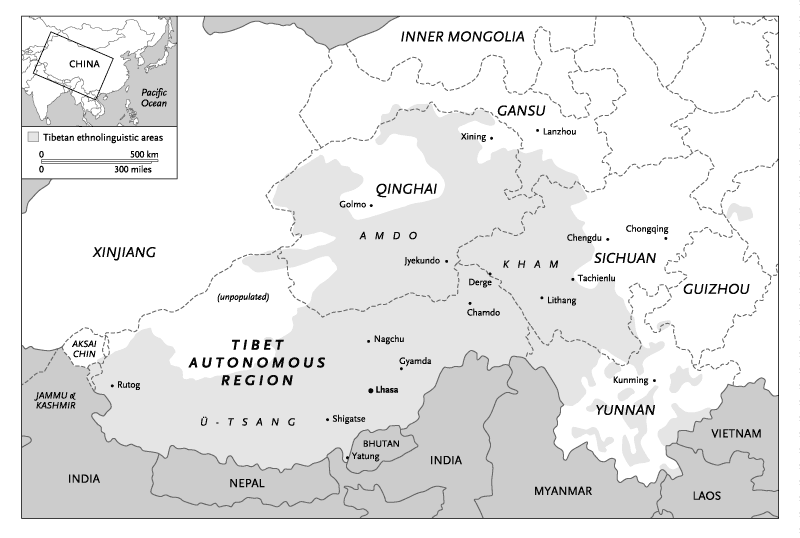
First, however, a survey of the broader historical background is required. For many centuries Tibet was an integral political entity, governed by the local religious leaders and feudal lords. Under the Qing dynasty, China exercised its jurisdiction over the region through the submission of this elite and did not interfere directly in local affairs. Between 1727 and 1911, the principal symbol of Chinese sovereignty over Tibet was the office of the Residential Commissioner, known as the amban. The imperial presence in Lhasa, however, consisted ‘solely of the commissioner himself and a few logistical and military personnel.’footnote1 These, together with a handful of civilian staff members, were responsible for carrying out all the daily administrative routines. Speaking no Tibetan they had to rely on interpreters and spent most of their time in Lhasa, making only a few inspection tours a year outside the city.footnote2 It is inconceivable that such a tiny apparatus would be able to exercise effective control over Tibet, an area of more than a million square kilometres. By and large, the Residential Commissioner could only serve as what I shall call a ‘connector’, mediating between the Qing authorities and the local rulers, the Dalai Lama and the Kashag.footnote3 Under this system, Tibetan peasants submitted solely to Tibetan masters—they ‘only knew the Dalai, not the Court’. On certain occasions—when the Qing army had helped repel aggressors, for instance—the Tibetan elite would be full of praise for the Commissioner’s advice. For the rest of the time, it would be unrealistic to expect that a few alien officials—linguistically handicapped, militarily weak, socially and politically isolated—would be obeyed by the local rulers, who held all the region’s power and resources in their hands.
Consequently, as the Qianlong Emperor admitted, ‘Tibetan local affairs were left to the wilful actions of the Dalai Lama and the shapes [Kashagofficials]. The Commissioners were not only unable to take charge, they were also kept uninformed. This reduced the post of the Residential Commissioner in Tibet to name only.’footnote4 In response, the Qing court issued in 1793 an imperial decree, the Twenty-Nine Articles on the Reconstruction of Tibetan Domestic Affairs, which consolidated the Commissioner’s authority over administrative, military and religious appointments, foreign affairs, finance, taxation and the criminal justice system.footnote5 These measures have given rise to the claim that the power of the Residential Commissioners subsequently ‘exceeded that of the governors in other provinces’.footnote6 Nevertheless, when the Imperial Commissioner Zhang Yintang visited Tibet a century later, he was greatly distressed to hear the Dalai Lama ridiculing the Qing representatives as ‘tea-brewing commissioners’. (Tea-brewing is a kind of Tibetan Buddhist alms-giving ceremony—one of the Commissioner’s duties was to distribute this largesse to the monasteries on the Emperor’s behalf; the insinuation was that he did nothing else.)footnote7 The Commissioner of the late Qing period, Lian Yu, also complained that ‘the Dalai Lama arrogated undue importance to himself and wanted to manipulate everything.’ If Tibetan officials appeared to be respectful and deferential, with an ‘outward display of honesty and simple-mindedness’, he found their actual behaviour was nothing less than ‘secret resistance’, and ‘very often they left orders unattended to for months on the pretext of waiting for the Dalai Lama’s return or for decisions yet to be made, simply ignoring urgent requests for answers.’footnote8
To some extent, however, this state of affairs was acceptable to both sides. In terms of state power, the Qing court retained the ability to occupy Tibet, but did not need to do so; and the connector system had the merit of being extremely cheap. The crux of the framework of ancient oriental diplomacy lay in the order of ‘rites’: as long as the lamas were submissive and posed no threat, they would be tolerated. Despite the Commissioners’ complaints and the Emperor’s occasional displeasure, it was only the threat that Tibet might break away from its orbit that caused serious concern at Court, and entailed some form of ‘rectification’. This occurred only a few times during the entire 185 years of Qing rule; for the most part, Residential Commissioners were stationed in Tibet to maintain the Emperor’s symbolic mandate rather than to govern in fact.
Shadows of modernization
The overthrow of the Qing Empire by the Chinese revolution of 1911 created a quite new situation. Just before, in one of its last acts of authority, the dynasty had dispatched an army to occupy Lhasa. But with the collapse of the imperial order, followed by four decades of turmoil in China itself, Tibet for the first time in centuries enjoyed virtually complete de facto independence. The Residential Commissioner and his entourage were expelled in 1912 and the thirteenth Dalai Lama consolidated his position as a national leader, expanding and modernizing the Tibetan Army along British or Japanese lines and setting up banks, mines and a postal service. Trade was promoted and students sent to study in the West. Young officers began to imitate the fashions of their polo-playing counterparts under the British Raj and the military band was taught to play God Save the King. But the price of the reforms was deemed too high by the monastic elite. The new officers saw the religious orders as the cause of Tibetan backwardness: not prayers but guns would make the country strong. While the Dalai Lama understood the importance of the Army in securing his secular power and resisting the potential Chinese threat, he could not tolerate any direct challenge to his authority; when the military leadership began to target his own position for reform, instigating a series of private meetings designed to pressure him to relinquish political power, he moved against them, putting a halt to Tibet’s modernization. The Army went into decline after the officers were purged, meeting defeat at the hands of a regional warlord in Kham—the section of Eastern Tibet that extends into Sichuan province—in 1931. After this, the Dalai Lama tilted back towards Beijing.
China, meanwhile, had been waging a ceaseless propaganda campaign within the international arena for its right to sovereignty over Tibet. This was tacitly granted by the West—the country would be a large and populous ally during World War II—which nevertheless continued to treat Tibet as, in practical terms, an independent state. The Tibetan elite, meanwhile, continued to vacillate: since they already had de facto self-rule, it was simpler to blockade themselves on their plateau, ringed with snowy mountains, than to get into arguments with China. As the thirteenth Dalai Lama told Charles Bell:
Some countries may wish to send representatives to Tibet; the travellers of other nations may wish to penetrate our country. These representatives and travellers may press inconvenient questions on myself and the Tibetan government. Our customs are often different from those of Europe and America, and we do not wish to change them. Perhaps Christian missionaries may come to Tibet, and in trying to spread Christianity may speak against our religion. We could not tolerate that.’footnote9
Arguably, if the forms of oriental diplomacy could have been maintained, some new system of connectors might have been an acceptable solution to the problem of mediating between China and Tibet. Once the Western concept of state sovereignty had been extended to the East, however, every Chinese regime was compelled to adapt to it; any attempt to prolong a more ambiguous approach could only encourage local rulers to move towards independent sovereignty, sooner or later.
‘One country, two systems’
Such was the situation when the Communist Party triumphed over the KMT in China, and founded the People’s Republic in 1949. Mao made no move towards Tibet till the outbreak of the Korean War in 1950. Then a 40,000-strong contingent of the PLA crossed into territory under the control of the Kashag, with a show of force that quickly routed the Tibetan army ranged against it in Chamdo. But Mao was in no hurry to bring the revolution to Tibet. The intention of the CCP, on the contrary, was to ‘manage’ the country from afar through something very like the Qing model. Despite its revolutionary commitments, the CCP did not at first attempt any social reforms in Tibet. Sovereignty took precedence. As long as Tibet ‘returned to the arms of the motherland’s big family’, Beijing was quite willing to tolerate the preservation of the ‘feudal serf system’ there. Although the number of Chinese military and civilian personnel stationed in Tibet after 1951 was vastly increased from the Qing era, political and social relationships were still mediated through de facto ‘connectors’. Local affairs continued to be administered by the Tibetan authorities, and a ‘one country, two systems’ mechanism was set in place. The name given to this tactic was the United Front. What it meant in practice was an alliance between the Communists and the Tibetan ruling class, who would cooperate in the consolidation of Chinese sovereignty. The basis for this was the Seventeen-Point Agreement signed by Li Weihan and Ngawang Jigme Ngapo in May 1951, in which the Dalai Lama’s government acknowledged that Tibet was part of China, gave post facto consent to the PLA’s entry and to the eventual integration of the Tibetan Army into its ranks, and accepted the central government’s authority to conduct its external affairs. In return, Beijing promised ‘autonomy’ for Tibet, leaving the social and religious system, the Dalai Lama’s status and the local officials’ positions unchanged, while restoring the Panchen Lama, driven into exile by the thirteenth Dalai.
The United Front line was followed not only in the areas under the administration of the Kashag government but also in Chamdo, where the PLA had established control. A People’s Liberation Committee of the Chamdo Area was set up, with seven Tibetans among its nine vice-chairmen. Apart from one CCP member, all of these were from local ruling families, as were the majority of the 35-member Committee. In the twelve subordinate zong or county-level Liberation Committees, there were 14 Han officials and 154 Tibetans, all from the elite. Chen Jingbo, director of the United Front Department of the CCP’s Tibetan Working Committee at the time, reported:
After the establishment of the Preparatory Committee for the Tibetan Autonomous Region in 1956, a large number of individuals from the local upper classes were appointed to various posts under the Committee. At the time, there were about 6,000 people that belonged to middle and upper classes (including major clan chiefs) in the whole region (among them, 205 were fourth-rank officials, 2,300 below fifth rank and 2,500 from religious circles). 2,163 of these were already assigned to posts and the remaining 3,400 are scheduled to receive various appointments by 1960.footnote10
The Dalai Lama and Panchen Lama were the paramount focus of the United Front. When in 1954 they were invited to attend the Assembly of the National People’s Congress in Beijing, Zhang Jingwu, secretary of the CCP’s Tibetan Working Committee and the central government’s highest representative in Lhasa, was specifically instructed by the Central Committee to look after them on the trip, which he took the utmost pains to do.footnote11 On their arrival at Beijing railway station they were met by Zhou Enlai and Zhu De, while Deng Xiaoping personally checked their living quarters and Mao Zedong received and hosted several dinner parties for them.footnote12 The Dalai Lama, just nineteen, was made a Vice-Chairman of the Standing Committee of the National People’s Congress and the Panchen Lama, even younger, nominated a Standing Committee member.
Beijing was, at this stage, perfectly willing to tolerate the Tibetan authorities’ stalling tactics on the Seventeen-Point Agreement. As Mao explained in 1952:
Although the establishment of the military and administrative committee and the reorganization of the Tibetan troops were stipulated in the Agreement, you had fears, and so I instructed the comrades working in Tibet to slow down their implementation. The Agreement must be carried out but, because of your fears, it has to be postponed. If you are scared this year, it can wait until next year. If you still have fears next year, it can wait until the year after that.footnote13
Indeed, the reorganization of the Tibetan Army had not gone beyond the issue of new uniforms and conferring of PLA ranks by the time of the 1959 Rebellion, in which a considerable number of its troops and officers would play an active part.
Ethnography and culture
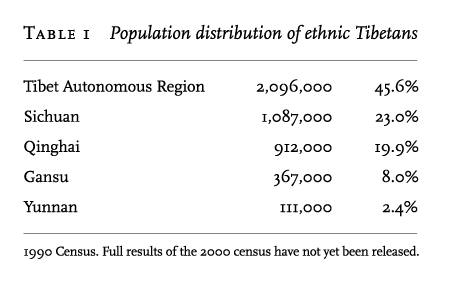
Historically, ‘Greater Tibet’ had rarely been under the control of the Kashag government, whose effective rule for the most part never extended beyond the current boundaries of the Tibetan Autonomous Region. The situation has persisted under the PRC. The latest available census figures, for 1990, show a majority of ethnic Tibetans (54.4 per cent) living in neighbouring provinces (see Table 1 below).
These administrative divisions do not correspond to the actual social landscape. Lhasa is the indubitable political and religious centre of the whole Tibetan ecumene, but the region of Ü Tsang (‘Central Tibet’) in which it is situated—often mistaken for the ethnographic land as a whole—is certainly not on a higher cultural level than the regions outlying it. Amdo (covering much of Qinghai and Gansu) contains two out of the six most important Yellow Hat monasteries. Kham (covering western Sichuan and the north-west corner of Yunnan) contains a variety of religious schools, and its cultural riches are far beyond those of Ü Tsang, as can easily be seen by the traveller today. Traditionally, a greater number of high-rank lamas have come from Amdo and Kham than from Ü Tsang. If the people of Ü Tsang look down on the Khampas, the prejudices are mutual. The former regard the latter as ‘uncivilized’, the latter view the former as ‘hypocritical’—similar stereotypes to those that divide southerners and northerners in other nations. Socially speaking, the people of Amdo are mainly nomads, those in Kham farmers. Authority in Amdo is tribal, but is more chiefly in Kham, where the local chabu—the Tibetan name means ‘king’—customarily enjoyed quasi-regal powers. Such social structures were to facilitate collective resistance to the Chinese authorities; but even without this, the religious factor alone was tinder capable of arousing the whole population against Han domination.
Nevertheless, when it came to implement the United Front, the CCP in the fifties took a purely bureaucratic approach, as if provincial borders mattered more than the cultural integrity of the Tibetan population as a whole. While those living inside the Autonomous Region—essentially Ü Tsang—were to be exempted from PRC reforms, Tibetans in Han-majority provinces were not. Nationwide collectivization was launched in 1955, and by 1956 the ‘high tide of socialist construction’—land redistribution, the creation of local CCP units, class-struggle organization and the battle against elites—was sweeping the Tibetan areas of Sichuan, Qinghai, Gansu and Yunnan. Work teams mobilized the masses, creating peasant unions; title deeds were burnt. With their traditional entitlements under threat, Tibetan landowners took the risk of initiating active revolts against the CCP. There was fierce fighting in Kham as the PLA stepped in to put down the rebellion. Refugees from the four provinces—some 60,000, between 1956 and 1958—fled to Ü Tsang. Epidemics spread a sense of panic among the uprooted population there.
Nevertheless, the initial reaction in Beijing was still to continue the United Front tactic within the TAR. When the Tibetan Working Committee, in 1956, made a move to step up social and economic reforms in the region, dispatching more than 2,000 Han cadres to Tibet for the purpose, Beijing swiftly reversed the decision and sent Zhang Jingwu—by then Director of the PRC President’s General Office—to stabilize the situation, announcing that there would be no reforms for the next six years. In March 1957 the Central Committee’s Secretariat decided to cut back significantly on the Party’s work in the TAR, reducing local administrative personnel from 45,000 to 3,700, with Han streamlined by 92 per cent, while troop levels were brought down from 50,000 to 18,000, and the number of military bases reduced; all facts testifying to the central government’s willingness to continue the connector-model United Front.footnote14 Zhou Enlai went so far as to assure the Dalai Lama that, if the region was still not ready for reform, the waiting period could be extended for another fifty years.footnote15
Tibetan Rebellion and the Dalai’s flight
The situation in Tibet, however, was growing increasingly turbulent, and the contradictions of the ‘one country, two systems’ approach ever more stark. Even the most trivial changes constituted a threat to the Tibetan upper classes and could cause major disturbance within such a highly traditional society. Wage payments to Tibetans working on road-construction schemes were seen as an assault on the centuries-old ulag service system. Free schools impinged on the monastic monopoly of education. Training of cadres with serf backgrounds upset the existing social hierarchy. In 1957, a serf in Shannan was beaten up by his lord for failing to perform his ulag service—an unconditional duty, whose dereliction customarily received brutal punishment. In this instance, the victim was a CCP activist who had been assigned a cadre position at grass-roots level. The case became a touchstone for Party policy in Tibet. United Front tactics demanded non-interference, but this would both dishearten peasant activists and encourage elite attempts to prevent the masses cooperating with the CCP. On the other hand, to discipline the assailant would cause trouble with the authorities’ feudal partners. Nevertheless, the CCP gave the instruction to relieve all Tibetan cadres of their ulag duties.footnote16
Ultimately the United Front tactic could be no more than an expedient measure. Support for the Communists would always come from the poorest layers, but the United Front was unable to provide these with any clear prospect. As one commentator put it:
The mass of Tibetans was steadfastly tied to the status quo without the slightest knowledge of, or experience of, any other way of life. Confused by the new ways offered by the Han, fearful of the Han who simultaneously urged ‘liberation’ of the serfs from the feudal masters while creating alliances with these masters, they did not join their ‘liberators’ in large numbers.footnote17
At the same time, despite all the compromises and conciliatory gestures, the United Front would never win the good faith of the Tibetan elite, who saw it rather as a game of cat and mouse in which, sooner or later, the mouse would inevitably be killed. Gradually, Beijing realized that the United Front—one of its three ‘big magic weapons’—not only failed to guarantee the lamas’ loyalty but would not garner the support of the masses, either—the biggest magic weapon of all. If Tibetan peasants could not be won away from their traditional deference, they would inevitably side with their local rulers in any uprising against the CCP, and Beijing would never be able to ensure lasting sovereignty over the region.
There was ample evidence for this in the 1959 Tibetan Rebellion. The PLA initially demanded that the Kashag government punish the Khampa ‘bandits’ who had fled to Ü Tsang in 1956 and 57; in 1958 its own troops entered the TAR, travelling in 60-truck convoys through the hostile countryside. Lhasa itself, surrounded by refugee tents, provided no sanctuary: the tension in the city had grown explosive. The detonating spark was a rumour that the PLA was planning to abduct the Dalai Lama. Kashag officials and Khampa rebels united in the call for an uprising. For days on end, thousands of demonstrators surrounded the Dalai’s Summer Palace, throwing up barricades against the troops and shouting ‘Kick out the Han’. Fierce fighting ensued before the Red Flag was hoisted over the Potala. The Dalai fled to India. Beijing assumed direct control.
‘Turn the Body Over’
The vast mass of lower-class Tibetans would have been genuine beneficiaries of Beijing’s initial reforms, yet they rose against them. Why? Many perceived only one distinction: between themselves and the Han. The long history of deference to monastic authority and tribal leaders ensured that, when their masters raised the twin banners of religion and nationality, Tibetan workers and peasants would rally to them. The conclusion drawn in Beijing was that ‘the fundamental improvement of national relations, in the final analysis, depends on the complete emancipation of the working classes within each nationality.’footnote18 Translated into plain language, this meant the abandonment of the United Front and a turn to class struggle, aimed directly at the overthrow of the local elite. Within every nationality, it was now argued, there would invariably be rich and poor, oppression and exploitation. The poor everywhere belonged to one family; the rich were all the same, as black as crows. Hoisting the class-struggle flag, the CCP proclaimed itself no longer a party of the Han but a leader and spokesman of poor people everywhere. It now set out to win over the poverty-stricken Tibetans from their national and religious allegiance to the elite.
As soon as the fighting in Lhasa came to an end, work teams composed of tens of thousands of military personnel and civilian cadres were sent to every village and rural area to launch ‘democratic reforms’ and to determine ‘class status’ among Tibetans as a whole. The first step was to induce the Tibetan masses to ‘vent their grievances’ and ‘find the roots of their misery’, asking questions such as, ‘Who is feeding whom?’. The work teams guided the discussions: ‘Why did generations of peasants suffer, while the owners of serfs lived in luxury from birth, with the best food and clothes?’; ‘Who was the Tibetan government protecting and serving?’; ‘Suffering was not predestined’. The goal was to convince the fatalistic Tibetans of the existence—and the injustice—of class exploitation. The new concept of classes was vividly depicted as fan shen, ‘flip the body over’: it turned previous criteria upside down. Now the poorer one was, the higher one’s social status. Work teams recruited a layer of activists from amongst the peasantry in order to expand their operations. This group became the backbone of the political regime at grass-roots level. The majority of them had never received any education, so there was much controversy when they were installed in leading positions. The work teams countered this with discussions around the questions of ‘Who were the most educated in the old society?’, ‘Who understood the poor best?’, and ‘Would somebody help the poor in their fan shen if he had administrative experience but harboured evil intentions?’. Step by step, a loyal contingent of Party supporters was trained.footnote19
Winning over the poor required tangible benefits, which could only come from a redistribution of wealth. This would have a double effect: not only earning the CCP the gratitude of the impoverished masses, but destroying the elite’s capacity to initiate revolt. Monasteries had been used as military bases during the Rebellion—the monks taking up arms—and the PLA had bombed them as it re-established control.footnote20 Mao now raised the slogan, ‘Lamas must go back home’. Monks and nuns were forcibly married, 97 per cent of monasteries were closed down, 93 per cent of their inmates—104,000 out of 110,000—dispersed, and monastic land was confiscated and redistributed among the poor. The property of all ruling-class participants in the Rebellion—some 73 per cent, or 462 out of the 634 noble households, according to the statistics of the time—was also seized and redistributed (those who had not rebelled being compensated when their land was nationalized).footnote21 The CCP found it harder, however, to win allies among the peasantry in Tibet than in China proper—work teams often found the level of class consciousness regrettably low. Many of the poorest herdsmen, for example, were apparently hired hands, but were reluctant to admit it, pretending instead to be the sons or daughters of the herd owners. Their response when the work teams tried to classify them as hired herdsmen—the highest rank in the new hierarchy—was resentful: ‘Why are you trying to force me to admit I’m a hired hand?’footnote22
A fear above all others
One of the unique characteristics of traditional Tibetan society was that, despite a considerable degree of social and economic polarization, there was hardly any history of actual class confrontation. Conflict was generally between upper-class factions, or between Tibetans and other ethnic groups. What explains such an unusual degree of deference and obedience? The answer surely lies in the deeply rooted religious traditions of Tibet. Even if aware of their suppressed and exploited status, the poor would resign themselves to their fate, seeing it as retribution for their previous lives. According to Buddhist doctrine, their hope of freedom from suffering lay entirely in the hereafter: only by resigning themselves to their present condition and enduring its misery might they hope to win the favours of the deities, and the chance of being born into a better afterlife. Any resistance was disobedience to the divine will and would be met with suitable punishment. This staunch belief moulded the Tibetans’ attitude of passive submission. The benefits of reform in this world could never match the happiness of the afterlife; if they committed the crime of ‘defying their superiors’ or ‘enriching themselves with dubious wealth’, the dreadful punishment that awaited them would far outweigh any earthly gains. This was why so many felt uncertain about class struggle, and why they not only joined their masters in the Rebellion but also followed them into exile and continued to serve them there. It was thus impossible for the CCP to win over the peasantry without tackling the problem of religion.
This was no easy matter. It would have been quite unfeasible simply to convert the Tibetans into atheists. If the highly evolved doctrines of the lamaist tradition are almost impossibly abstruse, the faith of the masses is far more comprehensible. The roots of their intense religiosity lie in the terrors of their natural environment—the explanation, surely, for the extraordinary proliferation of deities and monsters within Tibetan Buddhism, differentiating it from Indian and Chinese variants. Fear is the key factor. To find oneself in the harsh surroundings of the Tibetan plateau is to experience the mercilessness of nature, the arduous task of survival, the loneliness of the heart. Settlements on any scale could not subsist in most of the region, resulting in tiny human colonies that have clung on in the face of the vast, raging forces of nature. Encountering, alone, this savage expanse of earth and sky inevitably produced a feeling of being overwhelmed by such preponderance, a terrifying sense of isolation and helplessness, repeated down the generations. Fear provoked awe, and awe gave rise to the totem of deities and monsters:
The Tibetans were living in a state of apprehension and anxiety. Every perturbation, either physical or spiritual, every illness, every susceptible or dangerous situation, would drive them to search feverishly for its causes, and for preventative measures.footnote23
But the search for solutions only reinforced the anxiety: the more thought and explanation was lavished upon it, the deeper it grew. Faced with a fear that they could neither escape nor conquer, Tibetans were in need of a larger fear, clearly defined and structured, one that exceeded all others and which, so long as one obeyed it totally, would keep at bay all the lesser fears, lifting the intolerable psychological burden.
Fear formed the core of the Tibetans’ spiritual world. Only by propitiating their terror, by offering sacrifices to it in complicated ceremonies, by worshipping and obeying it, could one feel safe and free, reassured by its vast dominion and tremendous power. Such a fear already possessed, at a certain level, the nature of divinity; the origins of the vast number of ferocious and terrifying objects worshipped in Tibetan religion—including those of the Bon shamanism that predated the eighth-century introduction of Buddhism from India—can surely be traced back here.footnote24 In that frightful environment, humankind can scarcely persevere without some sense of divine guidance and support. From this perspective it might be argued that, even if all other religions were on their way to extinction, the Tibetan creed would probably be preserved to the very last day.
Tibetan Buddhism exacts an exorbitant price from its followers. The hope of a better life hereafter demands a punishing regime of forbearance, asceticism and sacrifice in the present. Tibetans also have to contribute a considerable part of their personal wealth to religious activity—building monasteries, providing for monks and nuns, performing ceremonies, making pilgrimages and so forth. Under the Dalai Lama’s government, 92 per cent of the budget was devoted to religious expenditure.footnote25 Even today, according to some estimates, the Tibetans pay about a third of their annual income to the monasteries. This was money that would not be transformed into productive investment nor used to improve the people’s lives. For over a thousand years, the sweat and toil of the Tibetans had gone to encrust the monasteries, while the governing monks formed an enormous parasitic social stratum. In the eighteenth century, according to Melvyn Goldstein’s estimate, about 13 per cent of the population were monks—in other words, around 26 per cent of Tibetan males.footnote26 The Chinese scholar Li Anzhai, in his 1947 sample survey of the Gede area of Xikang, found that the proportion of monks reached as high as 33.25 per cent—the highest in the world.footnote27 This unproductive layer was a heavy burden on Tibetan society, intensifying the existing shortage of labour. In addition, the celibacy lamaism enjoined contributed to the depletion of the population, one of the major problems in the region. Tibetan scholars themselves have attributed the decline of the Tufan dynasty to the effects of the religious system.footnote28 In the ninth century Langdarma, last of the Tufan kings, tried to force the monks to resume the tasks of secular life in an effort to reverse the decline.
Rotation of the gods
The Tibetans’ submission to a religion that apparently runs contrary to their material interests becomes prefectly comprehensible in the context of their worship of fear. Faced with a choice between a short spell of suffering in this world followed by a blissful hereafter, or an eternity of torture, the peasants inevitably remained in thrall to the monks who held the keys to heaven. But if it is impossible for Tibetans to live without a god, nevertheless their religion allowed for a reincarnation of the deity. What if a new god appeared who was not only more powerful and awe-inspiring than the old, but who also told Tibetans that this life was everything, that their suffering was injustice, and that they should seek happiness in the here and now? Would they still be willing to deny their own human needs?
As to who had more actual power between the Dalai Lama and Mao Zedong, there could scarcely be any doubt. At the Battle of Chamdo in 1950 the crack troops of the Tibetan Army were totally overwhelmed by the PLA; the Dalai Lama had to take refuge in Yatung. In 1959, with tens of thousands of rebels demonstrating in the streets of Lhasa, it took the PLA only 20 hours or so to prevail, and the Dalai fled into exile. The Tibetans were inevitably disturbed by the disparity. The divinity before whom they had prostrated themselves turned out to be less invincible than they thought. A god for them was, by definition, capable of defeating all with his overwhelming strength, of making clear demands and using stern, indisputable measures to reward and punish. This mentality permeated other aspects of Tibetan life, as evidenced in their submission to autocracy, their tolerance of suffering, their respect for winners and cruelty to enemies. In a thousand subtle ways the power of Mao Zedong corresponded to these needs; the same forms of worship could be extended towards him.
It is unlikely that Beijing understood the issue in terms of religion. The support of the ‘emancipated serfs’ was perceived rather as evidence of Marxism’s universal validity. In reality, however, it was impossible to overthrow centuries of worship without playing the role of a new god who came trampling on the old one, proclaiming the dawn of a new era and instituting a new system of punishment and rewards. Mao Zedong fitted the part perfectly. His rule could satisfy both the religious and the human needs of the Tibetans peasants—for, however deeply the concept of the afterlife had been instilled in their minds, the natural instinct to ‘seek gains and avoid losses’ still remained. Once ‘converted’, they took Maoism to extremes, smashing the old world and declaring their loyalty to the new with all the zeal of their traditional faith. The period of 1960 to 1966—from the final suppression of the Rebellion to the start of the Cultural Revolution—saw a movement from ‘awakening’ to overall mobilization in the region. The predominant image of the time was of Mao waving his red-starred military cap from a distant, temple-like building; Tibetans were only too familiar with the strong religious flavour of such a sight, which had always evoked in them a powerful emotional response. They plunged into the frenzy of the Cultural Revolution fired up both by fideistic fervour and material interest. Yet even as they shouted ‘atheist’ slogans against the monasteries, the underlying pulse was still there; it was simply that Mao had replaced the Dalai Lama as the god in their minds.
In this psychology, the rotation of deities meant the recreation of the universe: the dominion of this more powerful ruler would endure forever, the old one would be eternally damned. It was entirely rational, then, from the viewpoint of traditional Tibetan culture, to switch sides, submit to the new order and tear down the remnants of the old. Looking back at this process of ‘god creation’ during the Mao era, one notices religious echoes almost everywhere: supreme ideology corresponding to faith; the ultimate goal of communism, to heaven; unconditional obedience to the teacher and leader, to worship of God; political studies, to preaching, reforming one’s world outlook, to purifying one’s consciousness; self-criticism, to confession; strict Party discipline and sacrifice for the cause, to asceticism. If the actual ceremonies of Mao worship were slightly different, their spiritual essence was close enough to lamaism to make it an easy switch. To hang Mao’s picture in a cottage and bow to it daily, to recite his ‘highest instructions’ while clasping the Little Red Book, was not so far removed from the accustomed daily prayers and prostrations before the household image of the Dalai Lama.
As long as the need for a powerful deterrent force and for the corresponding placatory rituals was met, the actual religious content was far less important. The prayer-stone piles by the roadsides and on mountain passes were destroyed during the Cultural Revolution, and stone or cement billboards with Mao’s quotations erected in their place: the peasants circled them when they passed by, just as they had with the prayer piles. In the traditional Ongkor festival at the start of the harvest season, they used to carry Buddhist images, chant scripts and sing Buddhist songs. During the Cultural Revolution, they carried Mao’s picture, recited his quotations and sang ‘The East is Red’. Historically, Chinese emperors had been seen in Tibet as the embodiment of the Bodhisattva Buddha, with a higher status than the Goddess of Mercy, incarnated in the Dalai Lama; many Tibetans now accorded Mao the same honour.
Clearly, Mao might be a better choice for the peasantry, the Communist heaven preferable to the ‘paradise in the west’ and revolutionary organizations a substitute for monasteries—as long as the new rituals satisfied the ceremonial demands of their religion. Beijing’s harsh leftist policies were now principally targeted at the aristocracy; in a reversal of the previous relationship, in which the minority’s privileges had been maintained by the majority’s misery, it was the top 10 per cent that henceforward suffered most from the repression. The powerful new god was not only capable of inflicting the most brutal punishment on its enemies, it also took care of the impoverished masses, bestowing extraordinary favours on them: the abolition of the ulag and of taxation, airborne disaster relief, mobile medical treatment, the enrolment of peasant children at the universities. At the same time, the rules for differentiation were clear cut: everything depended on class. This philosophy of a fate predetermined by one’s birthright was almost identical to Tibetan Buddhism’s traditional account.
Destruction of the temples
The clearest manifestation of this rotation-of-the-gods in the minds of the Tibetan peasants was their active participation in levelling the very temples and monasteries they had once held most sacred. The Dalai camp and Western public opinion have always attributed this to Han Red Guards coming in from China proper, after the Cultural Revolution was launched in 1966. They have seen it as part of the CCP’s ‘systematic, methodical, calculated, planned and comprehensive destruction’ of Tibetan religion.footnote29 The truth is that, because of poor transportation and the huge distances involved, only a limited number of Han Red Guards actually reached Tibet. Even if some of them did participate in pulling down the temples, their action could only have been symbolic. Hundreds of shrines were scattered in villages, pastures and on rugged mountainsides: no one would have been capable of destroying them without the participation of the local people. Furthermore, most of the Red Guards who did reach the TAR were Tibetan students, returning from universities elsewhere. The fact that they often retained their organizations’ original names—Capital Red Guards, for instance—is one reason for the confusion over this. With the gradual return of these Tibetan Red Guards—who often combined their revolutionary work with visits to their families—the sparks of the Cultural Revolution spread across villages and pastures over the entire Tibetan plateau; followed by the rampage of destruction.
It is true that tension at the time was so high that no one dared voice any dissent; nevertheless, the rulers alone could not have created the sort of social atmosphere that then prevailed without the participation of the masses, who sometimes played a leading role. The authorities in Tibet often tried to restrain radical actions, with the PLA, for example, consistently supporting the more conservative factions against the rebels. Temples and monasteries survived best in the central cities and areas where the authorities could still exercise some control. In contrast, the Gandan Monastery, some 60 kilometres outside Lhasa and one of the three major centres of the Yellow Hat sect, was reduced to ruins.
To point out that it was largely the Tibetans themselves who destroyed the monasteries and temples is not to exonerate the Han; but it does raise broader questions, beyond the issue of responsibility. Why did the Tibetans, who for centuries had regarded religion as the centre of their lives, smash the Buddhist statues with their own hands? How did they dare pull down the temples and use the timbers for their own homes? Why did they ravage the religious artefacts so recklessly, and why were they not afraid of retribution when they denounced the deities at the tops of their voices and abused the lamas they had so long obeyed? Surely these actions are evidence that, once they realized they could control their own fate, the Tibetan peasantry, in an unequivocally liberating gesture, cast off the spectre of the afterlife that had hung over them for so long and forcefully asserted that they would rather be men in this life than souls in the next.
In 1969 an armed ‘revolt’ broke out against the introduction of People’s Communes into Tibet, which had been spared them in the period of the Great Leap Forward; this eventually spread to over forty counties. The Dalai’s camp saw this ‘Second Tibetan Rebellion’ as a continuation of the resistance of the fifties. In reality, the two were very different. During the earlier uprising, the peasants were fighting, in a sense, for the interests of the aristocracy. In 1969, they fought for their own. They did not want the pastures and livestock that had been redistributed among them from the old landowners to be appropriated by the People’s Communes. At the time a few of these protests, provoked by the Cultural Revolution, were actually intensified into genuine ‘revolts’ by the authorities’ repression.footnote30 The turbulence was quickly quelled once they realized their mistake. In comparison with the factional rivalries and armed conflicts in other parts of China, Tibet at the time remained relatively stable. In short, Maoism appeared to have achieved an overall victory in the sixties and seventies: China’s sovereignty over Tibet looked unprecedentedly effective and secure. The ‘nationality question’, later the cause of so much trouble, seemed scarcely worth consideration. Tibetans seemed on generally calm terms with the Han and the Dalai Lama almost forgotten, both in Tibet and in the West.
Costs of the Cultural Revolution
The reality was otherwise. The ideological success of Maoism in overturning lamaism was not matched by any comparable achievement in improving the material conditions of ordinary Tibetans. The ultra-leftist policies of the Cultural Revolution inflicted tremendous human and economic damage on Tibet, as everywhere in the PRC. Excesses on a massive scale had already been committed during the earlier campaigns for ‘democratic reform’ and the suppression of the 1959 Rebellion, many of which were discussed in the Panchen Lama’s Seventy-Thousand Character Petition of 1962. The prevailing situation was, indeed, clearly mirrored in the Panchen Lama’s fate. If any sense of the United Front approach had persisted within the CCP, he would not have been so mercilessly punished just for an internal petition. As it was, in 1964 he was classified as an enemy and removed from his posts, subjected to mass-struggle sessions and jailed for nearly ten years. Another important Tibetan religious figure, Geshe Sherab Gyatso, was sent back to his home town in Dunhua county, Qinghai province, where he was tortured to death. Political movements were launched across Tibet, one after another: the Three Educations, the Four Clean-ups, One Strike and Three Antis, Cleaning Ranks, Socialist Reforms, Double Strikes, Basic Lines Education, Purging Capitalist Factions, Criticizing Smaller Panchens. The 1980 Rehabilitation Conference held in the TAR after the Cultural Revolution revealed that, ‘According to a rough estimate, more than one hundred thousand people in the region were either implicated or affected by unjust and wrong cases, which accounted for more than 10 per cent of the entire population.’footnote31
During the entire period from the Tenth Plenary Session of the Central Committee in 1962, which reintroduced the class-struggle theme, to Hu Yaobang’s inspection tour of Tibet in 1980, CCP policy had been based on the thesis that ‘the nationality question is in essence a class question’. Anyone unfamiliar with the political jargon of the time would have a hard time understanding this. The nation itself was of no significance—‘the workers have no motherland’; the essential distinction was that of class. There was thus no need to select leading cadres on a national or ethnic basis: as long as they were revolutionaries, they could lead the masses anywhere. To request leaders from one’s own community would be to commit the error of ‘narrow-minded nationalism’—tantamount to sabotaging the class camp. During the Cultural Revolution, the Revolutionary Committee—the highest political organ in Tibet—had a Han chairman and only four Tibetans among its thirteen vice chairmen. In 1973, Tibetans made up only 35.2 per cent of Party Committee members; in 1975, they accounted for a mere 23 per cent of leading cadres at district level.footnote32
For the peasantry, the introduction of the People’s Communes—initiated in 1964, and covering 99 per cent of villages by 1975—meant an unprecedented degree of centralized control. If a Commune member wanted to get half a kilo of butter he had to report to his production team in advance and then work his way through a series of procedures involving team leaders, accountants and warehouse keepers. The remaining private elements of the economy were almost totally wiped out. Before 1966 there had been over 1,200 small retailers in Lhasa. By 1975, only 67 remained. In Jalung county 3,000 privately owned wool-looms and spinning-wheels were done away with in the name of ‘cutting off the capitalist tails’.footnote33 The organization of the People’s Communes killed off any enthusiasm for production; in conjunction with the political assaults of the Cultural Revolution this led to a stagnation of living standards, especially among the farmers and herdsmen. Although the suffering could be temporarily concealed by the high revolutionary energy of the time and by the introduction of other benefits, such as medical care and social promotion, according to the 1980 figures half a million of the already impoverished Tibetans—over a quarter of the population—were worse off after the mutual-aid groups were communized, and about 200,000 were rendered destitute.footnote34
‘Redressing the wrongs’
The Great Helmsman responsible for these disasters passed away in 1976. It was another two years before Deng Xiaoping became supreme leader. The process of ‘redressing the wrongs’ in Tibet began right from the start of the new Reform Era. On December 28, 1978, less than a week after taking power, Deng gave an interview to the Associated Press in which he indicated his willingness to start a dialogue with the Dalai Lama; he received the Dalai’s representative in Beijing the following March. The 376 participants in the 1959 Rebellion still serving prison sentences were freed. Over 6,000 others who had been released after completing their sentences but were still branded as ‘rebels’ and kept under ‘supervised reform’ had these labels removed. Party management of Tibet made an about-turn once more.
On March 14, 1980, Hu Yaobang presided over the first Tibetan Work Forum of the Central Committee Secretariat; its proposals were released to the whole Party under the title Central Committee Document Number Thirty One. Two months later, Hu made an inspection tour of Tibet, accompanied by leading officials including then Vice Premier Wan Li, Ngawang Jigme Ngapo and Yang Jingren. Hu stayed in Lhasa for nine days, meeting people from various circles. The day before his departure, he called an extraordinary TAR Party Committee meeting of more than 4,500 cadres, including all those above county and regiment level from the CCP, government and PLA. Hu’s speech to the meeting was considered a turning point in Tibetan history, its significance comparable to the extrusion of the Residential Commissioner in 1912, the PLA’s entry in 1951 or the post-1959 reforms. It has determined the approach to Tibet ever since. Hu made six major proposals:
-
Tibet should enjoy autonomous rule, and Tibetan cadres should have the courage to protect their own national interests;
-
Tibetan farmers and herdsmen should be exempt from taxation and purchase quotas;
-
Ideologically oriented economic policies should be changed to practical ones, geared to local circumstances;
-
Central government’s financial allocations to Tibet should be greatly increased;
-
Tibetan culture should be strengthened;
-
Han cadres should step aside in favour of Tibetan ones.footnote35
This was a striking departure from both the Qing court’s Twenty-Nine Articles and the CCP’s Seventeen-Point Agreement concluded in 1954, both of which had been intended to strengthen Beijing’s position of control over Tibet. The Twenty-Nine Articles had been imposed by imperial decree and, while the Seventeen-Point Agreement made various promises, the Tibetans had been forced to sign it after their military defeat, which it sealed. By contrast, Hu’s initiative proposed to restore Tibetan rights and pledged substantial aid.
The Six Proposals were unquestionably of benefit to Tibet. The tax and purchase exemptions initiated in 1980 were naturally welcome, as were the pro-privatization policies and the abolition of the People’s Communes. Beijing’s financial allocations to Tibet soared from 500 million RMB in 1979 to close on 2.9 billion RMB in 1994, while investment in Tibet’s infrastructure increased from around 100 million RMB in 1979 to over 900 million RMB in 1993.footnote36 The real turning-points for the Tibetans, however, were the proposals to strengthen autonomous rule, indigenous culture and Tibetanization—points one, five and six. Even before Hu’s visit to Tibet, Document Number Thirty One had already made the dramatic announcement that:
Among all the general and specific policies drawn up by the Central Committee and its various departments as well as all the documents, instructions and regulations issued nationwide, those that do not fit Tibet’s circumstances may not be carried out or may be implemented after modification by the leading organs of Tibetan party, administrative and mass organizations.footnote37
Historically, the central government had always sought the passive submission of the minority peoples of the borderlands. Now for the first time the authorities were, on their own initiative, urging the minorities to question their orders or even to resist them. In the past it would have been simply unimaginable that such a document could be issued to the whole Party. Hu made a further call at the mass Party Committee meeting:
Are all the secretaries at the level of county and above present here today? You should, according to the characteristics of your own areas, draft concrete laws, decrees and regulations to protect the special interests of your nationality. You really should do this. In the future we would criticize you if you still just copy indiscriminately the stuff from the Central Committee. Do not copy indiscriminately the experience of other places nor that of the Central Committee. Copying indiscriminately is only fit for lazybones.footnote38
While Hu’s speech did not touch directly on lifting the ban on religion, it put great stress on strengthening Tibetan culture, of which Buddhism was the core. Document Thirty One demanded ‘respect for people’s normal religious practices’. Following Hu’s speech, the TAR Party Committee and the regional government also issued decrees requiring the use of the Tibetan language in official documents and public speeches, and applying ‘competence in the Tibetan language as one of the major criteria for admission to school, employment and transferring one’s status to that of cadre, as well as for using, promoting and selecting cadres.’footnote39 Historically, dominant ethnic groups had always tried to force minorities to give up their own languages—Nationalist officials had even attempted to impose a Chinese-language exam on Tibetan ‘incarnates’ before they could accede to living Buddha status.footnote40 It was commendable that the central government now took measures to strengthen an indigenous tongue.
Tibetanization and instability
But the most significant of the Six Proposals was the insistence that Han cadres should step aside in favour of Tibetans. Hu argued that:
As the result of our discussion yesterday, in the next two or three years (in my opinion, two years is better), among state non-production cadres—here I am not talking about production cadres, who should be entirely Tibetans, but about non-production cadres, including teachers—Tibetan cadres should make up more than two thirds of the total. [Wan Li adds: I proposed an eight-to-two ratio the other day.] He was even more radical than I am and I also agree. He wants 80 per cent for Tibetan cadres and 20 per cent for Han cadres. [Wan Li: What I meant was an eight-to-two ratio for the county cadres. As for the prefecture cadres, it should be 100 per cent.]footnote41
This last proposal encountered great resistance from Han officials in the TAR but Hu’s instructions were: ‘Carry out the policy even if you do not understand; make decisions first and straighten out later’. Fifteen days later, the transfer plan was announced. The total Han population of the TAR stood at 122,400 at the time, of which 92,000—75 per cent—were scheduled to depart within the next two to three years. Among these were 21,000 Han cadres (of a total 55,000 TAR cadres, of whom 31,000 were Han) and 25,000 Han workers (of a total 80,000 TAR workers, of whom 40,000 were Han).footnote42 The plan was later modified because the departure of so many trained Han workers brought many organizations in Tibet almost to a standstill. Nevertheless, between 1980 and 1985 the Han population was reduced by 42 per cent.
The transfers vacated more than ten thousand cadre quotas and a similar number of ‘iron rice-bowls’ in the state-owned enterprises; Tibetans were the beneficiaries of this. The implementation of new legislation on ‘Autonomous Rule in the Nationality Regions’ subsequently ensured that all key positions in the governing bodies were held by officials from the local region; Han officials could only hold deputy positions. Tibetan cadres thus not only comprised the statistical majority but also controlled most of the leading government positions, including the crucial departments of finance, public security and justice. By 1989, Tibetans accounted for 66.6 per cent of total cadres in the TAR, 72 per cent at provincial level and 68.4 per cent at prefectural level. All ‘number one’ administrative leaders at provincial and prefectural levels were Tibetans, as were the Party Secretaries in 63 out of the 75 counties.footnote43 ‘Redressing the wrongs’ also brought tremendous improvements in living standards. In 1979 the average income of Tibetan farmers and herdsmen was 147 RMB; in 1990 it was 484 RMB and in 1994, 903.29 RMB. In 1992, the TAR’s total agriculture output was up 69.8 per cent from 1978—and 460 per cent up from its 1952 level. In the cities the improvement was even greater.footnote44
Under the new policy, religious practices in both the TAR and the Tibetan areas of the neighbouring provinces were revived to a level comparable to pre-1959—barring only the restoration of the old monastic economy and ‘unity of monastery and state’. The clergy were once again given special ‘United Front’ treatment; the number of monks and nuns increased to 46,000—2 per cent of the Tibetan population—by 1994. Temples were under construction everywhere. The decision of the Second Tibetan Work Forum of 1984 to ‘gradually restore about 200 temples by the end of the eighties’ was vastly exceeded, with 1,480 temples and monasteries reopened by 1992, and over 300 more by 1994.footnote45 A considerable part of the capital involved came from local government, while the TAR authorities allocated 260 million RMB for rebuilding between 1980 and 1992. The provincial governments in Sichuan, Yunnan, Gansu and Qinghai also contributed a sizeable amount of money to religious projects in their Tibetan areas. The central government disbursed over 53 million RMB for the renovation of the Potala Palace, as well as 64 million RMB and 614 kilos of gold to construct a tomb pagoda for the Tenth Panchen Lama.footnote46 In the spirit of promoting the religious revival, Wu Jinghua, the first secretary of the TAR Party Committee, participated—in full Tibetan costume—in a Great Prayer Festival in Lhasa which was broadcast to the entire region on TV. The few remaining restrictions were mainly applied to clerical organizations, and even they were largely lip-service; there was hardly any interference in the religious practices of the laity.
Deng Xiaoping’s policy in the region was, in all these respects, an essentially open and enlightened one. For most Tibetans, it might have been thought, the situation should have appeared the best in their history. These apparently optimal conditions, however, saw an unprecedented outbreak of discord and social instability. On September 21, 1987 the Dalai Lama appeared before the US Congress. Six days later Lhasa saw its first street demonstration since 1959. Big rallies demanded independence and raised the banned national flag. Arrests immediately followed, and when people heard the screams of monks being beaten in the central police station, crowds besieged the building and started throwing stones. The authorities were caught by surprise and the situation quickly deteriorated as buildings and vehicles were torched and Han were lynched. Troops opened fire as the confrontations escalated. The next seventeen months saw an increasingly bloody pattern of disturbances, leading ultimately to the imposition of martial law in March 1989, which remained in effect for 419 days. At the same time, the Tibetan question came under more intense international scrutiny, with Beijing’s policies eliciting an increasingly wide range of criticism in the West—as if the eighties’ turn had been retrogressive. Tibet became a bargaining chip with which to put pressure on China, and the Dalai Lama acquired unprecedented influence.
Getting down from the shrine
In secular terms, the Tibetans’ reaction to the liberalization of the eighties is hard to understand. Another form of analysis is required. Within the terms of Tibetan Buddhism, ‘redressing the wrongs’ destroyed the divine status Mao had been accorded. God did not make mistakes. Even if they could not understand his cruelty and his punishments, he would have his own reasons and did not need to explain—if he did, it would be incomprehensible anyway, like a book from heaven. God did not need to curry favour; he could order people to do whatever he desired. More importantly, he would never admit to any errors. That would reduce him to the status of human. Once that happened, people could settle accounts over all the past cruelties, and demand even more admissions and compensation.
The Tibetans did not necessarily feel grateful, therefore, when they got government money for restoring the temples. On the contrary, they saw it as an admission that the holy buildings had been destroyed by the Han authorities—the standard account now among Tibetan exiles as well as in the West. If the money was to be a compensation for these crimes, no sum could be large enough to earn their praise. In the past, when a new god appeared and demanded they destroy the old religion, they had obeyed. Now, all of a sudden, after they had smashed the monasteries and temples to pieces, they were told that the new god did not exist. It was all an unfortunate mistake and the previous religion needed to be restored. It is not hard to imagine how they felt; and such a feeling could hardly be commuted into gratitude by government grants.
This was also one of the crucial factors in the strong rebound of traditional religion. To all who had once sided with the Great Han atheist and taken part in the destruction of the monasteries, the resurrection of the old religion connoted that they had betrayed their god and would face the most horrifying punishments. Terrified by what awaited them they tried, on the one hand, to explain that they had had no choice and, on the other, to ‘atone for their crimes’ through redoubled, fanatical devotion to the traditional religious regime. It was common to find that those working hardest to rebuild the temples were the very ones who had led the way in tearing them down. Some officials also tried to ‘wash off’ their guilt by playing up ethno-national sentiments, resisting instructions from their superiors, and discriminating against the Han.
Maoism had fractured the Tibetan national entity through class polarization. Freed from the control of their old masters, the peasants had been the foundation of the communist regime. Under Deng, the class-struggle line was abandoned, and the old aristocrats, clan chiefs and lamas once again were invited to the National People’s Congress and the Chinese People’s Political Consultative Conference. Lhalu Tsewang Dorje, commander of the Tibetan forces in the 1959 Rebellion, was released from prison in 1979 and is currently a Vice Chairman of the regional Political Consultative Conference; his wife is a member of its standing committee and his son is Deputy Director of the regional Nationality and Religions Bureau. Meanwhile, Tibetan ‘activists’ who were once in the vanguard of the ‘Rebellion suppression’, the ‘democratic reforms,’ the struggle against the landowners and the destruction of the monasteries have now been cast aside.footnote47 The majority of such militants had been production-brigade cadres in People’s Communes. With the Communes gone, they have lost their previous status and are reduced to ordinary farmers and herdsmen. Many of them languish in poverty, with no help for their old age. According to the Organization Department of the Tibetan Party Committee, the majority of previous ‘activists’ have sunk into this poverty-stricken stratum. Based on his survey on pastures in Western Tibet, Melvyn Goldstein also points out that:
all the former wealthy households are among those with the largest herds and most secure income. On the other hand, all of today’s poor are from households that were very poor in the old society . . . The former commune cadres fall between these poles . . . In 1987, ten households (18 per cent) received welfare from the county . . . It is interesting to note that all ten households who received welfare in 1987 were poor in the old society.footnote48
On top of everything else, these ‘activists’ now also have to carry the burden of being seen as traitors to their nation, while their misfortune is perceived by others as well-deserved retribution.
The old rich have become rich again, and the poor have become poor. To the fatalistic Tibetans, this is an omen of God’s will. Consciously or unconsciously, many have already started to adjust their behaviour. A cadre with more than 20 years’ experience at grass-roots level in the Dingqing County of northern Tibet told me of one small change. During the Cultural Revolution, if an old landowner met emancipated serfs on the road he would stand to the side, at a distance, putting a sleeve over his shoulder, bowing down and sticking out his tongue—a courtesy paid by those of lower status to their superiors—and would only dare to resume his journey after the former serfs had passed by. Now things have changed back: the former serfs stand at the side of the road, bow and stick out their tongues, making way for their old lords. This has been a subtle process, completely voluntary, neither imposed by anyone nor explained. Although the pre-revolutionary era has not made a real comeback, the former serfs have sensed the change in the social atmosphere and feel it would be safer to show their repentance for holding their heads high in the past. This tiny change in conduct reflects the tremendous metamorphosis that has taken place.
Commercialization and superstition
Annual economic growth in Tibet was over 10 per cent between 1991 and 1999—higher than in China proper. Per capita income for farmers and herders has grown by 9.3 per cent per year, for urban residents by 19.6 per cent. These are not just empty figures. On a visit to Tibet in 2000, rising living standards were visible everywhere, in rural areas as well as the towns, with a lot of new construction taking place. Material conditions are currently comparable with those of inland—not coastal—China. Tibet is more prosperous now than ever before in its history. However, this has not gained the PRC the allegiance of the Tibetans, more and more of whom have become attached to the Dalai Lama, who has never given them a penny. There have been no recent street riots, and things look peaceful on the surface. But there is no difficulty in sensing where their feelings lie. Virtually all Tibetans have the Dalai in their hearts. Every year thousands of ordinary Tibetans risk their lives crossing the Himalayas to join him in India. Not infrequently, CCP functionaries themselves, PLA officers included, become Buddhists right after retirement. Meanwhile, many of the young Tibetans sent to China to be educated become the most radical oppositionists, with the strongest national sentiments. Chen Kuiyuan, the current CCP First Secretary in Tibet, complained in September 1996: ‘How many traitors were nursed by us’. It would be wrong to regard the present situation as more stable than in 1987. At that time, it was mainly monks and disoriented youth who led the riots. Nowadays, opposition lurks among cadres, intellectuals, state employees. In the words of one retired official: ‘The current stabilization is only on the surface. One day people will riot in much greater numbers than in the late eighties’.
The Han presence has become more variegated. Han cadres were resentful of Hu’s policy in the eighties: Tibetans gained a lot of ground in local life, and the Han felt marginalized. Later they turned their grudges against Zhao Ziyang, who blamed the 87–89 riots on ‘Han ultra-leftism’ in Tibet. Han officials, on the contrary, felt that the situation had got out of hand because of the incorrect Beijing line of laying all the blame for unrest in Tibet on the Party there, so justifying Tibetan trouble-makers and undermining their own ability to keep order in the TAR. They felt condemned to a passive stance, without instructions. In the nineties, however, the policies of Hu and Zhao were reversed: the official line now blames ‘the Dalai clique and Western intervention’ for the riots, and local Han power-holders feel thoroughly vindicated, viewing the retrospective change as a significant rectification. They are thoroughly comfortable with the ‘key point is stabilization’ line of the current CCP leadership.
But there has been a new influx of Han over the past decade. Some of these—prostitutes, cobblers, tailors, clock-repairers, vegetable farmers, grocers—have been drawn by the magnet of money-making. They are to be found along the highways, running small roadside restaurants, bidding for construction contracts, flocking to gold rushes, hunting rare species. Even Chinese beggars can make a living in Lhasa. As to their number, the TAR authorities have no idea. They are, of course, concentrated in the towns and along the main roads, giving them a more visible presence than the statistics may justify. A second type of newcomer is the tourist or adventurer, mainly from the Han elite—people such as journalists, writers, painters, photographers, students, and not a few officials, ostensibly on missions, but actually on travel jaunts. These Han differ from earlier cadres in that they don’t look to local political power for protection—nor do they get near the core of Tibetan society. They retain their outsider identities; few intend to stay. The first type are similar to the ‘floating population’ in the big PRC cities, and will leave when conditions cease to be profitable. The second group come and go anyway. But both bring secularization and commercialization to Tibetan society; the blow they represent to the traditional order is not to be underestimated.
What headway has secularization made in twenty-first century Tibet? A tiny minority—mainly younger urban people with higher education—may view the Dalai Lama in a more detached way, as a human being rather than a god, and embodying the attractions of Western liberalism and capitalist prosperity rather than reincarnated divinity. But within the TAR, those with college education comprised only 0.57 per cent of the population in 1990—including Han living in Tibet, who are better educated. The overwhelming majority of Tibetans are peasants, nomads and poorly educated town-dwellers who have never heard of the Nobel Prize or Hollywood. They worship the Dalai Lama with the same awe as they do the gods whom they would never be lucky enough to meet. It is common enough in Tibet today to see a crowd form and bow down to worship a little boy, merely because he is a reincarnated Buddha.
The Deng era renounced the class line, restored traditional Tibetan religion, and re-engaged the upper classes in a ‘united front.’ This turn greatly improved the living conditions of the Tibetans, but it forfeited the capacity of the CCP to intervene within Tibetan society, and led to its reintegration as a national community. If China had still remained closed, as in the past, the re-emergence of the Tibetans as one nationality might not have caused major problems for the regime in Beijing. But China was now opened up to the world, and could not insulate Tibet from changes in the international environment—among them the disintegration of the Soviet system, and new interventionist attitudes in the West. In earlier years, the rationale behind the policy shift from the ‘United Front’ to the class line was precisely that the two banners of religion and nationality had been monopolized by the upper classes, and outsiders were not allowed to play any role in the country. Today, the person who controls the two banners is none other than the Dalai Lama, who enjoys the status both of the highest spiritual leader and the internationally recognized symbol of Tibetan nationhood. With the Tibetan populace coalesced behind these banners, there existed no opposition force that could counter the exiled deity. Only Mao had succeeded in dissolving the religious and ethnic unity of the Tibetans, by introducing the element of class struggle. Renouncing this without creating any new ideology has left a vacuum that can only be filled by a combination of lamaist tradition and ethnic nationalism. Undeniably, the process of ‘redressing the wrongs’ has brought many positive changes to the Tibetan people, and even if it were desirable, the Mao era could not be reduplicated. Historically and morally, the reforms were absolutely necessary. But they have not solved the Tibetan question to the satisfaction of anyone, and today all the parties to the conflict over it have reason to fear for the future. New ways of approaching the problem must be found.
Translated by Liu Xiaohong and A. Tom Grunfeld.