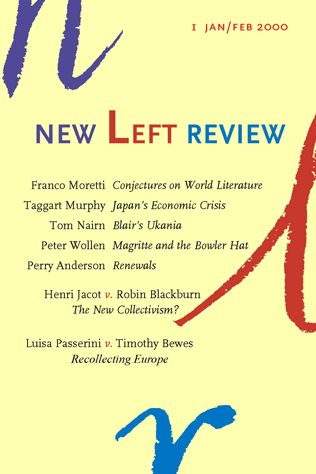
As New Left Review enters its fifth decade, a stock-taking of the journal. Where has it come from, and where is it going? How should the political and cultural scene of the nineties be assessed? A manifesto for the new series of NLR that begins with this issue.
articles
The 20th century’s most dynamic economy has fallen into prolonged paralysis. What are the causes of Japanese stagnation, and why have the country’s rulers reacted so phlegmatically to it? Taggart Murphy highlights the potentially explosive interdependency between Japanese recession and the American bull market.
Nearly two hundred years ago, Goethe announced the imminence of a world literature. Here Franco Moretti offers a set of hypotheses for tracking the birth and fate of the novel in the peripheries of Europe, in Latin America, Arab lands, Turkey, China, Japan, West Africa. For the first time, the prospect of a morphology of global letters?
Great Britain has finally yielded a parliament to Scotland. But the Labour regime in London still clings convulsively to the totems of Ukania, in Tom Nairn’s savage updating of Robert Musil. New Labour’s eupeptic rhetoric of youth as a sure sign of a system being wheeled into the terminal ward.
Why did Magritte populate his surrealist images with bowler hats? Peter Wollen takes us from the oneirics of the Belgian painter to the antics of Tintin and Chaplin, the purism of Le Corbusier, memories of Beckett, fantasies of Bond and Kundera. Emblem of working men and city toffs, cabaret girls and Orange parades—what icons have matched it for multiple meanings?
Pension funds are now huge forces in Anglo-American financial markets. Could they become levers of radical socialization, if their nominal collective ownership were activated from below? Henri Jacot of the French CGT doubts it.
Robin Blackburn develops his argument that pension funds might be unexpected sources of social change.
Luisa Passerini defends her retrieval of inter-war ideas of the unity of European culture and politics, without reference to post-war sequels, as a safeguard of actual discontinuities.
Timothy Bewes argues for the difficulties of Luisa Passerini's way of looking at a past that has not gone away.
reviews
Sebastian Budgen on Luc Boltanski and Ève Chiapello, Le Nouvel esprit du capitalisme. A sequel to Max Weber's Protestant Ethic and the Spirit of Capitalism from contemporary France.
Tom Mertes on Dick Morris, The New Prince. America's fallen political adviser as a surrogate Machiavelli for the White House.
Gopal Balakrishnan on Ernst Jünger–Carl Schmitt, Briefwechsel. Correspondence between two of Germany's most important thinkers of the radical Right.
Susan Watkins on Francis Wheen, Karl Marx. The latest biography—a man for postmodern times?
Doreen Massey on Mike Davis, The Ecology of Fear. Facts and phobias in Los Angeles: what constitutes a global city today.