In a famous essay entitled ‘An Illness Called Managua’, the Nicaraguan poet Pablo Antonio Cuadra contended that the city was paradigmatically ‘the reflection of [Nicaraguan] society, of its grace and its bitterness, of its vice and its beauty, of its history and its community’.footnote1 Managua’s recent development also provides a perspective on the dramatic transformations that the country has undergone over the past decades: from corrupt dictatorship through popular insurrection and social reconstruction, rapidly choked off by Cold War intervention and economic crisis, to a Miami-style restoration and a new growth model led by narco-trafficking and Free Trade Zones. A study of Managua’s changing morphology and socio-economic trajectory suggests that the city is less an ‘illness’ than a symptom of this pathologized development path.
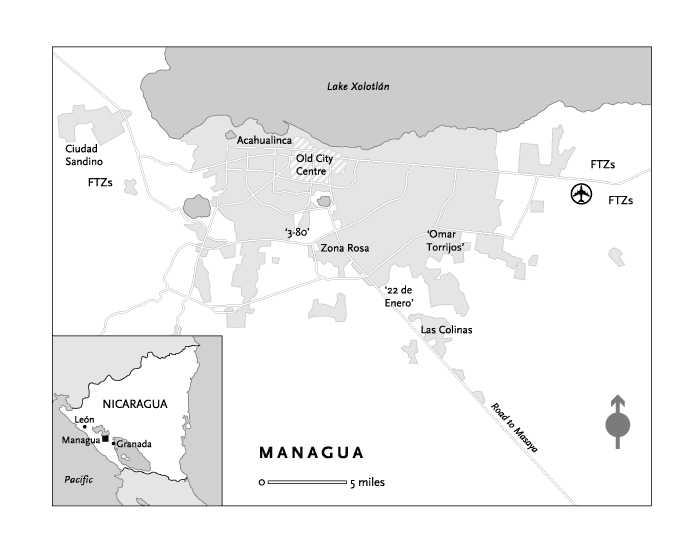
Sprawling along the southern shores of Lake Xolotlán, the city presents a strange landscape: a humid basin, filled with foliage and vacant lots, with sporadic developments thrown up apparently at random, punctuated by low hills and lagoons formed in the craters of extinct volcanoes. An eruption from one of these 10,000 years ago preserved the footprints of the site’s first settlers in the barrio of Acahualinca—one of the earliest such settlements in the Americas. Prior to the Spanish Conquest in the 16th century, the region was inhabited by a mixture of indigenous groups who had migrated both from Mesoamerica and from lands to the south, but the demographic collapse wrought by colonialism meant that mestizos soon came to dominate in numerical terms. During the colonial era and for decades after Nicaraguan independence—formally declared in 1821, but only fully obtained in 1838, with the dissolution of the United Provinces of Central America—the country’s principal cities were the colonial centres of León and Granada, respective headquarters of the feuding Liberal and Conservative factions of the oligarchy. Managua was designated Nicaragua’s capital in 1852, as a compromise between the two, but it remained relatively marginal until the middle decades of the 20th century.footnote2
It was under the dictatorship of Anastasio Somoza, head of the us-trained National Guard, that Managua assumed its national prominence. Somoza seized power in 1936, after murdering Augusto César Sandino and crushing the popular movement he had led against the 1912–33 us occupation of the country. Somoza established an authoritarian regime that was to prove Central America’s most durable, and among its most kleptocratic. He and his sons ruled Nicaragua until the 1979 Revolution, operating through the military and political apparatus of the National Guard, manipulating government contracts and siphoning off loans and aid to secure a commanding position in the country’s economic life. They eventually amassed a family fortune estimated at $500 million, as well as 1.2 million acres of landholdings and direct ownership of 200 companies.footnote3 Political stability was assured by a tacit pact between the Somozas and the traditional oligarchy, both Liberals and Conservatives, behind a constitutional façade, enabling all three groups to share the spoils, albeit unequally, during the growth years of the 1950s and 60s.footnote4
Nicaragua’s export earnings—gold, coffee, cotton—funded a degree of industrial expansion. The population of Managua rose to over a quarter of a million by 1960.footnote5 Its bustling downtown—the playground known as ‘Salsa City’—was packed with bars, dance-halls and cinemas that became a magnet for wealthy tourists from all over North and South America. The majority of the population growth, however, occurred in the ever-expanding informal settlements on the city’s periphery, as small tenant farmers were driven from the countryside by the mechanization of agriculture for export. The 60s boom also created a large if precarious urban middle stratum of small-scale entrepreneurs and shopkeepers, skilled service and white-collar workers, teachers, lower-rank administrative officials and so on, that made up nearly a fifth of Nicaragua’s workforce by the early 1970s—layers that were highly exposed to arbitrary predations by the lower ranks of the Somoza clan’s retinue and the National Guard.footnote6
Managua’s population had reached nearly half a million by 1972, when a devastating earthquake killed at least 10,000 people, destroyed 75 per cent of its housing, 90 per cent of its commercial buildings—including most of the centre—and left 300,000 homeless. Although international aid poured in to help rebuild Nicaragua’s shattered capital, little reconstruction actually took place. Anastasio Somoza—younger son of the original dictator, who had been assassinated in 1956—appointed himself head of the reconstruction committee and awarded his own companies over 80 per cent of the building contracts; but only a fraction of these were ever completed as Somoza pocketed the money himself. Downtown Managua was virtually abandoned and most rebuilding took place on land in the south and south-east of the city, owned by Somoza and his cronies.footnote7 As a result, ‘the central core took on a post-apocalyptic look’, while:
Much of the development [that did take place] can be characterized as leapfrog in nature, as the Somoza gang leaped over lands it did not own in favour of developing parcels it did. This gives the city the appearance of a deformed octopus. The tentacles of the octopus reach out along major transport arteries away from the old centre, but the octopus’s body is riddled with gaping holes. The rebuilding produced a sprawling city that made travel for the vast majority of the city’s residents increasingly difficult.footnote8
The criminal corruption displayed by the Somoza regime—and brutally enforced by the National Guard—in the aftermath of the earthquake played a major role in intensifying resistance to it. The elite compact came apart as Conservatives with interests in the construction industry lost out on their share of rebuilding contracts to the Somoza clan. Spiralling inflation, rising taxes and falling real wages brought the exposed small sectors of the economy to near collapse. Elite opposition, rallied in the udel, looked to the Carter Administration in Washington for support in ousting a dictator who had become such a patent liability.footnote9 But the Democratic Congress continued to vote military funding for the National Guard, and—even as the latter were subjecting the civilian population to aerial bombardment and artillery fire—Carter sent a personal letter to Somoza congratulating him on the human rights situation in his country.