China has undergone one of the most impressive processes of rapid development in world history.footnote1 Between the start of Deng Xiaoping’s market-oriented reforms in 1978 and 2005, the annual growth rate of national income, according to World Bank data, averaged 9.7 per cent—amounting to more than a twelvefold increase overall. This unprecedented economic growth has been accompanied by qualitative and structural transformations. Prominent among these has been the increasing international integration of the prc into the global economy, reflected in the growing share in national income of China’s international trade, which rose from 14 per cent to almost 70 per cent over the same period. Though this vertiginous growth has been most marked in the cities and in coastal areas, it has been national in its scope.
One of the most important consequences of this growth has been a substantial reduction in income poverty since 1978: according to official statistics, the proportion of the population that is poor in rural China fell by more than half between 1978 and 1985 alone, and seems to have continued to fall dramatically in the 1990s (although this process has been geographically uneven, with the greatest reductions taking place in the more rapidly growing coastal regions). In 2000, senior government officials even went so far as to declare that absolute poverty had been eliminated. Despite controversies surrounding the number of poor remaining, the sheer quantity of people lifted out of poverty in a short period of time remains a formidable achievement in world-historical terms.
In the light of China’s advances in poverty reduction, it is important to assess whether it has made commensurate improvements in other spheres of human well-being, such as education, health and access to basic services. It cannot be assumed that progress has been made in these areas in tandem with the growth of aggregate income—not only because income gains have been very unequally distributed, but because factors other than income are crucially involved. Rising incomes are likely to lead to improved nutrition, housing and sanitation, as well as enabling many to pay for marketized health care. This is the basis on which mainstream economists have advanced the thesis that ‘wealthier is healthier’.footnote2 However, there are grounds for arguing that China’s public health infrastructure has been seriously weakened as a result of the withdrawal of state institutions from the provision of health services; the Chinese public is increasingly forced to pay for treatment, and lower state spending has meant the closure of many medical facilities, leaving much of the country’s population with little or no access to health care.
Prior to the adoption of the Open Door policy in 1978, the prc had achieved extraordinary increases in health indicators, despite its low income. Post-revolutionary public health campaigns and preventative health care efforts—for instance, the famous Maoist campaign against the ‘four pests’: rats, flies, mosquitoes, bedbugs—played an important role. Indeed, China’s health achievements continue to surpass, in absolute terms, those of countries at comparable income levels, due to the advances made between 1949 and 1980. China and India, for instance, had similar figures for life expectancy at birth—just above 40 years—in the early 1950s, but by 1962, life expectancy was almost ten years longer in China—54 years to India’s 45—and by 1980 the gap had widened to thirteen years: 67 in China, 54 in India.footnote3 The average life expectancy for all low-income countries was much closer to India’s than to China’s: 44 years in 1962, 52 years in 1980. Such comparisons serve to underline the exceptional character of the prc’s health achievements prior to 1980.
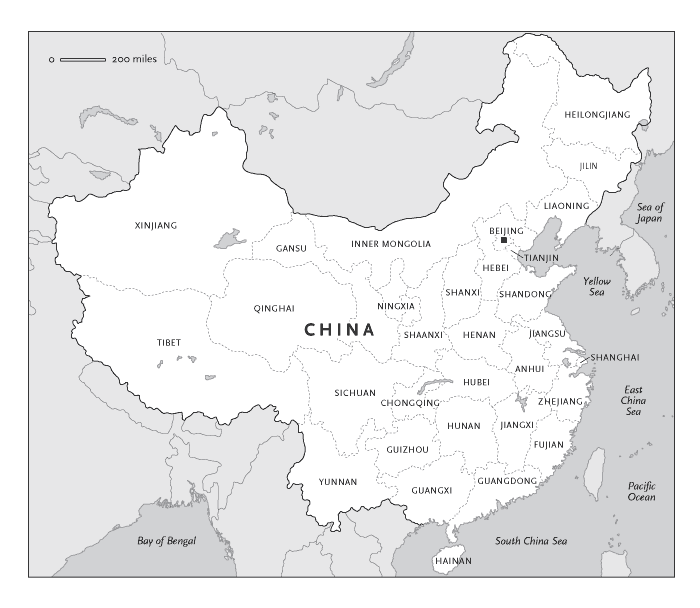
Has health in China continued on this upward trajectory in the last two and a half decades? Is the prc still achieving more rapid improvements in health than other countries facing similar constraints? My comparative analysis focuses on one measure of health outcomes alone—life expectancy. There are two reasons for this. Firstly, life expectancy provides a conceptually attractive measure of the overall health of a population, since it is an aggregate of mortality risks at different ages and is straightforward to interpret, as the expected life-span of a newborn child who will face these risks. Measures of infant and child survival, although highly informative, do not provide a comprehensive means of gauging the overall health of populations. Moreover, measures of access to health services or of health insurance coverage are difficult to interpret, as they can have very different meanings in different contexts, and refer to health inputs rather than outcomes. Second, estimates of life expectancy are available over a wider span of space and time than other indicators. Figures can be obtained for individual Chinese provinces from the early 1970s to the present, and for a wide range of comparator countries. Limitations on the data available do not allow for a systematic comparison between rural and urban areas; I have therefore adopted a province by province approach, which provides a relatively disaggregated portrait of the health situation in China.footnote4
After examining the improvements in life expectancy of Chinese provinces in three distinct decades, I turn to their relative performance compared to other countries. I compare the performance of China as a whole with that of other countries, and assess the record of individual provinces, measuring the best performers against individual comparators. My main findings are fourfold: firstly, province-level rates of improvement in life expectancy were higher in the 1990s than in the 1970s and 1980s, and were lowest in the 1980s, the first decade of market-oriented reforms, during which the Chinese health system was drastically transformed. Secondly, even in the 1990s, when the province-level rates of improvement were highest, they were lower than for many countries with similar initial life expectancy levels (although higher than the average for all such countries). Thirdly, China’s life expectancy improvement between 1980 and 2000 was achieved much more quickly by almost all other countries considered here, and in particular by most of the lower-middle income countries that achieved similar gains. Analogous conclusions can be drawn after setting China’s life expectancy improvements alongside those of two sets of comparators: selected developed countries and high-growth East Asian states. Finally, even those Chinese provinces that performed best over the period in question experienced rates of improvement significantly lower than those of comparator countries. China’s recent improvements in health appear, then, to have been notably less impressive than its achievements in poverty reduction.
Province-level estimates can be used to measure average annual rates of improvement in male and female life expectancy between 1970 and 2000. These figures are available at four points in time: an average for 1973–75, 1981, 1990 and 2000.footnote5 I have classified each province as falling into a given ‘life expectancy class’ on the basis of its life expectancy at the beginning of the relevant decade. These classes are defined as spanning five- or six-year intervals, beginning at 59 years, which is the minimum figure for any province in the entire period. The intervals are held fixed over time, but I have allowed provinces to move from one class to another, so as to take account of initial levels of achievement in each decade (which may have influenced the ease with which additional improvements could be made). Table 1 reports the average annual rates of improvement for provinces within each class—59 to 64 years, 64 to 69 years, 69 to 74 years and 74 to 81 years—for each of the decades considered.footnote6