Europe’s swiftest political reversal in recent years was famously triggered by text messages. ¿Aznar de rositas? one of these began. Is Aznar going to come out smelling of roses?footnote1 It was the Spanish Prime Minister’s blatant manipulation of the 11 March bombings at Madrid’s Atocha station that made such an outcome seem suddenly intolerable to a mass layer of Socialist voters, who had hitherto shown every sign of abstaining in Spain’s 2004 election as they had in 2000. The centre-right Partido Popular had ample reason to hope for a third term, if in coalition. The Spanish economy was buoyed up by a credit-based consumption boom. Mass opposition to the government’s role in Iraq had not prevented the pp from doing tolerably well in regional and municipal elections in May 2003. If Aznar’s arrogance was starting to grate, he was himself retiring from the political stage, and his designated successor Mariano Rajoy was a less abrasive presence. Above all, though, as opinion polls and regional results confirmed, the ruling party could count on the fact that Socialist voters were still too sickened by what they had had to swallow under fourteen years of Felipe González to turn out in any great numbers for José Luis Rodríguez Zapatero.
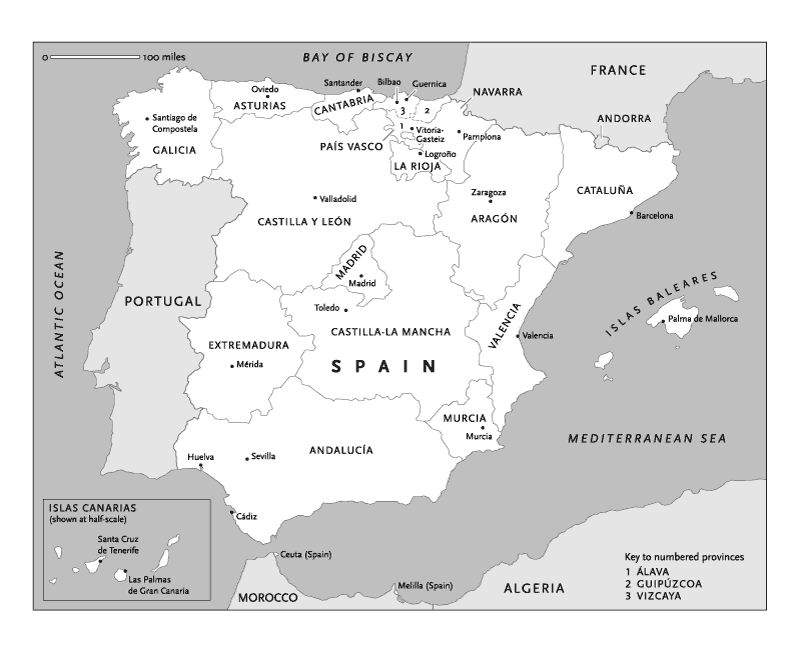
What Aznar achieved by his opportunist reflex in blaming Basque nationalists for the Atocha bombs—fortunately, none of the trains had yet pulled in under the vast brick-and-glass rotunda—was to coalesce, in an atmosphere of heightened national emotion, opposition on the two issues that defined his increasingly hawkish second term: subordination to us imperialism abroad, and deliberate exacerbation of the relationship between peripheral nationalisms and the central state at home. Elsewhere—in the uk perhaps, in the us certainly—an Islamist terrorist attack might have been calculated to shore up electoral support for a government embroiled in the occupations of Iraq and Afghanistan. In Spain it was openly acknowledged that widespread hostility to the Iraq war could only be strengthened, and risked being mobilized, by such an attentat. The orchestrated press campaign pointing the finger at the Basque separatist group eta only deepened popular suspicions that the waters were being muddied. An official demonstration called by the government on 12 March—‘For the Constitution, Against Terrorism’—was outpaced by the mass protests summoned by text message the following day. It became clear that, for the first time in years, the choice of one party over the other could have an impact in the geopolitical arena.
The result was a turnout of 77.2 per cent, a significant rise from 68.7 per cent in 2000 (though in line with turnouts over 77 per cent in 1993 and 1996). psoe took 11 million votes, or 42.6 per cent of ballots cast, compared to 9.6 million votes for the pp, or 36.7 per cent. The notorious Spanish top-up system—rigged to help Franco’s heirs, but left in place through a decade and a half of Socialist rule—then allocated the psoe 164, or 47 per cent of seats in the Council of Deputies, with the pp taking 148; another 30 seats were divided between the regional nationalists ciu (10), erc (8) and pnv (7) and the leftist Izquierda Unida (5). Zapatero’s Socialists would form a minority government with informal iu and nationalist support.
Elsewhere, the principal war criminals of the 21st century have been comfortably re-elected, with Bush and Howard returned to office in 2004 and Blair set to follow this spring. Only in Spain has popular revulsion ousted a leading collaborator in us imperial aggression. More surprisingly, perhaps, Zapatero not only fulfilled his campaign pledge to withdraw Spanish troops from Iraq in short order but is the only world leader to have denounced Bush and Blair for invading that country ‘on the basis of lies’. His Foreign Minister, Miguel Ángel Moratinos, has worked to lift the 2003 eu sanctions on Cuba and to mend ties with Chávez in Venezuela, publicly regretting his predecessor’s support for the 2002 coup attempt. At home, proposals are in place to reverse the Aznar government’s pro-clerical education reforms and to legalize gay marriage. A new bill will allow illegal immigrants in possession of a work contract to regularize their civil status. What type of breakthrough does the Socialist victory in Spain represent? How should the Zapatero government be assessed?
In its structuring dynamics, the forcefield of contemporary Spanish politics is still determined by the social contract that was sealed in the 1970s transition from authoritarian dictatorship after Franco’s death. This transition, in turn, sought to preserve in liberal-democratic form many of the solutions that the victors of the Civil War had imposed on social conflicts—over forms of state power, the socio-economic model, the Church, the Crown, the Army—which had convulsed Spain throughout its turbulent 19th century, during the long struggle for the overthrow of absolutism and establishment of a bourgeois state. In the context of a profound structural crisis, rival factions of the dominant classes strove to intensify processes of capital accumulation even as they battled to consolidate their hegemony, with no side strong enough to impose a durable victory.
Spain’s first written constitution—proclaimed in 1812 by the wartime Cortes meeting in Cádiz, itself besieged by Napoleon’s forces—was among the most progressive of the age: a legislature elected by (indirect) universal male suffrage, of which the monarch would be head. The restoration of the Bourbon Fernando vii in 1814 ushered in an era of intense reaction which, in turn, provoked a pronunciamiento by liberal army officers in 1820, in favour of the 1812 Constitution. Fernando was restored in 1823, after a year of civil war, but by now the Spanish American colonies were in open rebellion. Modernizers in Madrid seized the initiative again on Fernando’s death in 1833, backing his infant daughter Isabel for the throne, while Catholic counter-revolution and northern reaction (Navarre, the Basque Country, parts of rural Catalonia and Aragon) rallied behind the banner of Don Carlos, Fernando’s younger brother, in the civil wars of 1833–39 and 1846–48. An insecure victory for the former was funded in part by the expropriation of the monasteries, creating a powerful new layer of rich landowners and allying a now impoverished and embittered Church ever more closely with Carlist reaction. By the late 1860s, Isabel’s corrupt and unaccountable regime had lost Army and urban liberal support. The pronunciamiento of General Prim that overthrew her in 1868, attempting to establish a constitutional monarchy with the import of Amadeo of Savoy, was met by a new Carlist uprising.
By now, however, the political struggle of the dominant classes was being interrupted by new actors, as an artisanal working class and insurrectionary peasantry forced their way onto the stage. During the short-lived First Republic of 1874–75 that followed Amadeo’s abdication, insurgent petty-bourgeois forces led by Francisco Pi y Margall attempted a modernization along anti-clerical and federalist lines, perilously close to the model of the Paris Commune. The Restoration Monarchy of 1875, imposed at bayonet point, initially succeeded in stabilizing matters with a parliamentary oligarchy, the Conservative Prime Minister Cánovas and the Liberal Sagasta alternating in a turno pacífico under the Bourbon crown.footnote2