With Álvaro Uribe Vélez’s inauguration as President of Colombia on 7 August 2002, the outlaws have become the establishment. Uribe’s father, Alberto Uribe Sierra, had been languishing in debt in the middle-class Medellín neighbourhood of Laureles, in the mid-1970s, when a strange reversal of fortune catapulted him to wealth and influence as political broker and real-estate intermediary for the narco-traffickers, boasting extensive cattle ranches in Antioquia and Córdoba. Uribe Sierra was connected by marriage to the Ochoas, an elite family that joined the upwardly mobile contrabandistas arribistas to form the Medellín cartel; when Pablo Escobar launched his ‘Medellín without slums’ campaign in 1982, Uribe Sierra organized a fundraising horse race to help out. Uribe fils was removed from his post as mayor of Medellín for his conspicuous attendance at a meeting of the region’s drug cartel at Escobar’s hacienda, Nápoles. When his father was murdered at his ranch in 1983, leaving behind debts of around $10 million, Álvaro Uribe flew there in Escobar’s helicopter. During his tenure as governor of Antioquia, between 1995 and 1997, Uribe’s ‘Montesinos’—to borrow a phrase from Alfredo Molano—was Pedro Juan Moreno Villa, alleged by a former us dea chief to be the country’s leading importer of potassium permanganate, the main chemical precursor in the manufacture of cocaine.footnote1
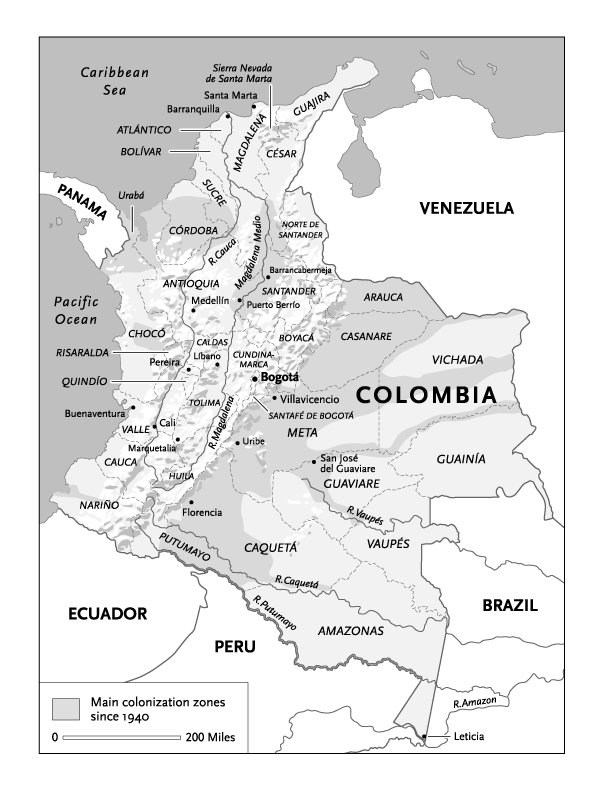
This is Washington’s leading exponent of the ‘war on drugs and terror’ in the Western hemisphere. In April 2003 the us Congress awarded Uribe an extra $104 million, on top of the $2 billion that has already been disbursed since 1999 under Plan Colombia. Whereas elsewhere in Latin America the imf issues stern demands for fiscal surplus, Colombia’s special needs are treated with indulgence and its military expenditure thoughtfully excluded from the public-sector cutbacks the Fund requires. For the well-known statistics of Colombia’s spiralling violence also mark it out from all other Latin American countries. By the mid-1990s, the homicide rate had soared to world-record heights: 72 per 100,000 inhabitants, compared to 24.6 for Brazil, 20 for Mexico, 11.5 for Peru and 8 for the us. Homicide is the leading cause of death among men and the second leading cause among women.footnote2 An average of twenty political killings were committed daily in 2001, up from fourteen per day in 2000—although it should be pointed out that most of these take place within five or six specific zones. Over half the world’s annual kidnappings occur in Colombia. In 2001, 90 per cent of all trade-union activists murdered were killed there. The country has the third highest number of internal refugees in the world with over 2.9 million, out of a population of nearly 45 million, driven from their homes in the countryside; it is no exaggeration to say that it is rapidly becoming a place with nowhere to run and nowhere to hide.
Uribe’s inauguration ceremony was famously marked by nineteen mortar-bombs fired in his direction by farc guerrillas; symbolically, these failed to do much damage to the Presidential Palace but killed twenty-one people in the nearby slums. Again, in contrast to El Salvador or Peru, the Colombian state has succeeded neither in neutralizing nor defeating its guerrilla insurgencies, intact since the 1960s. The farc, or Fuerzas Armadas Revolucionarias de Colombia, with multiple bases and a stronghold in the southeast, has an estimated 16,000–18,000 combatants. The eln, or Ejército de Liberación Nacional, mainly centred in the oil regions of the northeast and the Caribbean export zones, has between 5,000 and 7,000. Their longevity parallels the exclusion of popular demands from the mainstream political system: whereas elsewhere mass mobilizations have created new parties, forced changes in policy or overthrown governments, in Colombia neither urban populism nor social democracy has ever been allowed to emerge as a national force.
Yet this is no dictatorship. With presidential elections held like clockwork every four years, Colombia’s constitutional democracy can boast the longest running two-party system in Latin America; despite the fact that the two factions have often shed each other’s blood, the classic political paradigm—structured, along Iberian lines, by an oligarchic division between Conservatives and Liberals—persists to this day. The system was, of course, characteristic of the newly independent Latin American states of the early nineteenth century where a ruling elite of landowners, lawyers and merchants, manipulating a restricted suffrage in which those who had the vote were clients rather than citizens, typically split into two wings. Conservatives were devoted first and foremost to order, and—like their counterparts in Europe—religion, in close alliance with the Catholic Church. Liberals declared themselves in favour of progress, and were on the whole anti-clerical. Economically speaking, landed wealth tended to be more Conservative; commercial fortunes more Liberal. This civilian division, in turn, would be punctuated or cross-cut by pronunciamientos and seizures of power by rival military chieftains, in the name—but not always with the assent—of one or other of the opposing political parties.
Elsewhere, however, by the early twentieth century, this pattern had started to give way to a modern urban politics, in which radical coalitions or populist parties mobilized newly awakened masses with calls for basic social change. Throughout the rest of the continent, accelerated urbanization and pressure from agrarian reforms led to a decline in the political weight of the landed fraction of the ruling class. In Colombia alone, a Conservative–Liberal dyarchy has survived nearly a hundred years longer, remaining outwardly intact down to the twenty-first century—and this despite legislative elections governed by the rules of proportional representation. The singularity of this phenomenon is not confined to Latin America; in effect, no other party system in the world can boast a continuity comparable to the Colombian. Perhaps the simplest way of grasping the extraordinary character of the oligarchy is to list the kinship ties of its modern presidents. Mariano Ospina Rodríguez (1857–61) was the first self-declared Conservative President of Colombia, in the epoch of Palmerston; his son Pedro Nel Ospina held the same office in that of Baldwin (1922–26); his grandson Mariano Ospina Pérez, in that of Attlee (1946–50). Alfonso López Pumarejo, the most significant Liberal President of modern times, was a contemporary of Roosevelt (1934–38, and again 1942–45); his son Alfonso López Michelsen, was President (1974–78) in the time of Ford and Carter. Alberto Lleras Camargo, another Liberal, was President in the days of the Alliance for Progress (1958–62); his cousin Carlos Lleras Restrepo during the Vietnam War (1966–70). The Conservative Misael Pastrana succeeded him (1970–74); twenty years later his son Andrés Pastrana took up the reins of power (1998–2002). If Presidential candidates, as well as winners, were included, the list would be yet longer: Álvaro Gómez Hurtado, the Conservative party’s standard-bearer in 1974 and 1986, was the son of Laureano Gómez (1950–53), the most extreme of all Conservative Presidents. How could this oligarchy, excluding all class rivals, defy a course of extinction for so long? What relation does it bear to the ineradicability of the relatively small guerrilla forces—and to the consolidation of the murderous paramilitaries? No conclusive answers have been offered to these questions, but a key to the modern agony of Colombia must lie here.
Originally, the division between Liberals and Conservatives had a rational ideological foundation in Colombian society. Liberals were lay-minded members of the landed and merchant elite, hostile to what was perceived as the clerical and militarist compromises of the last period of Bolívar’s career as Liberator. Conservatives, who initially had closer links to the colonial aristocracy or officialdom, stood for centralized order and the social controls of religion. Ideas mattered in disputes between the two, starting with the Santander government’s directive that Bentham’s treatises on civil and penal legislation be mandatory study in the University of Bogotá, as early as 1825—inconceivable in England itself even fifty years later. Furious clerical reaction eventually led to the reintroduction of the Jesuits, who had been expelled from the colonies by the Spanish monarchy in 1767, to run the secondary schools; and then their re-expulsion in 1850.footnote3
But the clash was not just over questions of education; nor was it a purely intra-elite affair. The Liberal Revolution of 1849–53 involved risings of peasants against Conservative hacendados in the Cauca Valley, and mobilization of artisans stirred by the Parisian barricades of 1848 and the writings of Proudhon and Louis Blanc.footnote4 As in Europe, the Liberals abandoned their craftsmen supporters to the rigours of free trade, and dissolved communally held indigenous lands. But by their own lights, they remained committed to radical reforms. Slavery and the death penalty were abolished, church and state separated, clerical quit-rents lifted, divorce legalized, the army reduced, and universal male suffrage introduced; one province even—for a surreal split second—granted women the vote, a world-historical first.